


 Francais
 Deutsch
 Italiano
Refine Your Search
Greek-Civil-War stock footage and images
- Showing 1399 to 1404 of 27579 results more
more Hide
Hide
German Army operations in the assault on France, during World War II
The German assault on France during the Battle of France in World War II. French and other Allied soldiers surrender. The soldiers surrender to German officers on a street. Officers question the soldiers. French African soldiers surrender. German troops proceeding through places made famous during World War 1. The World War I battlefield at Compiegne. World War I memorials at the site. French Marshal Ferdinand Foch's statue and a memorial tablet with a dedication to him. A swastika placed on the memorial. A museum containing Foch's railway car in which the World War I armistice was signed. The Alsace-Lorraine Memorial. German troops battle their way through a village. Soldiers march with rifles. armored vehicles advance on roads. Street fighting between German and French soldiers. Soldiers fire machine guns and take cover among the ruins on the village. Rubble strewn across the streets. Soldiers enter and inspect damaged buildings. Smoke due to a sudden explosions nearby. The soldiers pass a corpse on the street.
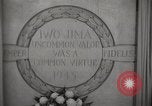
Dedication of Marine Corps War Memorial at Quantico Virginia, and sculptor Felix de Weldon working on sculpture for Arlington location.
The U.S. Marine Corps War Memorial original statue during its unveiling ceremony at the Marine Corps base in Quantico, Virginia on November 10, 1951 (This is after the statue had been moved from its original Constitution Avenue location in Washington DC in 1947, and subsequently renovated under sculptor de Weldon's supervision while it was in Quantico.). A sign on the memorial reads "Uncommon valor was a common virtue, 1945." Next scenes show sculptor Felix de Weldon as he works to build the larger Marine Corps War Memorial in Arlington, Virginia, which was dedicated in November 1954. Felix de Weldon measuring a model of the flag raising on Iwo Jima made by him. de Weldon and others on his team work to carve the large war memorial in plaster before it is cast in bronze. Views of the sculpted faces of the six Marines who raised the flag on Iwo Jima: Faces of John Bradley, Rene Gagnon, Ira Hayes, Franklin Sousley, Harlon Block and Michael Strank. Brief glimpse of the original flag raising scene on Mount Suribachi in February 1945. Next scene, circa 1954 or 1955, shows the completed Marine Corps War Memorial in bronze, in Arlington Virginia, with Washington Monument and Lincoln Memorial landmarks of Washington DC in the background. Close-up views of faces of a young boy, an elderly woman, and a middle aged man who removes his hat. American flag fluttering in the breeze atop the war memorial.
Scenes in Italy following the battle of Caporetto in World War I
Large number of Italian prisoners of war assembled in an open field in Italy, after the battle of Caporetto in World War 1. Austro-Hungarian soldiers in long caravan of horse-drawn wagons, advancing along snow-covered road. Damaged and destroyed Italian artillery and equipment lining the sides of road. Austrian troops rummage through abandoned Italian war materiel. Abandoned equipment, including a huge mortar. Another view of the Italian prisoners of war in the outdoor holding area. Italian prisoners walking across a railroad track. Some wave their helmets at the photographer. Wounded Austrian soldier being tended on the ground as medic wraps his entire lower body and legs in bandages. Ambulatory wounded Austro-Hungarian troops assembling to be transported. Tall snowy mountains of the Alps in background. Austrian soldiers rummaging through abandoned Italian war materiel. Austrian infantry, accompanied by trucks, advancing along a snow-covered mountain road.
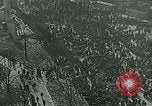
Crowds in Manhattan, New York City , gather and celebrate the armistice ending World War I.
New York City celebrates the Armistice ending World War 1. View from above of crowds on 5th avenue, in Manhattan, New York city, gathered at Madison Square, around the Altar of Liberty designed by architect Thomas Hastings, to honor the homecoming troops from the World War. The crowd forms a sea of waving hats, hands, and flags. Scene shifts to George Washington Statue at Federal Hall, Wall Street, which has been draped with American flag and signs reading: "Liberty cannot die." A clergyman stands below the statue and paces back and forth like a cheerleader. Closeup of a bearded Jewish man, wrapped in a Yiddish newspaper announcing the end of the war. He is blowing a horn and has an American flag and a blue and white Jewish flag fastened to his back. Camera pans over young women dressed in costumes as: soldiers, nurses, drum majorettes, the statue of liberty, red cross workers, and Uncle Sam. (World War I; World War 1; WWI; WW1)
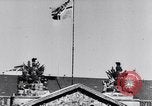
Adolf Hitler and top military leaders pay homage on Heldengedenktag (Day of Commemoration of Heroes) in World War II
German war ensign flying over the Zeughaus (military museum) on Unter den Linden, in Berlin, Germany on Heldengedenktag (Day of Commemoration of Heroes) in World War 2. A military band outside plays the National Anthem, as Adolf Hitler walks out of the building, accompanied by General Paul von Hase, Commandant of Berlin. An honor guard of soldiers presents arms in salute. Hitler and Marshal Hermann Goering (Göring) lead members of the German High Command, including Marshal Wilhelm Keitel; Grand Admiral Karl Doenitz; SS leader Heinrich Himmler; Marshal Fedor von Bock; and Marshal Erhard Milch, as they walk along the street, reviewing troops in formation. Flag bearers dip 30 colors of the old German Kriegsmarine and 30 of the new German army, in salute, as the reviewers pass. Soldiers stand holding a large memorial wreath. Hitler and his entourage turn and walk towards the Neue Wache (New Guard) National War Memorial building. Scene shift to inside the memorial, as the wreath bearers enter, followed by Hitler and the Marshals. The strains of "ich hatt einen kameraden" war song are heard played as a dirge. Soldiers place the wreath, and all present salute. Many more flowers are seen on the memorial floor. View of the memorial black granite block topped by an oak wreath (designed by the sculptor Ludwig Gies) situated under an oculus. It is flanked by two guards. Flowers cover the entire floor in front of it. Meanwhile, outside, on Unter den Linden, all persons simultaneously salute, including military and civilians. As Hitler leaves the memorial building, accompanied by the Marshals, he stops to shake hands and converse with wounded German officers and soldiers in wheel chairs. He greets older veterans of earlier wars. A crowd including many young people hold up placards on poles.
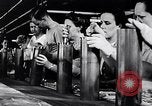
American women actively working and participating in the National Defense Program of the United States in World War II.
Wartime activities of women in United States during World War 2. American women war production workers busy in an ammunition factory helping men with war production. They check the shells at the munitions plant. A woman gives a lecture. A chart on wall. Other women attend the lecture. They wrap surgical dressings for the Red Cross. A woman gives blood to blood bank. Doctor and nurses take the blood in a glass container and put it in a box. The women participate in the defense program and war effort, filling many roles previously occupied by men fighting in World War 2.
CRITICALPAST.COM: About Us | Contact Us | FAQs - How to Order | License Agreement | My Account | My Lightboxes | Shopping Cart | Advanced Search | Featured Collections | Website Terms & Conditions | Privacy Policy ©2026 CriticalPast LLC.
License Agreement |
Terms & Conditions |
Privacy Policy
©2026 CriticalPast LLC.