


 Francais
 Deutsch
 Italiano
Refine Your Search
Greek-Civil-War stock footage and images
- Showing 1411 to 1416 of 27579 results more
more Hide
Hide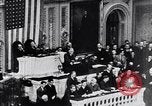
President Franklin D. Roosevelt addresses the Congress during "Four Freedoms" speech of 1942; also war production scenes
President Franklin D. Roosevelt addresses the U.S. Congress in his "Four Freedoms" speech during the State of the Union address on January 6, 1941, in Washington DC, United States. During his address, various war production worker and war materiel manufacturing images are also shown (before the entry of America into World War 2, but during lend-lease production): Tanks, airplanes and flying boat aircraft are shown. Workers at war production factories making artillery shells and munitions. Scenes at a manufacturing plant building bomber aircraft warplanes during World War 2. They appear to be B-25 Mitchell bombers. Workers work installing plexiglass nose cone gunner shield. They assemble various parts of airplanes. Scenes of biplane aircraft in formation and diving. Large, flat landing barge filled with American soldiers approaches a landing area.
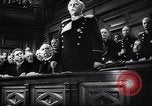
Unification of Germany under kingdom of Prussia; German military attacks on its neighbors; leadup to World War 1.
Mix of actor portrayals and actual footage: Otto Von Bismarck the Prime Minister of Prussia declares war against Denmark in a house of Ministry of Prussia. Scenes of war, cavalry and infantry invading Denmark. War against Denmark. Victory parade by German soldiers, while people cheer for them. War against France in year 1870. Meeting of minister to declare unification of Germany. Actual footage of Palace of Versailles and nearby buildings. Dramatized crowning ceremony for German Emperor Wilhelm I. Mix of actor portrayals and actual footage of growth of German military complex: Closeup view of sculpture of Chariot driven by Victoria atop Brandenburg Gate. German industries and men working in factories; merchant marine ships of Germany at harbors. German man drinking beer from glass. German man eating a sausage. German farmers tending fields on hillsides in Germany. Mountain villages in Germany. Fleet of German Navy warships. Actual footage of troops of German army, riflemen, cavaliers march through the streets in decade of 1910s. Dramatization of German men dueling swords in German universities. Actual footage of German Army officers in discussion in early 1910's before World War 1, including Helmuth von Moltke the Younger and other officers.
Relief and rebuilding works by the occupation forces of United States in Germany and Japan after World War II.
U.S. War Department information film "Overseas Mission" describes relief and rebuilding works in Germany and Japan by United States Army, after World War II. Battle between the Allied forces and the Nazi armies, soldiers and artillery fire during battle in German cities and towns. General Eisenhower signs accepting surrender of Germany. General MacArthur signs accepting surrender of Japan to mark the end of World War II. Soldiers carry casualties on litters. Treaty of Versailles after World War I. Newspaper lines read Nazi rearmament of Germany. Allied tanks and troops march in Germany. Marching Allied forces in Japan. Destroyed buildings and factories in cities of Japan and Germany. Nuremberg trials and arrests of Nazi generals. Allied forces dismantle German factories and industrial plants capable of making war materiel. A U.S. Army officer pushes handle to detonate explosives destroying a German factory. Nazi flags, German ammunitions and German factories are destroyed. Nazi troops and civilians saluting Hitler. Allied army engineers make roads and bridges, medics checking patients to prevent epidemics. Borders guarded, Nazi Germans tried. Prisoners of Nazi and Japanese released, dispensary checkup their health. Japanese prisoners released, board a bus. Declaration of Independence on July 4, 1776. Re-establishment of press, churches, courts and schools. Japanese children at school. Election in the occupied countries to run democratic government. Map showing opposite positions of occupied countries. Rations for occupation forces and civilians transported in trucks. Officers hiring labor to carry out relief works.
Images showing interests, culture, lifestyle and events involving Americans, including World War 1, in the period 1915 -1918
America in the World War 1 years, before and during the U.S. involvement in the war. View of Woodrow Wilson in academic robe and cap, as President of Princeton University. Steel mill with stacks belching smoke. Workers tap an open hearth furnace in steel mill. Children on a city street dancing and being sprayed with a fire hose to keep cool in summer. Boy hopping over the backs of his friends. Boys seated on a bench. Scenes from early motion pictures, interposed with images of Uncle Sam from Army recruiting poster: They are rapid montage comedy and stunt scenes, including Keystone Cops chasing fugitive; cars racing, gangster shootouts from cars; automobile hijinks; men raising barrier at railroad level crossing while a woman is left dangling from the raised crossing gate; car races and crosses railroad track in front of rapidly approaching locomotive; comic car chase down; line of 3 open top cars racing over an edge into a deep ditch, a motorcycle taking flight off of a road and into a river; a man waving warning flag frantically at a blasting site; The Cunard Ocean Liner ship, RMS Lusitania, underway; Newspaper front page about torpedoing of the Lusitania. American soldiers boarding troop ship for France in World War 1; View of the troop ship deck filled with U.S. soldiers. Various scenes of U.S. troops in the American Expeditionary Forces (AEF) in France during World War I: amid war torn ruins and destroyed buildings in France; firing French 75s and heavier artillery; soldiers charging across no-man's land; French and American soldiers caring for wounded behind the lines and in trenches of the battlefields; soldiers placing helmets and identification cards of fallen soldiers on rifles that are inverted, bayonet into ground.
Japanese attack Hawaii islands in United States during World War 2, and U.S. response to attack.
A film titled 'Jap-US at war' shows Japanese diplomats leave the venue of the diplomatic talks in Washington DC in United States, soon after Japanese attack on Pearl Harbor, Hawaii islands. Secretary of State, Cordell Hull also leaves the building. President Roosevelt is seen. Japanese troops prepare for war. Japanese troops in mainland Japan board trains as crowds of Japanese citizens wave Japanese flags and cheer for their troops leaving for war. Scenes of Diamond Head in Hawaii in peaceful times are shown, including buildings, people on beaches with sunbathers and fast small boats with outriggers in the surf. City streets in Honolulu Hawaii are shown with cars and shops and view of Aloha Tower lighthouse in background. Japanese planes drop bombs over Pearl Harbor in Hawaii. United States Presidential Secretary Stephen Early tells the press of Japanese attack and the damage suffered by America. People in American cities read newspapers and scrolling lit sign (likely Times Square New York) with news about Japanese attack as the lead story. American citizens buying newspapers describing the attack at newsstands. U.S. troops march in front of War Department - Navy munitions building in Washington DC. Night time view of soldiers on guard in Washington DC. Sailors return to battle stations. U.S. Navy sailors boarding ships of U.S. Navy in the U.S. west, bound for battle. Brief scenes from American ports in Guam and Wake Island. U.S. Navy fleet ships underway in Pacific heading west toward battle with Japanese forces. Biplanes launched via catapult from U.S. Navy ships and then seen flying over Navy ships in formation as narrator encourages Americans to work together and put aside differences to win the war. Overhead view of a U.S. Navy ship passing under a bridge with deck busy with sailors and operations.
United States Army preparations and structure for involvement worldwide during the Cold War
Importance of Army being explained in the light of increasing Soviet and Chinese military strength, expanding communism, Cuban missile crisis, Berlin crisis and Korean War. Soviet military parade in Red Square. Chinese Army forces parade in China in review. U.S. Army soldiers in combat in Korean War, with soldier firing machine gun and two soldiers firing a mortar. American tank on streets of Berlin during Berlin Crisis. Fidel Castro speaking from podium at a rally in Cuba. Cuban rebels marching. Still image of Soviet missile sites on Cuban soil during Cuban Missile Crisis. American soldiers and marines in Indochina and soldiers wading in water. A map shows the regions of major conflicts in the world. Three types of wars being enumerated including general war, limited war and insurgencies. A map shows American Army establishments in the country.
CRITICALPAST.COM: About Us | Contact Us | FAQs - How to Order | License Agreement | My Account | My Lightboxes | Shopping Cart | Advanced Search | Featured Collections | Website Terms & Conditions | Privacy Policy ©2026 CriticalPast LLC.
License Agreement |
Terms & Conditions |
Privacy Policy
©2026 CriticalPast LLC.