


 Francais
 Deutsch
 Italiano

Refine Your Search
Greek-Civil-War stock footage and images
- Showing 1483 to 1488 of 27579 results more
 Hide
Wartime nutrition public service film focuses on improving nutrition of American and British people. Also shows British war scenes.
Film on importance of good food and good eating habits during World War 2. Sweeping views of open farm land in the United States. Wheat harvesting by a harvester machine on a farm. Corn picked from stalks. Pigs in a pen. Cattle eat at a trough. Fish leaping on deck of a boat after being emptied from a net. Butcher weighs meat on a scale for a woman customer. Grocer puts meat, sugar, eggs, and other rationed items in a grocery bag. Scene changes to England, probably London, with smoking rubble on the ground from a blitz bombing run by German forces during World War 2. British firemen pour water on a blaze from fire hoses. A queue of British women and children citizens waits to receive food aid. Many of the British civilians look tired. A girl holds a large doll in her arms. A woman with a bandaged head holds a young girl child. Scene shows a British family at a table eating ration reduced portions of eggs, butter, and cheese. A British scientist holds a beaker and adds it to a large food preparation drum, adding vitamin enriched material to a food such as margarine, to aid with improving nutrition despite scarcity in the United Kingdom during World War 2. A box of butter is shown. Hand flips butter packet over to show label "Contains Vitamins A and D". British staples such as a wheat bread loaf and also beans, peas, and cereals are credited by the narrator as being "nerve conditioners, at a time when iron nerves are needed most." Footage of a British paratrooper in training jumping from a British aircraft. Next scene is in a steel mill as British men wearing protective glasses use shovels near a furnace. Scene of a British woman receiving cod liver oil and milk as a ration for a young child. Grocer at produce stand hangs sign saying "no tomatoes". But a victory garden sign behind shows someone pushing a shovel into the earth. People are shown working in victory gardens to grow fresh vegetables. All ages of older men and women and young children in England are shown working to tend victory gardens in plots large and small. Soldiers beneath a barrage balloon tend a garden with hoes. Scene in a community kitchen with a group of British citizens eating a meal. Next scene shows Americans in a restaurant and then in a diner ordering food at the diner counter. A woman orders and coffee is poured for her and two donuts are served. Narrator notes that the food nutrition choices made by many Americans are not good, and notes that malnutrition saps the strength of Americans. A woman secretary is seen typing and being frustrated and tired. A man welding lifts his helmet and rubs his head and face in exhaustion. A doctor and nurse examine and treat an eye of an American war worker. A U.S. Army recruitment or induction center is shown, with new recruits receiving medical examinations. Doctor uses a tongue depressor and examines a person's throat. A blood pressure machine takes a reading. An eye chart is shown. Doctor uses a stethoscope on a recruit's chest. Group of U.S. Army soldiers marching in formation. A group of new citizen recruits without uniforms marches.
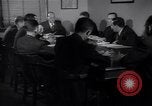
Atlantic Coast Director, W W Schwenk in a meeting with other officials in War Shipping Administration Division headquarters (WW2)
View at War Shipping Administration Division headquarters in New York City. Atlantic Coast Director W.W.Schwenk discussing with other officials in a meeting. Schewenk discussing and looking into Secret War Administration Data Book. Door sign of 'OFFICE OF ATLANTIC COAST DIRECTOR - WAR SHIPPING ADMN ENTRANCE' can be seen. (World War II period)
New Yorkers, in lower Manhattan, celebrate Armistice ending World War I
Crowds fill streets celebrating Armistice ending World War 1. Street cars move through the crowds. Many people wave American flags. Mounted police maintain order. Crowd filling space in front of S.S. Kresge Company 5&10 cents Store. Large American flags hang from front of the Central Savings Bank, at 14th Street and 4th Avenue (Union Square). People gather around a large monument displaying many figures. A group of people realize they are being photographed and face the camera smiling. One man lifts up a small boy dressed in soldier uniform, holding a flag and saluting. Several men carry a wood slab with effigy of defeated Hun on it. Scene shifts to large open area, where crowd is gathered around a multistory copy of the Statue of Liberty. A group of women in white dresses (possibly nurses) stand in front of a seated Army brass band. Scene shifts back to Union Square, again with crowd around the large monument and American flags draped over windows of the Central Savings Bank. Trick photography creates ethereal image of statue of liberty in the scene. Next, lines of people with banners and flags move near area of trolley cars. Another group gathers near camera, as mounted policeman moves behind them. Trinity Church steeple can be seen in far background. Several men in blackface makeup carry a coffin containing detritus of war. View from building overlooking avenue filled with people. American flags fly from building window sills. A flag displaying "104" (104th Regiment?) and numerous stars, hangs from one window. (World War I; World War 1; WWI; WW1)

Citizens in Washington DC prepare for parade celebrating World War I Armistice. President Wilson in his limousine.
An open truck filled with revelers, carrying American flags, travels along a street in Washington DC during World War 1 Armistice celebrations. Views from a moving vehicle passing crowds lined up on the sidewalk, in front of the State, War, and Navy Building (AKA the Old Executive Office Building, or Eisenhower Executive Office Building) ready to view a parade. A group of women walking in a street in front of a crowd. They pass an automobile where several U.S. Army soldiers stand. Scene shifts to White House driveway, where people gather outside the fence. President Woodrow Wilson steps from the White House front entrance, with an officer and other officials, and enters his Pierce Arrow limousine, displaying license plate number 80002, and an AAA symbol on its radiator. Scene shifts to the President's car leaving the Capitol building, with Secret Service Agents riding on the running boards. A crowd breaking up in front of the Capitol, as the President's car leaves. A small group of persons, including soldiers in uniform and a woman, surround an Army officer who affixes a message to the leg of a carrier pigeon, and sets it free. (World War I; World War 1; WWI; WW1)
Newsreel 'Women aid war effort in U.S. and Canada'
Views of many women war production workers seen working in ship yards in Canada as part of war production effort in North America during World War 2. Women help in building Victory ships in shipyards. Canadian women are seen wearing uniforms and helmets to aid the war production effort. Women work as electricians and in construction. A woman is seen smoking. In the United States, view of women in WAC (Women's Army Corps) repairing airplanes. Women are seen servicing the aircraft.

Modernization of Japan through World War 2
Modernization of Japan through World War II. Japanese civilians seen. Japanese civilians bow down to the Superiors. Many scenes of Japanese military and cilvilian persons as they bow to others. Japanese girls sold by their fathers working in factories. Women work in the rice fields. Men wearing local hats seen. Japanese peasants working hard. Japanese people use telephones in office and living in traditional Japanese homes. Simply furnished Japanese homes without chairs, windows and beds seen. Japanese family wearing kimonos, eating food. Japanese men in kokumin-fuku worker uniforms working in a factory producing war materiel and armament for the war effort in World War II.
CRITICALPAST.COM: About Us | Contact Us | FAQs - How to Order | License Agreement | My Account | My Lightboxes | Shopping Cart | Advanced Search | Featured Collections | Website Terms & Conditions | Privacy Policy ©2026 CriticalPast LLC.
License Agreement |
Terms & Conditions |
Privacy Policy
©2026 CriticalPast LLC.