


 Francais
 Deutsch
 Italiano
Refine Your Search
Greek-Civil-War stock footage and images
- Showing 1495 to 1500 of 27579 results more
more Hide
Hide
United States citizens give isolationist views regarding potential war in Europe; New Deal programs in America in 1930s
The background of World War II. United States citizens state isolationist and anti-war views. They give their views regarding the beginning of war in Europe, and their desire for the United States to stay out of the war. Board reads 'No foreign Entanglements'. View of idle and closed factories during the Great Depression. Ground level, track level view of a railroad train approaching. Elevated view of homeless and unemployed hobo men riding on top of a train car. President Franklin Roosevelt signs Fair Labor Standards Act of 1938 assuring a minimum wage and maximum work week. View of factory workers arriving at a large factory or production plant for a work shift. Newspaper headlines read 'Social Security Laws Go into Effect'. Civilian Conservation Corps (CCC) workers seen hanging telephone lines, digging ditches, and building roads. Aerial view of new highways and clover leaf overpasses.
Attack on Pearl Harbor by Japanese, and President Roosevelt asks for war declaration on Japan in 'date of infamy' speech.
United States Government film entitled "The World At War" dealing with World War 2. Film opens showing Japanese warplanes in formation above a Japanese military installation. Slate reads: "Pearl Harbor December 7, 1941. An airfield is seen filled with parked U.S. Army Air Forces B-17 bombers. Two Boeing XB-17 (Model 299) bombers are parked next to each other on the ramp. Derricks and ships are shown at the Pearl Harbor naval base. A formation of Japanese Mitsubishi G3M bombers is seen in flight. They are seen overhead as bombs explode on the U.S. Navy Air Station at Ford Island destroying hangars and aircraft. Next, is shown the famous image of the USS Arizona burning, listing, and sinking, after being bombed. Film continues, panning over post-air raid views of destruction. On December 8, 1941, U.S. President Franklin D. Roosevelt, addresses the Congress, delivering his declaration of war message. He calls December 7, 1941 "a date which will live in infamy." Roosevelt recounts that the United States was at peace with japan and in conversation with its government and Emperor, in the interest of maintaining peace.in the Pacific. even at the time of the attack. Japanese ambassador and his colleagues seen visiting State Department offices to meet with U.S. Secretary of State prior and even during the initial attack operations by Japan.Roosevelt recounts that the United States was still in conversation with Japan even at the time of the attack. Japanese ambassador and his colleagues seen visiting State Department offices to meet with U.S. Secretary of State prior and even during the initial attack operations by Japan. Photographers take pictures of the visiting Japanese delegation. President Roosevelt asks Congress to affirm that a state of War exists between the United States and the Japanese Empire.
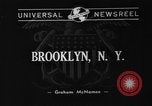
United States engineers work on equipment at Brooklyn Navy yard in New York during World War II.
Us prepares for World War II. United States engineers and war production workers building warships in Brooklyn, New York. Americans prepare for defense as war accelerates in Europe. View of US King (DD-242) sand USS Rodgers (DD-254) at a harbor. War workers entering the shipyard. Engineers work on equipment at Brooklyn Navy yard. Women sew American flags.
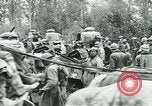
American and French forces marshaling in France, during World War I. French deploy Renault FT tanks.
American soldiers and supplies being moved towards the front in France during World War 1I. A unit of French Renault FT tanks drives through the U.S troops, who move aside to allow them passage. The tanks proceed, along a dirt road, towards the front. (Note: After World War 1, the Renault FT tank was often called the FT-17.) (World War I; World War 1; WWI; WW1)
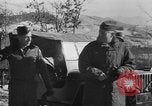
Lieutenant General Lucian K. Truscott assumes command of the 5th Army in Italy during World War II
On 10 December 1944, Lieutenant General Lucian K. Truscott, Jr. (newly appointed Commander of the 5th Army) arrives by jeep at a U.S. Army encampment in Italy during World War II. He is escorted the headquarters of II Corps, on the Apennine front below Bologna, where he is greeted by Major General Geoffrey T. Keyes. They walk together around a building. The next day General Truscott is seen saluting as he is escorted by Major General Willis D. Crittenberger, Commander 1V Corps. Next, General Truscott is seen at the headquarters of the Brazilian Expeditionary Forces contingent of the 5th Army, where he greets its Commander, General João Baptista Mascarenhas de Morais and his aides. As General Truscott leaves, his jeep passes a Brazilian honor of soldiers who salute him. Brigadier General, Donald Carlson. new Chief of Staff of the 5th Army, accompanies Generals Truscott and Crittenberger to a forward observation post near the village of Castelluccio. They observe from a bunker overlooking a valley, where white smoke is rising. (Narrator states that the smoke screen indicates the position of the Allied line of the IV Corps Sector on 11 December.) Next the three American officers are seen making their way up a mountain side, with smoke rising from the town of Vergato, in the background below, where heavy fighting is taking place. (World War II; WW II; World War 2; World War Two)

U.S. and German forces clash at Stavelot, Belgium, during World War II
Opening slate identifies site of World War 2 combat as Stavelot, Belgium, 20 miles from the German frontier. American soldiers of the 30th Infantry Division are seen digging protective field positions. M1917 Browning 30mm machine guns are at their positions. U.S. troops set up 90mm guns along the roads, as fog begins to obscure the area. On 21 December, 1944, Two U.S. soldiers walk across a square in the town of Stavelot where American and German forces clashed on December 20th. Views of destroyed buildings, abandoned Tiger II tank of s.SS.Pz.Abt.101 and Stummel half-track and wreckage. Civilians run for cover into a substantial building as German forces renew an attack on the town. (World War II; WW II; World War 2; World War Two)
CRITICALPAST.COM: About Us | Contact Us | FAQs - How to Order | License Agreement | My Account | My Lightboxes | Shopping Cart | Advanced Search | Featured Collections | Website Terms & Conditions | Privacy Policy ©2026 CriticalPast LLC.
License Agreement |
Terms & Conditions |
Privacy Policy
©2026 CriticalPast LLC.