


 Francais
 Deutsch
 Italiano
Refine Your Search
Greek-Civil-War stock footage and images
- Showing 1489 to 1494 of 27579 results more
more Hide
Hide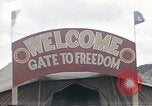
Liberated prisoners of war get out of ambulance truck
Group of senior officers at Camp Munsan-Ni in Korea near the end of the Korean War. A sign on a tent reads "Welcome gate to freedom". U.S. flag on the left side and UN flag on the right side of the tent. Freed and liberated American prisoners of war get out of ambulance truck during Operation Little Switch repatriation (preceding Operation Big Switch later in 1953). Ambulances leave Ramp area. A freed American prisoner of war escorted by U.S. Marine in dungarees. Some freed POW soldiers are carried on stretchers or litters. A liberated prisoner of war lying on a stretcher gives a thumbs-up sign.
Worldwide operations of United States Coast Guard in World War 2
Overseas activities of United States Coast Guard in World War II. U.S. Landing Craft Infantry, LCI(L) 617, part of LCI Flotilla 22 in World War 2. She is seen underway in rough waters of the Pacific ocean during 1945. Coast Guardsman ordered to Battle stations. A Coast Guardsman observes approaching enemy aircraft through binoculars. Coast guard gunner fires Antiaircraft guns using foot trigger. Enemy aircraft crashes in ocean. A Coast Guardsman signals using semaphore flags. Beachhead supply operations. Coast Guard Picket Boat, CG-42022, seen patrolling around U.S. transport ships in a Persian port, while they carry lend lease supplies to the Soviet Union. Coast Guard combat patrol in jungle using canines (dogs). The Cactus (A) Class 180 foot buoy tender, USCGC Tupelo placing a buoy at sea. Releasing a weather balloon. A Coast Guard wooden 83 foot cutter ("83 footer"). Loading a Coast Guard B-24 aircraft on Guam. The plane takes off. Invasion task force of U.S. warships underway. Coast Guard crews at various duty stations aboard their ships during the war. The former luxury ocean liner, SS Manhattan underway, her decks crowded with troops, following her conversion into the U.S.Coast Guard-manned USS Wakefield (AP-21). U.S. Navy attack transport USS Arthur Middleton (APA-25) at sea in the Pacific. Coast Guard operating transport ships unloading cargo for Allied invasion forces and running inter-island shipping service in the Pacific, during World War II.Landing Ship Tank (LST-788) arriving at the beach next to Landing Ship Medium, LSM-242, on Iwo Jima. A Landing Vehicle Tracked (LVT) being driven off LST-760. USS LCI(L)-87, Flagship of LCI Flotilla 10. Her Captain, M. E. Imlay, USCG, is seen on her bridge, before departing from England for the Normandy invasion. U.S. Landing Craft Infantry, LCI(L)-668 at beach and troops wading ashore.
Role of the Jeep in U.S. military operations during World War II.
A U.S. Army Air Forces (USAAF) Waco CG-4A-WO glider is seen descending and landing in a grass field. Upon touchdown, its front pops open and and an army jeep drives out. USAAF C-47 aircraft are seen next, offloading jeeps pulling small artillery pieces, and infantry who move rapidly from the parked aircraft. Jeeps traversing a high hump in a dirt road. A jeep towing an M-3 Antitank Gun 37mm, and others driving through underbrush and bouncing over rough road while towing 37mm guns and trailers. Soldiers stepping from jeeps to set up machine guns. American soldiers playing a game of horse and rider, during a break in duties. Soldiers setting up mortars. Jeeps driving through bodies of water. Two M4A1 (76)W Sherman tanks, with cast steel hulls, drive into a stream. Troops setting up several 37mm guns on a river bank. Two soldiers in a communications jeep. Army officers perusing a map laid out on the hood of a jeep. U.S. field artillerymen using periscopic binoculars on tripods, to spot and direct gunfire. Military vehicles, including jeeps, moving across desert terrain. Artillery crews firing M59 (M2 Long Tom) 155mm guns. A Douglas A-26 Invader aircraft flying overhead. Jeeps in various roles, bouncing along in the desert and laying smoke screens. Jeeps equipped with M3 anti-aircraft guns and others with stretchers for wounded affixed to their sides. U.S. Army Ford GPA "Seep" amphibious jeeps plunging into water and continuing on as boats. A jeep production and assembly line in a U.S. factory showing stages of assembly and finished jeeps driving out of the plant into yards containing hundreds of them. A convoy of jeeps driving over a bridge, and others carrying a U.S. military brass band in a parade in England. A Hollywood actress (Gloria Swanson?) being lifted into a jeep by several men. Glimpse of an unidentified actress with an American soldier, in a jeep. Hollywood stars, Stan Laurel and Oliver Hardy clowning in the front seat of a jeep with Desi Arnaz and two women riding in the back. Several jeeps carrying these and other Hollywood personalities during a war bond parade in Washington DC. The Capitol looming in the background as the jeeps move away from it toward the camera. Jeeps being prepared for transport to overseas destinations. Jeeps being partially disassembled and loaded into wooden crates and placed on rail cars for transport. Jeeps being hauled by cranes and placed aboard ships. Landing crafts mechanized (LCMs) transporting infantry and vehicles, including jeeps. An M4A1 Sherman tank driving out of a landing craft into surf. A jeep being driven onto beach at Adak,in the Aleutians,from a landing craft of the USS J.Franklin Bell (AP-34), in 1942. In 1943, this transport ship was reclassified as APA-16.) American troops with jeep on a South Pacific island in World War 2. A soldier on motorcycle, skids in mud on road in North Africa, and jeeps drive past him. American soldiers ride camels and some drive in a jeep near the Great pyramid and Sphinx in Egypt. Jeeps seen in China, with Generals Joseph Stilwell and Claire Chennault. One parked next to a Flying Tiger P-40 airplane. Soldiers in a jeep in Alaska, next to a tent and sign pointing to "Tokyo." Local tribesmen literally carrying a jeep, on long poles, across a river in Timor. General Douglas MacArthur, accompanied by staff officers, being driven in a jeep along a jungle road in New Guinea, past a line of local tribesmen. Wendell Wilkie, serving as Ambassador-at-large, during the war, speaks to U.S. officers in a jeep. Britain's King George VI in a jeep followed by another carrying Queen Elizabeth. President Franklin D. Roosevelt riding in a jeep to review troops. He removes his hat as they pass the American flag. Sign on a building in North Africa reads "Bizerte." General George S. Patton, standing in a jeep during a victory parade in North Africa. Soldiers at an outdoor religious service during the war with the hood of a jeep serving as a make shift altar.Various views of jeeps driving with soldiers in them.
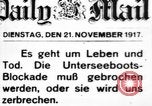
German U-Boat stops the Spanish steamer " Asuarca," at sea in World War I
Slate mimics The British Daily Mail newspaper, Tuesday, November 21, 1917, declaring that England must break the German U-boat blockade or be broken by it. Another slate alludes a statement by British MP Gibson Bowles to the effect that Britain's food supply is being controlled by the German submarine. Crew of a surfaced German submarine is seen on deck taking advantage of good weather to perform maintenance on their deck gun, during World War 1. Officers in Conning tower scan horizon with binoculars. The neutral Spanish Steamer, "Asuarca," is sighted from the conning tower, where the Imperial German Navy war ensign is displayed along with a nautical pennant bearing a white cross on red background, indicating the numeral "4." The crew is also raising a bicolor nautical flag for the letter "H." (A slate states that the U-boat is signalling for the ship to send a boat.) View of the single-stack Spanish steamer. A boat from the Asuarca, sits alongside the U-boat after bringing an officer carrying her papers. The officer is seen leaving the submarine and boarding the ships dinghy, to return to the Asuarca. A Slate indicates she carried no contraband and was therefore allowed to proceed unhindered. (World War i; World War 1; WWI; WW1)
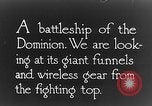
King George V visits the Grand Fleet at Scapa Flow during World War I
King George V in visit to the Grand Fleet at anchor in Scapa Flow, Orkney Islands, Scotland, during World War 1. View from above, of funnel and wireless apparatus atop a Queen Elizabeth-class British Battleship, during World War 1. Other warships in the background. Four of the Battleship's BL 15 inch Mark I guns are seen with barrels closed by plugs. Sailors walk past the guns. A mascot dog eating a treat while perched in the open barrel of a gun. Three of the Ship's officers display a moose head received from the Canadian Government. Group of ship's officers pose standing on deck while several sit down holding their mascot dog and cat. The moose head is displayed behind them. The seated officers tease the cat and dog by making them confront each other. Change of sequence, to a royal visit by King George V to the Grand Fleet. British Admiral Sir David Beatty, Commander of the Grand Fleet, is seen standing with British Admiral of the Fleet, Sir Frederick Charles Doveton Sturdee, on the deck of a British battleship.They are joined by another officer, as King George V paces back and forth past them, in earnest conversation with the ship's captain. Scene shifts to Admirals Beatty and Sturdee, conversing with other high ranking British Naval officers. Next, sailors are seen boarding steam launches, at a pier, for return to their respective ships, after shore leave. The launches proceeding out to the ships. (World War I; World War 1; WWI; WW1)
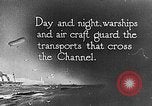
British warships protecting shipping and convoys in the English Channel during World War I
British Royal Navy efforts to protect shipping and convoys in the English Channel during World War 1. Boats are seen behind a breakwater on coast in United Kingdom, during World War 1. A British two-stacker I- class destroyer underway with black smoke pouring from its funnels. British soldiers with weapons and personal gear at a rail yard, with train in background. They descend stairs to a pier and board a crowded troop ferry ship. Two troop ferries underway in the English Channel. View of the British Monitor ship, "Marshal Soult" mounting two 15-inch guns. British soldiers loaded aboard two troop ships departing the United Kingdom (one is a side-wheeler). Women on the pier waving goodbye. A British gunboat underway. View from stern of a boat putting out a good wake. A dirigible low over the water and a steaming warship seen in background. Workmen marching across the mole protecting the German submarine (U-boat) base at Zeebrugge, Belgium (Slate says before it was blown up by the British). (World War I; World War 1; WWI; WW1)
CRITICALPAST.COM: About Us | Contact Us | FAQs - How to Order | License Agreement | My Account | My Lightboxes | Shopping Cart | Advanced Search | Featured Collections | Website Terms & Conditions | Privacy Policy ©2026 CriticalPast LLC.
License Agreement |
Terms & Conditions |
Privacy Policy
©2026 CriticalPast LLC.