


 Francais
 Deutsch
 Italiano

Refine Your Search
Greek-Civil-War stock footage and images
- Showing 19297 to 19302 of 27579 results more
 Hide

Chinese civilians move to safer places and clog highways and rail road tracks in the process during a Japanese attack.
United States 14th Air Forces in China. Barrels of oil piled up. Chinese people loaded in trucks flee their villages due to Japanese attack. Trucks being repaired as men wok on the engine of the trucks. Chinese civilians and soldiers cross a bridge on foot. Wounded civilians being carried to safe places on litters. Chinese people clog the rail road track as they move to safer places. Chinese men loaded on a rail road train. A Chinese woman with her children. A wounded being carried on a litter. A Chinese man carries luggage. Chinese soldiers board a plane and it takes off. Soldiers advance along a hill. A map of China shows American 14th Air Force action in China. Cars move along Ledo road. Aerial view of the traffic on Ledo road. Figures symbolize number of ships and planes used, dead soldiers, and civilians in the operations against Japanese in China. (World War II period).

Australian soldiers in Timor raid a village and get supplies after establishing contact with the headquarters.
Australian troops in Timor during World War II. A map of Timor. Australian troops isolated on the island. The soldiers cook food and eat. A man holds a coconut and takes a bath. Natives help a soldier to bathe as they pour water. Soldiers plan a run raid on Japanese positions. They look at a map. They attack a native village. People run away to save their lives. Australian troops construct a radio set. They work on the radio to send messages to the nearby head quarters. Authenticity of their messages is tested. On being proven authentic help flies in. A plane in flight as it brings mail, food and arms. Soldiers read their mail.
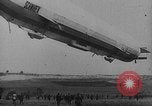
German Zeppelin airship from Schwaben goes down in flames over North Sea after London bombing run
A German Zeppelin airship during World War 1. It has the word "Schwaben" written on it. (Presumably from Schwaben, Germany). It is seen taking off from the ground in Germany, soaring above a German city and out over the sea. Narration indicates it is on a London bombing run, scheduled to arrive over London around midnight. Next scene shows the Zeppelin in flames and crashing into the North Sea the next day.
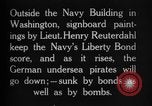
U.S. Lieutenant Henry Reuterdahl paints a sign board outside a navy building in Washington D.C. during Liberty Bond drive
Promotion of Liberty Bonds in Washington D.C., United States during World War I. Lieutenant Henry Reuterdahl and another officers paint a sign board outside the Navy Building. Men in foreground with the sign promoting the sale of Liberty Bonds in the background. Lieutenant Reuterdahl paints part of the sign which reads ' Sink the U Boat '. The sign has a separate hard cut-out piece in the shape of a German submarine. It moves along a sliding groove so that it can be shown as sinking into the painted waves. Lt. Reuterdahl moves the end of the U-boat cutout up and down showing its motion.
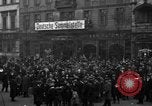
Citizen residents of Upper Silesia voting to determine whether they will be associated with Germany or Poland.
After World War 1, in accordance with Article 88 of the Treaty of Versailles, residents of Upper Silesia are deciding by ballot, whether to be attached to Germany or Poland. Citizens in Kattowitz (Katowice) milling about in front of a building with a sign that reads ' Deutsche Sammelstelle. ' A horse and wagon passes them. Armed French occupation troops climb aboard an open truck. A small boy watching is chased away by a soldier.The truck drives away, past crowds of people on sidewalks. Three uniformed French soldiers pose in front of crowd of spectators. Three uniformed men with Red Cross arm bands stand under red cross flag flying from building. People massed at entrance to a building move into it under sign reading "eingang." A French officer (General Henri Le Rond) standing with a British officer (Colonel Henry Percival) and an Italian officer (General Antonio de Marinis), reads a newspaper and converses with the others in garden at Oppeln (Opole). Views from moving train of industrial complexes with numerous smoke stacks and factories, in the Oppeln region of Upper Silesia. A map showing area of plebiscite, and the coal reserves and coal mines of the region.
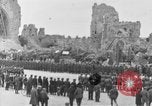
Destroyed St. Martins cathedral in Belgium and views from a moving car of the Schwebebahn suspended railway in Germany
Allied military and some civilians gather for a ceremony at the ruins of Saint Martin's Cathedral, in Ypres Belgium, destroyed by Germany in World War 1. Scots Guards in kilts are seen among the assembled military. A ladder is seen and something is being raised by a hoist in the background,as preliminary cleanup is being undertaken. Scene shifts to point of view footage from a moving rail car on the Suspension Railway (Schwebebahn) in Barmen-Elberfeld Germany. At first it travels above a street in the city. Then it is seen moving over the Wupper River, in the Elberfeld region, as another suspension rail train approaches from the opposite direction. It continues traveling along (above) the waterway. (Note: Barmen-Elberfeld was re-named Wuppertal in 1930. The Schwebebahn is still in operation today, and is the oldest operating transportation monorail in the world. It is now called the Wuppertal Suspension Railway. Its original full name is: "Electric Elevated Railway (Suspension Railway) Installation, Eugen Langen System" (Anlage einer elektrischen Hochbahn (Schwebebahn), System Eugen Langen)).
CRITICALPAST.COM: About Us | Contact Us | FAQs - How to Order | License Agreement | My Account | My Lightboxes | Shopping Cart | Advanced Search | Featured Collections | Website Terms & Conditions | Privacy Policy ©2026 CriticalPast LLC.
License Agreement |
Terms & Conditions |
Privacy Policy
©2026 CriticalPast LLC.