


 Francais
 Deutsch
 Italiano
Refine Your Search
Haustenbeck Germany 1945 stock footage and images
- Showing 247 to 252 of 10471 results more
more Hide
Hide
Villagers of Bande, Belgium, massacred by Nazis on Christmas Eve, in retribution for deaths of three German soldiers, in World War II
A sign identifies the village of Bande, in Belgium, during World War 2. View of snow-covered village rooftops from a distance. Closeup of a cafe in the village. Bodies of 34 young men from the village are seen lying in the cellar of the cafe. All had been executed on Christmas Eve, by a unit of the Nazi SD (Sicherheitsdienst) affiliated with the SS (Schutzstaffel) in retribution for the deaths of three German soldiers killed by Belgian maquis (Resistance fighters) on September 5, 1944. (Bande had been occupied by U.S. forces soon thereafter, but was retaken by German forces in the December Ardennes offensive, setting the stage for the massacre.) British troops that re-occupied the village on January 10th, 1945, are seen removing the bodies from the cellar and placing them on the snow-covered street. Wooden coffins are stacked up at the side of the building. Some closeups of the victims are seen. Scene shifts to a snowy field where the bodies are on the ground and men wrap them in sheets and place them in coffins. Closeup of British soldiers placing cover on a coffin and affixing an identification tag on it. Next, the Village Priest presides over a mass funeral for the victims, as villagers stand along the line of coffins. Women in black grieve over the victims. British soldiers carry the coffins to army trucks.The villagers follow behind the trucks as they proceed to the graveyard for burial. The coffins are placed on the ground at the cemetery.
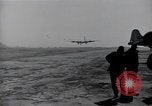
B-29 bombers of United States Army Air Force land at a base on island Iwo Jima, during World War II.
United States Army Air Force at their base on the island of Iwo Jima, during World War II. B-29 bombers of the U.S. Air Force land on landing strip one after the other. Airmen at the runway. Airman marshaling a B-29. A pilot looks out form cockpit window of one of the B-29. The aircraft with painted nose art of an attractive, semi-nude woman and slogan 'A-Broad With Eleven Yanks.' (B-29 number 42-24698. Assigned to 499th BG, 877th BS. Shot down over Kyushu, Japan July 11, 1945. 1 crewman killed, 10 survived and rescued. Missing Air Crew Report (MACR) 14344.)
Americans in New York City celebrate the surrender of Japan in World War II, at Times Square.
Film opens showing aerial view of a United States B-29 Superfortress bomber aircraft in flight, then scenes of numerous U.S. Army Air Forces warplanes and bombing (partially obscured by on screen newsreel text). Next, crowds are seen jamming Times Square in Manhattan, New York City, celebrating victory over Japan in World War 2. (Known as V-J Day or Victory over Japan day, marking the end of World War 2, on 14 August, 1945.) A facsimile of the Statue of Liberty has been set up in the square. Moving lights on Times Building motograph news zipper or ticker announce Japanese surrender. Jubilant celebrations and smiling Americans wave American flags. Closeup of the Statue of Liberty facsimile. A woman dances the Lindy Hop with a U.S. Navy sailor, as others (including many servicemen in uniform) watch.
Interview of Capt. William S. Parsons, U.S. Navy, crew member on Enola Gay, after the Hiroshima atomic bombing mission
Setting: North Field, Tinian Island in Mariana Islands, South Pacific, almost a week after the atomic bomb was dropped on Hiroshima Japan, August 8, 1945, during World War II. Public Relations Officer, Major John F. Moynahan (not seen) is interviewing members of the Crew of the B-29, Enola Gay, from which the bomb was dropped. Here he interviews Captain William Sterling "Deke" Parsons of the U.S. Navy who was weaponeer aboard the Enola Gay, during the mission. and who now serves as Scientific Head of the Atomic Bomb Project in the Pacific Theater. Captain Parsons describes the events of the mission from their early morning departure through the actual bombing. He notes that the actual bombing went smoother than earlier practice missions.
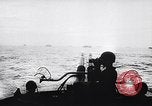
United States warships and the Marine Corps raid and gain control over the Japanese island of Okinawa, during World War II.
The Pacific Theater of World War II during the Year 1945. Attack on Japanese island of Okinawa by the United States Military. United States Navy ships from the sea, launch a number of missiles towards the islands. The missiles traverse an aerial route and destroy the target Japanese positions. United States Marine Corps raid the island moving in amphibious landing tractors towards the island. Battle between Japanese soldiers and U.S. Marines. American flag hoisted on Okinawa after four months of furious battle. Officials and Military Commanders and soldiers salute the flag.
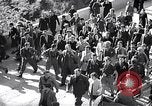
Several Italian Fascist officials and soldiers apprehended by Partisans in Ivrea Italy, as World War II ends in Europe.
Armed Italian Partisans escort several Italian Fascist officials, who walk with their hands raised along a street in Ivrea, Northern Italy, during final days of World War 2, in Europe. Local citizens walk along beside and behind them, including some on bicycles. Another scene shows Italian Partisans escorting several soldiers, of the Italian National Republican Army, with their hands on their heads. This group is also followed by a large number of local citizens. Scene shifts to an American jeep carrying an officer and two U.S. soldiers. It is followed by an automobile, seen, later parked with another near a sidewalk, where several Italian Republican Army officers are conversing cordially with American soldiers of the U.S. 92nd Infantry Division.(By May 5, 1945, all Nazi German forces in Italy, had capitulated.) Italian women and children seen in a small open bus.
CRITICALPAST.COM: About Us | Contact Us | FAQs - How to Order | License Agreement | My Account | My Lightboxes | Shopping Cart | Advanced Search | Featured Collections | Website Terms & Conditions | Privacy Policy ©2026 CriticalPast LLC.
License Agreement |
Terms & Conditions |
Privacy Policy
©2026 CriticalPast LLC.