


 Francais
 Deutsch
 Italiano
Refine Your Search
Haustenbeck Germany 1945 stock footage and images
- Showing 259 to 264 of 10471 results more
more Hide
Hide
Montage of scenes related to 1942 Fall of Corregidor, the Bataan Death March, POWs and destruction of manila, in World War II
World War 2 scenes related to the Philippines. Opening shot shows Japanese troops unceremoniously taking down American flag in 1942, followed by superimposed images of Japanese soldiers boots trampling over U.S. flags. Next, U.S. Lieutenant General Jonathan Wainwright with members of his staff, are seen seated at a table in the Japanese headquarters building on Bataan to discuss surrender with General Masaharu Homma, Commander of the 14th Japanese Imperial Army. Homma has General Wachi at his left and Colonel Nakayama to his right. Repetition of the superimposed Japanese army boots trampling American flags. Next, U.S. defenders of Corregidor are seen surrendering to Japanese troops in 1942, and then being marched under guard to Mariveles, where the infamous Death March commenced. Several views of the American and Filipino prisoners marching under guard. Glimpse of American combat helmets piled up in a heap. Views of the POWs without helmets, using white cloths over their heads to protect from the sun. Huge numbers of POWs held in an open area for the night, and then marching again during the day. One who had fainted is carried in a blanket by several others. Illustrations of POWs being tortured by Japanese soldiers. Views of two POWs, who died during the march, lying on the ground. Next scene shows emaciated Allied POWs in 1945 being freed by American soldiers from a Japanese prison camp. American soldiers speaking with another group is a section of prison behind a sign reading: "Dysentary, Keep Out." Undernourished former prisoners of war eating a meal. One smoking a cigarette. Aerial view showing large swaths of Manila, Philippines, destroyed by Japanese forces retreating from advancing American forces. Smoke rising along a line of destruction in the background. Bodies of numerous Filipinos lying amid rubble in the streets of Manila. Many have hands tied behind their backs. Glimpse of dead children. Cadres of Japanese soldiers raising victory cheers. New Japanese conscripts in large formations during military training for new recruits following draft. Japanese naval trainees in white uniforms, waving their hats. Huge crowd of Japanese people cheering, followed by view of Emperor Hirohito, in Army uniform, saluting as he stands on a balcony. Cheering Japanese people, at a rally in a stadium.
United States fighter aircrafts F6F Hellcat and F4U Corsair on aircraft carrier USS Essex (CV-9); point of view approach from SBD Dauntless.
Aircraft of Carrier Air Group 9 (CVG-9), embarked aboard the USS ESSEX (CV-9), operating with Task Force 58, are seen returning from a strike over Tokyo, Japan, in February, 1945, during World War 2. They display the white double-diamond tail design of aircraft assigned to the USS Essex. F4U Corsair makes an arrested landing. Unusual point of view shot from rear seat, left side, of a Douglas SBD Dauntless aircraft as it approaches aircraft carrier, turns, and comes in for landing on the carrier deck. F4U Corsair taxiing to deck edge elevator and lowered to hangar below. F6F Hellcat touchdown for an arrested landing. Pilots seen in the cockpit.
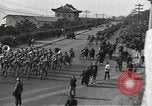
U.S. 6th Marine Division marching into Tsingtao, China, after Japan's surrender ending World War II
Following the Japanese surrender, ending World War 2, on September 2, 1945, U.S. Marines were sent into China to help the Nationalist Chinese Government with the surrender of Japanese forces occupying parts of China. This film shows Marines of the 6th Marine Division marching into Tsingtao (aka Qingdao) China on that mission. Headed by a brass band, they march along an avenue in the city. A number of Chinese civilians walk alongside them. A man riding an empty rickshaw, is seen on the sidewalk. A U.S. military policemen stands guard along the line of march. Some Chinese enter the roadway to follow the band, walking, riding bicycles, and several on a horse-drawn wagon. They have to move aside to avoid interfering with the first contingent of marching Marines following the band. Next a squad of Marines is seen marching onto a dirt field. Many Marines are assembled in another field across the road in the background, where a U.S. M4 Sherman tank and other armor are also seen. The squad is followed by a larger group of Marines. Shift in scene shows Marines marching past a building displaying the Nationalist Chinese (Republic of China) flag.
Air-Sea rescue and accident during World War II in the Pacific Theater of operations
Celebes, Netherlands East Indies (NEI). Air-Sea Rescue June 11, 1945. View from low flying aircraft of a 13th Air Force B-24 ditched in Japanese-controlled waters off the coast of Celebes, NEI. A Catalina PBY flying boat of the Jungle Air Force's 2nd Emergency Rescue Squadron, lands and picks up the B-24 crew. However, as it takes off on the water, it founders and crashes, killing three men. An accompanying PBY lands immediately and picks up all survivors who are aboard a rubber raft. Crew members on the wing of the PBY, help survivors aboard.
Casualties loaded onto USAAF L-5B aircraft on Okinawa, Japan.
Air evacuation of Marine causualties from narrow road, near Itomen, Okinawa in 1945 during World War 2. A Stinson L-5B Sentinel ambulance aircraft of the 163rd Liaison Squadron lands and rolls past a flagman and waiting Marine with arm wound. View of the wounded Marine inside the airplane. View of L-5B taking off and in flight. Wounded Marine on stretcher being loaded on an L-5B and another being taken, on a stretcher, from an ambulance and loaded on an L-5B.
Destroyed B-29, its parts and scattered debris viewed the day after it crashed on Tinian in the Northern Marianas Islands.
Remains of United States Army Air Forces B-29A Super fortress that crashed on March 30, 1945, at North Field, Tinian,in the Northern Mariana Islands, during World War 2. Scattered debris on ground. Remaining piece of tail section displays serial number 265283 indicating it is B-29 number 42-65283, nicknamed "Big Wheel," from the 9th Bomb Group, 99th Bomb Squadron. Reportedly, it experienced mechanical problems during a mission to drop mines in Japanese waters. After jettisoning its munitions, it returned to Tinian, but crashed on the shore. Of the 12 crew, only the radar operator survived.
CRITICALPAST.COM: About Us | Contact Us | FAQs - How to Order | License Agreement | My Account | My Lightboxes | Shopping Cart | Advanced Search | Featured Collections | Website Terms & Conditions | Privacy Policy ©2026 CriticalPast LLC.
License Agreement |
Terms & Conditions |
Privacy Policy
©2026 CriticalPast LLC.