


 Francais
 Deutsch
 Italiano
Refine Your Search
Hoboken New Jersey 1918 stock footage and images
- Showing 7441 to 7446 of 9472 results more
more Hide
Hide
Resident-General of Morocco, General Alphonse Juin, arrives in Casablanca aboard French Cruiser Georges Leygues
View of French Cruiser ship Georges Leygues in harbor of Casablanca, Morocco. A launch carries new Resident-General Alphonse Juin to the shore, where he is greeted by honor guard of French sailors. He greets a civilian woman and man dressed in formal attire and samples food proffered by Moroccans. General Juin then rides along a road in an open automobile, accompanied by Moroccan troops on horseback, while spectators watch and applaud from the roadside. Accompanied by French officers in white uniforms, he participates in a wreath laying at the Monument commemorating Moroccan units that served with the French during World War I. (The monument, by sculptor Landowski, erected in 1924, depicts a French Poilu and a Moroccan Spahi, both on horseback, shaking hands.) The General's car and entourage then proceed to the courtyard of the Royal Palace, where General Juin is escorted by Moroccan officials, while a Moroccan military band plays. He enters the Palace and has an audience with the Sultan of Morocco. A Short, unrelated scene at the end of the clip shows Crown Prince Amir Saud of Saudi Arabia, and two members of his royal party, stepping from a car, and entering a building during a 1947 visit to the United States.
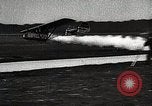
First practical attempts to use rockets for propulsion.
The German Ente (duck), world’s first rocket-powered airplane. Designed by Alexander Lippisch as a sailplane, it was purchased by Fritz von Opel who equipped it with rockets. It is seen with Opel painted on its fuselage, in its first rocket-powered flight on June 11, 1928 (flown by Fritz Stamer). In a slate, Adolf Hitler is quoted to the effect that : One cannot achieve what one cannot first imagine. A slate refers to the inadquate resources and consequent difficulties of early experimenters. Men help Prince Michalikais, with his "invention", in New York, where he attempts to propel himself with rockets while on ice skates. He wears a board on his back equipped with rockets. On first attempt, the rockets burn without propelling him and associates throw snow on his back to extinguish any fire. On next attempt, rockets fire but he loses his balance and falls.
German engineer, Reinhold Tilling, conducts the first successful mail-rocket flight, on Dümmersee near Osnabrück,Germany
Men carefully move a Tiling mail rocket from a boat on a canal, handing it up to others on shore. Row boats are seen in the canal and sailboats on the lake (Dümmersee) in the background. The rocket is carefully carried with fins folded and placed on the ground. Reinhold Tiling with his assistant Angela Buddenboehmer, and his mechanic Friedrich Kuhr, prepare the rocket for launch. View of rocket, being held,sitting on its nose. In next scene, the rocket is placed on its launch pole,in the marsh, behind a man sitting in a boat.The launch team raises the rocket. In next scene,viewed at a safe distance, the rocket emits smoke, rises rapidly, and slowly turns toward the lake (Dümmersee). Next, the rocket is seen on the surface of the lake with its wings open, as the team, standing in a boat, recovers it. A completely new sequence begins on Sunday, August 21, 1932,with more rocket launches at Atterheide-Osnabrück. Several Tiling rockets are seen laid out on the ground, with their wings opened. Closeup of a single rocket. Still photographs of show a rocket early in launch and another of rocket curving away later in the flight.
Liquid rocket research and development, led by Robert H. Goddard, in America
Robert H. Goddard with the first flight of a liquid fuel rocket on March 16, 1926, in Auburn, Massachussets. He stands next to the rocket perched high on a launching frame. Goddard uses a long pole and can of benzene to fuel the rocket. Photogaph of his camera and barograph used on July 17, 1929. An 18 meter tower being prepared. A 6 meter high test stand. The barrel could be filled with water and serve as ballast. Picture of a Performance recording device. A man in a protective bunker 15 meters from the launch point for tests in New Mexico. A man using a telescope to observe from a shed 900 meters from the launch point. Another with a telescope and recording device on a tripod. Pictures from the first gyro-controlled rocket flight on April 19, 1932
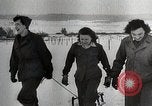
U.S. 26th "Yankee" Infantry Division celebrates Thanksgiving, 1944, during World War II.
Thanksgiving 1944 in Northeastern France, with the U.S. 26th Infantry Division, during World War 2. Several U.S. Army women nurses walk through muddy snow covered field in Northeastern France, during World War II. One of them pulls a small sled. At the same time,US troops march along sides of a nearby road. A U.S. soldier is issued a winter coat by a quartermaster.Other soldiers putting on new overcoats. U.S. troops in overcoats march along a wet road. A soldier holds up a sign reading," 26 'Yankee' Infantry Division, HAPPY- THANKSGIVING !, Europe 1944." The troops huddle over field cook stoves in a field. They smoke cigarettes. Large group of U.S. soldiers in a chow line near a cemetery in a French town (probably Dieuze, which they captured on November 20th). They receive a Thanksgiving dinner. Soldiers playing football on a snow covered field.

Director Streibert speaks on the purposes of the USIA and Soviet influence; scenes from a Soviet anti-American propaganda film
Theodore Cuyler Streibert , Director of the U.S. Information Agency, speaks on the purposes of the Agency (USIS). The Director seated at a table. He states that there is much misunderstanding about the United States, throughout the world, and Communist entities wish to take advantage of this to spread misinformation about the U.S. As the leading world power for peace, he says the U.S. must tell the world the truth about America. This is the mission of the USIA. A map portrays Soviet dominated areas within the so-called "iron curtain,"encompassing 800 million people. Another map illustrates targets of Communist propaganda employed to facilitate North Korea's aggression against South Korea. A graph illustrates propaganda spending by the Soviet Union and Communist China, primarily to spread misinformation about America. Segments of a Soviet propaganda film about the U.S. are shown. It begins with a map of the U.S. and then shows the Statue of Liberty. Camera pans over Manhattan, showing skyscrapers. A narrator disparages American commercialism, materialism and sensationalism. A lion is seen sitting in a convertible car, looking over a young woman's head. Next are scenes of an American beauty contest, and of women performing precision water skiing. Then an airplane is seen crashing on landing and a car is seen burning. View from trolley car moving along Broadway, from Times Square, in Manhattan, New York City, at night. A follies-style Broadway show. Show girls in bathing suits, walking past the camera. Show girls performing on stage. Another nighttime view of Times Square. Dogs being manicured by groomers. Outdoor soup kitchen scene from the Great Depression in the 1930s with unemployed men receiving food. Hobos or homeless men at a railroad siding. Milk and grain being spilled from containers during a labor and pricing dispute. Scenes of slum area tenement houses with wash drying on lines strung between the buildings. Men playing bocce ball in the yard of an apartment house. Camera pans up the Empire State Building from street level view. African American drummer with other band musicians performing in a civilian band, and scenes of African American musicians in a U.S. Army band. Poor African Americans in the South, at home and doing wash outdoors. Mounted police maintaining order in scenes of a fire and public protest or labor strife (circa 1935) interposed with views of the Statue of Liberty. A Soviet propaganda poster about the Korean War, shows an American soldier walking away from a dead Korean woman whose small child clings to her. Fires burn and a burning airplane falls from the sky in the background. A propaganda cartoon shows "warmongers of the west" being counterbalanced by a Soviet fist on a pair of scales.
CRITICALPAST.COM: About Us | Contact Us | FAQs - How to Order | License Agreement | My Account | My Lightboxes | Shopping Cart | Advanced Search | Featured Collections | Website Terms & Conditions | Privacy Policy ©2026 CriticalPast LLC.
License Agreement |
Terms & Conditions |
Privacy Policy
©2026 CriticalPast LLC.