


 Francais
 Deutsch
 Italiano

Refine Your Search
Hoboken New Jersey 1918 stock footage and images
- Showing 775 to 780 of 9492 results more
 Hide
Color Sound
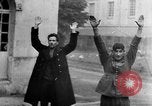
German troops advance through a village in France.
French prisoners stand raising their hands in a town during the Battle of France. A group of French men comes out of buildings and surrenders to Germans. French prisoners line up on sidewalk during German occupation. Railroad cars in which Allies signed '11 November 1918' armistice. German Infantry advances over bridge through town in France. Soldiers advance behind tanks through a French village. Dead Frenchman on ground as troops advance on street. (World War II period).
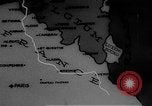
Canadian troops in action around the town of Albert, in West Flanders, Belgium during World War I
Canadian troops in West Flanders, Belgium near Ypres and Albert during World War 1. An animated map shows the region and the Somme River. Canadian troops hunkered down in grass and shrubs on a hill overlooking flat terrain. Shells exploding on horizon in background. A large contingent of Canadian troops marching downhill with left-shouldered arms. Senior officers walk out of a courtyard gate. Next, General Sir Sam Hughes, Canadian Minister of Militia and Defence, is seen shaking hands with several officers. Scene shifts, after he greets only two, and shows Canadian troops marching in platoons along a dusty road. Next, Canadian soldiers are seen moving supplies by horse-drawn wagons along a tree-lined road leading into a town. Final scenes show the war-damaged Albert Basilica. The camera pans upward, along its tower, to the Golden Virgin statue at its top, which is leaning precariously to one side, almost falling off its base. (The statue became the subject of British superstition that the war would end when the statue fell. But British artillery, itself, knocked it down while targeting the tower to prevent its use by the Germans as an observation post, during the 1918 Spring offensive)
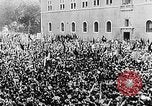
The fall of France and entry of Italy, on side of the Axis Powers, in World War II
Crowd fills the Plaza Venezia in Rome where Benito Mussolini appears on the balcony of the Piazza Venezia (formerly known as the Palace of St Mark) in Italy, on June 10, 1940. He announces that Italy has entered World War 2 on the side of the Axis powers. Views of the jubilant crowd waving Italian and some Swastika flags. Next, a road sign points to Paris and to Poissons, in France followed by view of German troops triumphantly entering Paris, through the Arc de Triomphe during occupation of France. View of the Eiffel Tower, and of a German flag flying atop it. More views of German troops marching through Paris. A German railway gun firing. (Narrator implies that the target is the Maginot Line, which is not correct. It was bypassed by the Germans, negating need to attack it directly.) Other German railway guns and siege mortars firing and many huge explosions and fires are seen, including some from flame throwers. Next, German troops are seen marching around a circle where a railroad car is parked near Compiègne, France. This rail car is the scene of Germany's surrender to France in World War I. Statue of French Marshal Foch, who had then, received the delegates of vanquished Germany here. Adolf Hitler walking past a German Honor Guard, salutes. He is accompanied by Marshal Hermann Goering and other high ranking military persons. The nearby 1918 "Alsace-Lorraine monument" is covered by a German flag. The German delegation headed by Hitler and Goering, enter the rail car and take their places. Outside, the French delegation, headed by General Charles Huntziger, is escorted by German officers. They enter the car and he German delegation stands. Both delegations exchange salutes. Next, Hitler is seen stepping from the rail car, followed by Goering. The German delegation walks past the honor guard, and Hitler salutes them. German and French officials still in the rail car exchange salutes. Hitler expresses jubilation.
An anti-aircraft gun used in World War I and a gun crew fires a 105 mm anti-aircraft gun in Maryland.
United States anti-aircraft guns used in Maryland during World War I. The guns are manned by 61st C.A.C. (Coastal Artillery Corps). An anti-aircraft gun which was used in the defense of Paris in 1918. Various views of the gun. A 105mm anti-aircraft gun with muzzle velocity 3000ft. and vertical range of 7 miles. The gun crew fires the gun.
Mining and transportation of iron ore to a steel plant in Italy; Coke manufacture in WWI
'Italian munitions 1914-1918 ' Men mine iron ore at a hilly region in Italy during World War 1. Iron ore transported in trolleys and then shipped. Trolleys carrying iron ore unloaded at a port in Italy and placed on trailers with a crane. Coking ovens are emptied and blast furnace charged with the ore and coke. Furnace is tapped and molten steel poured giving a fiery flare.

American military recruits for World War I undergo psychological tests in United States.
Draft and mobilization activities for U.S. Army soldiers of World War 1 in 1917-1918. American military recruits undergo psychological and mental acuity tests to determine their intelligence and ability to serve as soldiers. They undergo attention and observation tests. Figures drawn on a board as an instructor guides them, and Army recruits write on papers. Recruits must rapidly pick up their pencils on cue in a test of alertness. Rejected recruits discharged with payment and a discharge letter. The discharged soldiers stand in line at pay window. Close-up view of U.S. Army honorable discharge certificate. Slates indicate that most soldiers participated in the life insurance plan that was offered. Scene of soldiers seated at tables as they write letters home.
CRITICALPAST.COM: About Us | Contact Us | FAQs - How to Order | License Agreement | My Account | My Lightboxes | Shopping Cart | Advanced Search | Featured Collections | Website Terms & Conditions | Privacy Policy ©2026 CriticalPast LLC.
License Agreement |
Terms & Conditions |
Privacy Policy
©2026 CriticalPast LLC.