


 Francais
 Deutsch
 Italiano
Refine Your Search
Hoboken New Jersey 1918 stock footage and images
- Showing 793 to 798 of 9472 results more
more Hide
Hide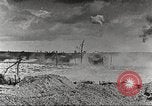
Extract from British feature film "The Somme," made in 1927, depicting warfare on the Western Front during WWI.
Reenactment of scenes from 1916 in World War 1, filmed in 1927 in Southwest England. Two British Mk V Tanks advance through shellfire. One has its gun mountings plated over and has dummy guns; the other has its gun mounts intact, though the guns might be dummies, and carries anti-grenade mesh on its roof. (These are by historical errors by the film makers, since this type of anti-grenade protection was not carried on Mark V [Mark 5] tanks, and the Mark V did not enter service until 1918.) The tank advances towards enemy trenches, followed by British soldiers who pursue German soldiers fleeing along the network of trenches. The tank, filmed from below, in the trench, as it moves over the trench. Note: (The film "The Somme" can be seen in full on the British Film Institute website.)
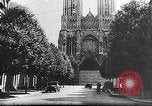
German forces advance in France in WW2; scenes of World War I monuments; Germans take Versailles in World War 2.
German occupation of France during World War 2. The cathedral in Reims, France. Vehicles and a few men on a road in front of the church. Trees lining the road. The railway car in which an armistice agreement was signed by Germany and the Allies at end of World War 1. The Memorial Tablet symbolic of the 1918 armistice, the Alsace-Lorraine, and Ferdinand Foch's Memorial in Compiegne Forest. Ferdinand Foch's carriage in which the first armistice was signed. In 1940 : German troops cross River Marne in rafts. A signboard showing the distances to Paris and Soissons. Another signboard showing the distances to Grand Fitz James and Paris. Troops on tanks moving on roads. A signboard shows distances to Pontarme and Paris. A soldier with a gun on his back. Soldiers moving with carriages on a path between fields. Trees lining the path. German troops moving on tanks advancing deeper into France. The troops on the road in front of the castle in Versailles. The German flag hoisted on a flag pole over the Palace of Versailles and German soldiers occupy the Palace of Versailles.
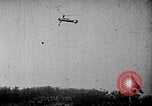
Kellett KD-1 autogiro hovers above U.S. troops on maneuvers, moving on horse drawn vehicles in the United States.
Kellett KD-1 autogyro (rotary wing aircraft) in flight over U.S. Army maneuvers in the United States. Mounted troops and a horse drawn caisson move across open terrain. Troops in 1918-style uniforms move on horse drawn vehicles. Kellett autogiro in flight. View of military maneuvers. Troops load and fire French 75 artillery pieces. Shells burst in area near damaged farm building.
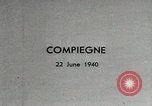
Germany concludes armistice with France in Compiegne, France during World War II.
The Armistice at Compiegne, France on 22nd June, 1940 between France and Germany during World War II. German officers including General William Keitel, accompany Chancellor Adolf Hitler as they walk past a German honor guard lined up, while a band plays the German National Anthem. French General Charles Huntziger and another officer arrive and enter a railway carriage (the same one in which Germany signed the 1918 armistice). Interiors of carriage showing French General Huntziger signing the documents. Adolf Hitler has left and is chatting with German officers outside. General Keitel presents the document to Hitler for countersigning. Hitler asks for a pen, and they drop it as Keitel hands it to Hitler. Keitel quickly retrieves it and Hitler signs. French General Huntziger steps down from the rail car and is escorted away with others of his party. Hitler expresses pure delight in chatting with members of his staff.
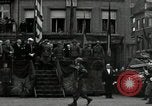
U.S. troops of 2nd Armored Division parade in Belgian town of Hasselt, during World War II
Troops of the 82nd Reconnaissance Battalion, U.S. 2nd Armored Division, pass in review before their Commanding General, Brigadier General Isaac White, who stands on a stage with Belgian officials, in the town of Hasselt, Belgium during World War 2. The troops are led by the 66th Armored Regiment military band. A contingent of the marchers carries numerous American flags. Civilian spectators line the sidewalks, and Belgian officials in formal dress with medals, watch the parade which ends at a World War I memorial monument in the square. General White carries wreath of flowers and places them at the foot of the memorial, which is inscribed: "1914 - 1918." The U.S. troops parade from the scene. Group of children applaud. Camera focuses on young woman, in crowd, smiling and applauding. View of flag bearing inscription: "Hasselt Liberators."
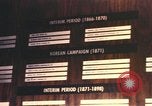
Hall of Heroes at the Pentagon showing hero names from Korean Campaign to the Vietnam War
View of the Hall of Heroes at the Pentagon, in the United States, during the Vietnam War. Names of the war heroes in the hall. Nameplates of the war heroes of each historical conflict on the wall. Names of the soldiers and officers who served the best in the wars. Names under the nameplates reading: 'Interim Period (1866-1870)', 'Korean Campaign (1871)', 'Interim Period (1871-1898)'. Other nameplates read: 'War with Spain (1898)', 'Philippine insurrection (1899-1913)', 'China Relief Expedition-Boxer Rebellion (1900)'. Several other conflicts mentioned in the hall. Other nameplates read: 'World War I (1917-1918)', 'Haitian Campaign (1919-1920), 'Second Nicaraguan Campaign (1925)', 'Word War II (1941-1945) and 'Vietnam (1964-Present).
CRITICALPAST.COM: About Us | Contact Us | FAQs - How to Order | License Agreement | My Account | My Lightboxes | Shopping Cart | Advanced Search | Featured Collections | Website Terms & Conditions | Privacy Policy ©2026 CriticalPast LLC.
License Agreement |
Terms & Conditions |
Privacy Policy
©2026 CriticalPast LLC.