


 Francais
 Deutsch
 Italiano
Refine Your Search
John-F.-Kennedy stock footage and images
- Showing 73 to 78 of 3762 results more
more Hide
Hide
John F Kennedy and First Lady welcome former President of the U.S. Truman and his wife at White House, Washington D.C.
Former President of the U.S. Harry S. Truman visits White House in Washington D.C., United States. The White House building. Truman and Bess Truman get off from a car. U.S. President John F. Kennedy and First Lady Jacqueline Kennedy welcome them. The White House staff greets them. Truman's daughter Margaret Truman meets her father former President of the U.S. Mrs. Kennedy escorts Mrs. Truman. Kennedy, Truman, First Lady and Mrs Truman stand together and the White House staff in the background.
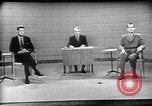
Senator John F. Kennedy and Vice President Richard Nixon face off in their first Presidential debate, in Chicago Illinois.
The first Kennedy-Nixon Presidential Debate in Chicago, Illinois. Moderator Howard K. Smith introduces the candidates-- Republican candidate U.S. Vice President Richard M. Nixon and Democratic candidate Senator John F. Kennedy. He talks about the opening and the closing statements to be given by the candidates. He talks about the questions which the panel of correspondents would ask the candidates. Senator Kennedy begins his statement. Kennedy talks about the direction of freedom for the Americans. He discusses domestic issues and the kind of society people live in. He talks about the strengths and the progress rate of the Americans. He urges people to make their country more powerful in every field. He feels disappointed about the unused steel-mill capacity, low rate of economic growth and poor educational system. He says he's not satisfied when he sees men like Jimmy Hoffa in charge of the largest union in the United States, and still free. He insists on overall infrastructural development and improvement of hydro power production where he says the Soviet Union has a lead. He states that every American should enjoy his full constitutional rights and they should meet their responsibilities. He says African American and Puerto Rican babies have much lower chances in education, work ,and advancement in the United States, and that this needs to change. He states that the government should provide effective programs and social security system for its citizens.
Senator John F Kennedy answers a panel of correspondents during a presidential election debate in Chicago, Illinois.
The first Kennedy-Nixon Presidential Debate in Chicago, Illinois. Moderator Howard K. Smith thanks Republican candidate U.S. Vice President Richard M. Nixon and Democratic candidate Senator John F. Kennedy for their opening statements. The Moderator the panel of correspondents: Sander Vanocur from NBC News, Charles Warren from Mutual News, Stuart Novins from CBS News and Bob Fleming from ABC News. Mr Fleming directs his first question to Senator Kennedy. He asks him why does he think that people should vote for him rather than Vice President Nixon. Kennedy answers and tells about his 14 years of experience in the Labor Committee. He compares the programs being advocated by the Democratic party and the Republican party. He states that the Republican leadership has opposed federal aid for education, medical care for the aged and development of country's natural resources in the past few years.
Richard M. Nixon and John F Kennedy give their summation speeches during a presidential election debate in Chicago, Illinois.
The First Kennedy-Nixon Presidential Debate in Chicago, Illinois. Moderator Howard K Smith asks the candidates to give their summation speeches. Republican candidate U.S. Vice President Richard M. Nixon starts his summation speech and compares the progress of the Soviet Union with that of the United States. And he states that in terms of the Gross National Product (GNP), the U.S. is far ahead of the Soviet Union. He compares his proposals with that of Kennedy and states that his own proposals would result in greater growth. He compares his health program which provides a choice of having either government insurance or private insurance with that of Kennedy's health program with compulsory government health insurance under Social Security. He talks about the spendings and inflation during Truman Administration. He concludes his speech and states that U.S. President's should work for every program that would mean growth. Democratic candidate Senator John F Kennedy comments on the statement given by Nixon regarding comparison of the Soviet Union and American economy. He speaks in favor of his proposed health program for aged which was an amendment to the Kerr bill and which provides assistance to all those who were not on Social Security. He thus contrasts Nixon's point on health program for the aged. He concludes his speech and speaks about the goals and responsibilities of the Americans. Moderator Smith thanks the candidates.
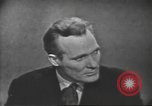
John F Kennedy and Richard Nixon comment on need for labor laws during a presidential election debate in the U.S.
The third Kennedy-Nixon Presidential Debate in the United States. Frank McGee from NBC News asks Republican candidate U.S. Vice President Richard M Nixon to comment on the need and purpose of new laws to protect the public against labor unions' power. Nixon talks about his speech on this topic. He disagrees with Kennedy's statement favoring compulsory arbitration as a President's weapon to stop national emergency strike. He states that in Steelworkers Union speech Kennedy had indicated government seizure as the best way to stop a strike. Nixon states that he does not believe in either compulsory arbitration nor seizure. He says that the management should be involved in dispute settlement. He concludes and urges the need for the greatest cooperation possible between labor and management. Democratic candidate Senator John F Kennedy states that he has never suggested compulsory arbitration as the solution of national emergency disputes. He talks about seizure. He states about president's course and setting up of a fact-finding committee.
Air Force One, carrying President John F. Kennedy and party, arrives at Naval Air Station Quonset Point, Rhode Island.
U.S. Marine Honor Guard in dress uniform stands at attention on the ramp at Naval Air Station Quonset Point, Rhode Island, anticipating the arrival of President John F. Kennedy, and his party. They decide to reposition themselves, and march, at 'trail arms,' toward the camera. Many sailors and other naval personnel and families have turned out to see the President. They are lined up behind a rope across the ramp. Some children are seated on the ground. Camera focuses on some with closeups. Several members of a greeting party stand near steps positioned for placement against Air Force One, when it arrives. Governor John A. Notte, Jr. of Rhode Island strolls across the ramp to where State Rhode Island State Trooper, Robert F. Washburn Jr.(wearing number 18 on his uniform) and others, are standing around a table holding a large silver punch bowl. Trooper Washburn holds a matching silver goblet. A phalanx of photographers stands ready for the arrival. The presidential aircraft lands (It is Douglas VC-118A, serial number 53-3240). White smoke is seen off to the side, as the United States president's arrival is greeted with cannon salute.
CRITICALPAST.COM: About Us | Contact Us | FAQs - How to Order | License Agreement | My Account | My Lightboxes | Shopping Cart | Advanced Search | Featured Collections | Website Terms & Conditions | Privacy Policy ©2026 CriticalPast LLC.
License Agreement |
Terms & Conditions |
Privacy Policy
©2026 CriticalPast LLC.