


 Francais
 Deutsch
 Italiano

Refine Your Search
John-F.-Kennedy stock footage and images
- Showing 289 to 294 of 3762 results more
 Hide

President Kennedy visits a government sponsored low cost housing project and attends Mass service during his visit to Mexico.
President John F. Kennedy visits Mexico. The President of the United States John Fitzgerald Kennedy moves in a motorcade through the streets followed by a ticker tape parade. Civilians lined up on either side of the street cheer. They hold banners. A luncheon is organized in honor of President Kennedy. The President addresses a gathering. Dignitaries raise a toast. He visits the site of a government sponsored low cost housing project. Residents shake hands with the President. American and Mexican flags flutter in wind from a building. Portraits of Kennedy and Mexican President Adolfo Lopez Mateos placed on buildings. President Kennedy meets Mexican officials during a table conference. They discuss new measures to reduce contamination in the Colorado River. He visits tombs of Mexican Heroes. An archbishop prays for the success of the President's visit during a Mass service. President Kennedy get in a car and heads for an airport.
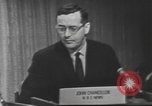
Vice President Nixon and Senator Kennedy debate in the United States over nuclear tests resumed by the Soviet Union.
The fourth presidential election debate held between Democratic nominee Senator John F. Kennedy and Republican nominee U.S. Vice President Richard Nixon in in New York, United States on 21st October 1960. NBC News correspondent John Chancellor asks a question to Senator Kennedy in relation with U.S. relations with the Soviet Union. Correspondent Chancellor asks if Russians have resumed testing of nuclear devices as per news from Atomic Energy Commission of Washington and if the U.S. would resume its own nuclear weapon testing in 1961. Senator Kennedy replies to the question and says that the next President of the United States should make one last effort to secure an agreement on the cessation of nuclear bomb tests. He mentions the Conference for the Reduction and Limitation of Armaments from 1932-1934 held in Geneva, Switzerland. Kennedy says that he believes the effort should be made once more by who so ever is elected the President of the United States. Senator Kennedy says that if they fail in making the effort, the responsibility will be clearly on the Russians and then they'll have to meet their responsibilities for the security of the United States, and they may have to test underground. He says that there may be testing in outer space. Senator Kennedy says that he is most concerned about the whole problem of the spread of atomic weapons. ABC News correspondent Quincy Howe asks the Vice President to comment. Vice President Nixon says that the Soviet Union is filibustering. He says further that the elected president should immediately make a time table to break Soviet filibustering.
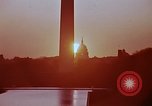
Excerpt from Kennedy inauguration speech; women kneeling in front of eternal flame at John Kennedy's grave.
The Washington Monument at sunset. The Capitol dome in the background. 35th President of the United States John F. Kennedy giving Inaugural speech, including line "Ask not what your country can do for you. Ask what you can do for your country. My fellow citizens of the world, ask not what America will do for you, but what together we can do for the freedom of man." Eternal flame at Kennedy grave. Two women at grave site. Two women kneeling and one makes sign of cross. A close up flame. Inscription on the grave. The Washington Monument.
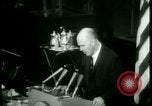
The shooting of President John Kennedy in Dallas, Texas is announced to a gathering at the Dallas Trade Mart.
A man stands at a lectern bearing the Presidential seal and announces the news of the John F. Kennedy shooting at the Dallas Trade Mart gathering, saying "The motorcade has been shot." He says "we will tell you as much as we know, as soon as we know anything." Another man comes to the microphone to lead a prayer. All present stand up and pray. People depart after the prayer. (President Kennedy had been scheduled to speak at a luncheon at the Trade Mart at 12:15pm that day. He was en route to the Trade Mart when he was assassinated.)

Irish Army Cadets performing 'Rifle drill' ceremony as a part of funeral services for President John Kennedy.
Funeral of President John F. Kennedy. View of U.S. Military units of Navy, Army, Air Force, Marines and Coast Guard at Arlington National Cemetery. Dignitaries and mourners arrive. Flag-draped casket is placed on open grave by pallbearers. Irish Army Guard, drawn from the 37th Cadet Class of the Irish Army, performs 'Rifle drill' ceremony as Honor Guard holds stretched flag over grave. (They were invited by Mrs. Kennedy, as JFK had been impressed by the cadets during his recent visit to his ancestral home. ) After the drill they march away from the graveside. Dignitaries and mourners move in closer. Richard Cardinal Cushing reciting prayer at the grave.
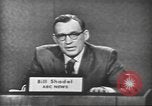
John Kennedy and Nixon talk about steps to improve U.S. economic growth during a presidential election debate in the U.S.
The third Kennedy-Nixon Presidential Debate in the United States. Roscoe Drummond of New York Herald Tribune asks Republican candidate U.S. Vice President Richard M Nixon to comment on declining economic growth and what steps he would take to improve it. Nixon answers that he is not satisfied with the economic growth of the U.S. He compares the nation's growth rate during the Truman Administration and the Eisenhower Administration. He urges for the development of private enterprise sector of the economy. He talks about his program of tax reform which would stimulate more investment in U.S. economy. He talks about the upliftment of the distressed areas and full utilization of resources of those areas. He talks about the adequate use of talents of the Americans and their civil rights. He concludes and states that there has been a continuous development of American economy in the past years. Democratic candidate Senator John F Kennedy states that Nixon has pointed a rise in food prices in his proposed agricultural program which is not true. He comments on the statement given by Nixon on aiding distressed areas and education. He says that the bills of these program have been opposed by the administration. He talks about the lowest rate of economic growth during this administration.
CRITICALPAST.COM: About Us | Contact Us | FAQs - How to Order | License Agreement | My Account | My Lightboxes | Shopping Cart | Advanced Search | Featured Collections | Website Terms & Conditions | Privacy Policy ©2026 CriticalPast LLC.
License Agreement |
Terms & Conditions |
Privacy Policy
©2026 CriticalPast LLC.