


 Francais
 Deutsch
 Italiano

Refine Your Search
John-F.-Kennedy stock footage and images
- Showing 295 to 300 of 3762 results more
 Hide
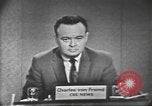
The third presidential election debate between Senator John Kennedy and U.S. Vice President Nixon in the United States.
The third presidential election debate held between Democratic nominee Senator John F. Kennedy and Republican nominee U.S. Vice President Richard Nixon in the United States. ABC news correspondent Von Fremd questions Vice President Richard Nixon about exodus of four billion dollars of gold in past three years from the United States. Vice President Nixon responds stating that there should be balanced budget in the country and increase in exports from the United States. He further says that the U.S. must support programs abroad for economic and military assistance. Senator Kennedy speaks about oil depletion. He further talks about gold. He says that United States have to maintain balance of trade, sound monetary and fiscal policy and control over inflation.
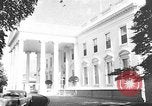
U.S. President Kennedy talks about respecting African American citizens and giving them equal rights during a speech on Alabama in Washington DC.
U.S. President John F. Kennedy's speech on Alabama in Washington DC. The White House. United States President John Kennedy seated at a desk and speaks over a microphone. The President speaks about the discrimination of blacks by whites in the United States. He talks about the University of Alabama not giving admission to two clearly qualified young Alabama residents (James Hood and Vivian Malone) who happened to have been born African Americans. President Kennedy says that the nation is founded on the principle that all men are created equal, and that the rights of every man are diminished when the rights of one man are threatened. The President says that it is possible for the American consumers of any color to receive equal service in places of public accommodation, to register and to vote in a free election without interference or fear of reprisal. President Kennedy talks about respecting African Americans and all Americans and urges people not to discriminate and to uphold civil rights. He says that no city or State or legislative body can prudently choose to ignore them.
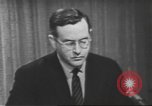
Vice President Nixon and Senator Kennedy debate over Quemoy and Matsu issue prior to presidential elections in the U.S.
The fourth presidential election debate held between Democratic nominee Senator John F. Kennedy and Republican nominee U.S. Vice President Richard Nixon in New York, United States on 21st October 1960. ABC News correspondent Quincy Howe speaks during the debate and allows NBC correspondent John Chancellor to pose a question to Richard Nixon a . Correspondent Chancellor asks a question about Quemoy and Matsu issue. Vice President Nixon points out inconsistency of Senator Kennedy. He further explains it by saying that Senator Kennedy signed a resolution in 1955 which gave the president the power to use United States forces to defend Formosa (Taiwan) and offshore islands. But he also voted for an amendment which was lost, an amendment which would have drawn a line and left out those islands. Vice President Nixon supports President Eisenhower's position. Correspondent Howe asks Senator Kennedy to comment on the topic. He speaks about President Eisenhower sending a mission to persuade Chiang Kai-shek in the spring of 1955 to withdraw from Quemoy and Matsu because they were exposed. The President was unsuccessful. He refers to the fact that in 1958, as a member of the Senate Foreign Relations Committee, he was very familiar with the position that the United States took in negotiating with Communist China (PRC) on these two islands. He further that the U.S. was unable to persuade China's Chiang Kai-Shek to withdraw and thus it was decided by the U.S. to defend the islands.
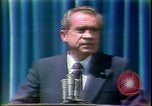
In San Clemente, California U.S. President Nixon talks about the existence of wiretaps during the Kennedy administration.
U.S. President Richard Nixon talks about the role of wiretaps in national security during a press conference in San Clemente, California. A journalist questions the President about his statement regarding the 10 additional wiretaps that could have been initiated by late U.S. Senator Robert F. Kennedy, which would have lead to the discovery of the Oswald plan and thus prevented U.S. President John F. Kennedy's assassination. The President responds that 10 more wiretaps could have found the conspiracy, if it was a conspiracy in the first place, then it would have been worth it. The President also talks about the high number of wiretaps in the National Security area during the Kennedy administration for national security purposes. The taps on news organizations, news people and civil rights leaders were all justified. The journalist then asks the President if he thought that President Kennedy's assassination threat mattered more to the national security wiretaps. The President does not agree with this and believes that the assassination was a breakdown in the President's security. He also states that he personally does not prefer to have secret service.
John and Annie Glenn with Vice President Lyndon B. Johnson as they arrive at the White House in Washington D.C.
American astronaut John Glenn being welcomed after he successfully orbited the earth in a spacecraft. John Glenn and Annie Glenn in Washington D.C. Women in coats and holding umbrellas. Two women talk and drink hot coffee. A policeman controls the crowd. Water flows on the road due to rains. Spectators stand on either side of the road. The White House in the background. The door of the White House and people stand at the side of the door. A policeman enters the White House gate. Men with camera on a podium. A television in the garden . Two officers step from their car. People stand behind the tied ropes. A car carrying the Glens and President Kennedy arrives at the White House and is met by Vice President Lyndon Johnson. John and Annie Glenn leave the car, escorted by the President and Vice President. Men take pictures. U.S. President John F. Kennedy, John and Annie Glenn and Lyndon B. Johnson walk into the White House, followed by their children, David and Carolyn,and other officials. Newsmen and television reporters broadcast live from the White House lawn.

National Aeronautics and Space Administration (NASA). Apollo 1 service module transported from Pad 34 at Kennedy Space Center
Apollo 204 review board at National Aeronautics and Space Administration (NASA). Apollo 1 service module placed on a vehicle moves along road at Kennedy Space Center in Florida. It is escorted by a pair of leading police cars with blue lights flashing. A crane and others cars follow. Men stand on the road. John F Kennedy Space Center written on a sign at the side of the road. The vehicle carrying the module moves inside a huge building. Sliding doors close behind it.
CRITICALPAST.COM: About Us | Contact Us | FAQs - How to Order | License Agreement | My Account | My Lightboxes | Shopping Cart | Advanced Search | Featured Collections | Website Terms & Conditions | Privacy Policy ©2026 CriticalPast LLC.
License Agreement |
Terms & Conditions |
Privacy Policy
©2026 CriticalPast LLC.