


 Francais
 Deutsch
 Italiano
Refine Your Search
Long Binh Vietnam 1969 stock footage and images
- Showing 721 to 726 of 5707 results more
more Hide
Hide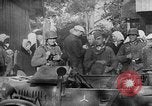
German troops are welcomed as they enter Kaunas, Lithuania , during World War Two.
German forces entering the outskirts of Kaunas, Lithuania, during their surprise offensive on the Eastern Front during World war 2. Three German soldiers stand next to a parked staff car in a town. Several local women in bonnets and babushkas stand behind them.A Panzer III tank breezes past between them and the camera. Lithuanians and ethnic Germans (Volksdeutschen) wave their hats in welcome and one gives a Nazi salute, as a Panzer I tank enters the town. Soldiers on motorcycles and another Panzer I tank follow. Soldiers ride horses pulling artillery caissons camouflaged with tree branches. Soldiers ride in them. Closeup, near the ground, of horses, their trappings and the caissons they pull. Scene shifts to soldiers loading war materiel onto flat raft ferries at a river bank. Soldiers work to load a 105mm light howitzer, model 18, onto a ferry. A ferry carrying several caissons being pushed across the river by a ferryman in a small boat using a long-shaft outboard motor. Another ferry is seen carrying horses and infantrymen. A line of soldiers walk their bicycles along a path beside the river towards a spot where several large river steamer boats are docked. Substantial buildings of old town Kaunas stand on the other side of the river. Camera pans across the cityscape, showing twin spires of the Catholic Church (Jesuit) of St. Francis Xavier and associated buildings. View from riverbank as German soldiers descend its slope and walk towards a riverboat. The arch of a suspension bridge is seen in background. Troops cross a long plank to board the riverboat. View of soldiers gathered on deck of the riverboat. The German flag and the Lithuanian flag, just beneath it, are seen flying atop a tall structure at the port. Later, as German soldiers disembark from riverboats, they are greeted by women, in what appear to be nurses uniforms, who distribute flowers to them. The soldiers proceed along a paved road beside the river. The arched suspension bridge, shown earlier,is now seen to be part of the bridge connecting Old Town with Aleksotas across the Nemunas river. It consists of several arches, but only one is standing, and the rest destroyed. The infantry on bicycles speed down an incline on the road.
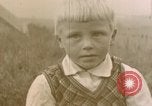
Local views of a community in coastal Norway in 1939
Filmed by Eva Braun during a visit to Norway while cruising on the M/S Milwaukee (Hamburg-Amerika Line) in July, 1939: Closeup of a Norwegian boy and girl in a farm field enclosed by a strand of barbed wire in Norway. The weather is very misty. The girl holds a puffin sea bird. she is joined by two other girls, one of whom now holds the puffin. A group Norwegian men and women walk past the field toward a town barely discernible in the mist. Closeup of a Norwegian man and woman standing at the back of their house. Two women walking along a road toward the town. Camera pans over the area, showing houses and fields. It focuses on a man leading a pony pulling a two-wheeled cart. Closeup of wash hung out to dry. the line and wash move to and fro in a breeze. Closeup of a smiling Norwegian boy. Four Norwegian boys pose in a front yard. A fifth joins briefly. Two girls and a smaller boy pose. A man poses next to a canvas covered boat (not seen under the wraps). A boy poses next to a pony.A friend comes up to steady the animal as the boy jumps on ready to ride bareback. He quickly slides back down again. One of Eva Braun's sisters pets the pony. View of local people walking toward their waterfront. Buildings on stilts at the water's edge. A fishing boat nearby. Judging by the level of the water below the buildings, the tide must be out. Camera pans across several boats and scenery at the waterfront. Eva Braun's mother, Franziska, and one of Eva's sisters, standing near a taxi cab. Camera focuses on the car. Scene shifts to a waterfront open market on a large pier, where many Norwegian people are mingling, gathered, as if waiting, near a long line of below- deck tanks from which steam is rising. The tanks are covered with concave semicircular gratings. Men with long poles tend to the contents.
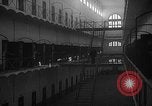
Prisoners in athletic attire leave their cells simultaneously and double-time in formation to the prison courtyard
A long gallery at a prison in Valence, Spain. Cell doors open simultaneously and prisoners in athletic attire double-time in formation down the central staircase and across a long gallery to reach the central courtyard. Prisoners lined up in a courtyard. (World War II period).
U.S. forces searching Saipan for holdout Japanese defenders in World War II
Camera follows American troops as they comb through hiding places at the end of the battle for Saipan in World War 2. Small children hiding among some boulders. Next a Japanese woman and four small children are seen seated on the ground. A U.S. soldier bandages the arm of one child. A group of American soldiers searches for Japanese soldiers near a cave. Two soldiers seen firing at a suspected Japanese enemy position. Next, they search the underbrush and retrieve a box of canned goods next to the body of a dead Japanese soldier. A dead Japanese soldier floating in a stream. U.S. infantrymen continuing their search for Japanese holdouts. One retrieves an abandoned Japanese rifle. Another holds a Japanese grenade. One GI displays a Japanese long Arisaka Type 38 rifle with a Type 30 bayonet. (The rifle is 4 feet, 2 inches long and the bayonet 20 inches, making it almost 5-feet in overall length.) Camera pans across misty landscape near the shore, with so-called "suicide cliff" in background. A woman and small girl sitting beneath a rough shelter.
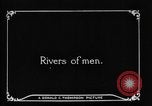
The French Army marshalling troops in World War I
French army recruitment and marshalling for World War 1. French Infantry marching casually before the camera in their field gear (sans steel helmets). They move on a path or road, proceeding under a broad arch overpass. The first two soldiers walk holding bicycles. Some soldiers wear no caps. Others wear soft caps. None wear steel helmets. They are then seen from a high place (possibly the overpass) as they proceed in a long irregular column. The sequence shifts to a unit of mounted French cavalry, passing a tent as they proceed along a path in a camp ground.They are next seen from the rear as they continue and cross a bridge over a small canal. Next seen is a very long column of French infantry, all wearing steel helmets, proceeding along a dirt road. The next sequence shows pack animals and wagons carrying supplies for the troops. In the final scene, several soldiers open and read their mail in the midst of a group of relaxing troops. One soldier clowns around with another. (Note: this film was shot by the famous war photographer Donald C. Thompson.)
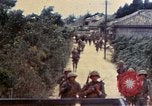
U.S. Marines of 'F' Company, 2nd Battalion 22nd Regiment come through village hunts in Okinawa.
U.S. Marines of 'F' Company, 2nd Battalion 22nd Regiment advance through a town in Okinawa. Marines in two long files come through village huts in background. Long line of Marines at different intervals, march down a winding road. All Marines in combat gear with weapons slung over shoulders. 30 caliber machine gun crew behind a stone wall. Grassy terrain in background.
CRITICALPAST.COM: About Us | Contact Us | FAQs - How to Order | License Agreement | My Account | My Lightboxes | Shopping Cart | Advanced Search | Featured Collections | Website Terms & Conditions | Privacy Policy ©2026 CriticalPast LLC.
License Agreement |
Terms & Conditions |
Privacy Policy
©2026 CriticalPast LLC.