


 Francais
 Deutsch
 Italiano
Refine Your Search
M4-training stock footage and images
- Showing 7207 to 7212 of 8218 results more
more Hide
Hide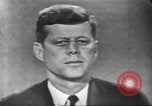
Kennedy and Nixon talk about racial prejudice in the presidential campaign during a presidential election debate in the U.S.
The third Kennedy-Nixon Presidential Debate in the United States. Roscoe Drummond of New York Herald Tribune asks Democratic candidate Senator John F Kennedy to comment on the purpose of the secret domestic militant organization Ku Klux Klan (KKK) in the presidential campaigns. Kennedy answers that the head of the Ku Klux Klan in a statement stated that he would vote for Nixon and not him. Kennedy states that he has never suggested that Nixon has slightest sympathy and involvement with the Ku Klux Klan. Republican candidate U.S. Vice President Richard M Nixon states that it is the Americans who will choose the President. He states that elections are not any test of religion, race but test of a man. He states that Communism is the enemy of all religions and he opposes the Klan organization. He concludes, early in the civil rights movement, that if civilians believe in America they cannot have religious or racial prejudice in the presidential campaign.
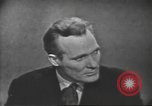
John F Kennedy and Richard Nixon comment on need for labor laws during a presidential election debate in the U.S.
The third Kennedy-Nixon Presidential Debate in the United States. Frank McGee from NBC News asks Republican candidate U.S. Vice President Richard M Nixon to comment on the need and purpose of new laws to protect the public against labor unions' power. Nixon talks about his speech on this topic. He disagrees with Kennedy's statement favoring compulsory arbitration as a President's weapon to stop national emergency strike. He states that in Steelworkers Union speech Kennedy had indicated government seizure as the best way to stop a strike. Nixon states that he does not believe in either compulsory arbitration nor seizure. He says that the management should be involved in dispute settlement. He concludes and urges the need for the greatest cooperation possible between labor and management. Democratic candidate Senator John F Kennedy states that he has never suggested compulsory arbitration as the solution of national emergency disputes. He talks about seizure. He states about president's course and setting up of a fact-finding committee.
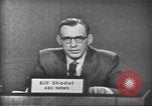
John F Kennedy and Richard Nixon contrast costs of their party platforms during a presidential election debate in the U.S.
The third Kennedy-Nixon Presidential Debate in the United States. Douglass Cater of Reporter magazine asks Democratic candidate Senator John F Kennedy to comment on costing of party platforms calculated by U.S. Vice President Nixon. Kennedy states that he believes in a balanced budget and an unbalanced budget is warranted during a recession or a national emergency. He comments on the cost of his budget and compares it with that of Nixon. He talks about high interest-rate policy that has added huge amounts to interest on debt. He talks about a different monetary policy to reduce the interest-rate burden. He talks about the bill passed by the Congress for the medical care for the aged. He says that more money would be spend on aid to education, housing and defense in his programs. Republican candidate U.S. Vice President Richard M Nixon comments on Kennedy's medical care for aged program under social security. He talks about the cost of his agricultural program and points out resulting rise in food prices. He concludes and states that following Kennedy's program would lead to inflation.
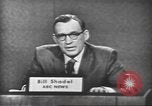
John Kennedy and Nixon talk about steps to improve U.S. economic growth during a presidential election debate in the U.S.
The third Kennedy-Nixon Presidential Debate in the United States. Roscoe Drummond of New York Herald Tribune asks Republican candidate U.S. Vice President Richard M Nixon to comment on declining economic growth and what steps he would take to improve it. Nixon answers that he is not satisfied with the economic growth of the U.S. He compares the nation's growth rate during the Truman Administration and the Eisenhower Administration. He urges for the development of private enterprise sector of the economy. He talks about his program of tax reform which would stimulate more investment in U.S. economy. He talks about the upliftment of the distressed areas and full utilization of resources of those areas. He talks about the adequate use of talents of the Americans and their civil rights. He concludes and states that there has been a continuous development of American economy in the past years. Democratic candidate Senator John F Kennedy states that Nixon has pointed a rise in food prices in his proposed agricultural program which is not true. He comments on the statement given by Nixon on aiding distressed areas and education. He says that the bills of these program have been opposed by the administration. He talks about the lowest rate of economic growth during this administration.
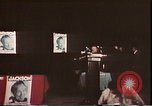
U.S. Senator Henry Jackson delivers a speech during the presidential election campaign of 1972 in the United States.
United States Senator from Washington Henry M. Jackson delivers a speech in the United States. Senator Henry Jackson arrives at a podium and delivers a speech during the presidential election campaign of 1972. Newsmen take down notes.
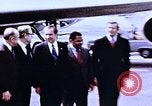
U.S. President Richard Nixon tours the proposed Gateway National Recreation Area in New York and New Jersey
Presidential tour of proposed Gateway National Recreation Area in New York and New Jersey. U.S. President Richard M. Nixon, standing in front of the Presidential Aircraft at Newark Airport, Newark, New Jersey, with Governor William Thomas Cahill, of New Jersey, Governor Nelson Rockefeller, of New York, Mayor Kenneth Allen Gibson, of Newark, and Mayor John Lindsay, of New York City. The President's helicopter maneuvering over the proposed Gateway National Recreation Area. President Nixon speaking about the project in Hangar 14 at Newark Airport, Newark, N.J. Seated on the stage are: Governor Cahill, Secretary of Interior, Rogers C.B. Morton, Governor Rockefeller, Mayor Gibson, and Mayor Lindsay. The President shakes hands with the Governors and Mayors after concluding his remarks.
CRITICALPAST.COM: About Us | Contact Us | FAQs - How to Order | License Agreement | My Account | My Lightboxes | Shopping Cart | Advanced Search | Featured Collections | Website Terms & Conditions | Privacy Policy ©2026 CriticalPast LLC.
License Agreement |
Terms & Conditions |
Privacy Policy
©2026 CriticalPast LLC.