


 Francais
 Deutsch
 Italiano
Refine Your Search
M4-training stock footage and images
- Showing 787 to 792 of 8218 results more
more Hide
Hide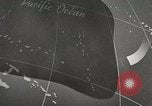
American Forces advance against Japanese held areas of New Guinea during World War II.
Animated map shows U.S. forces extending control in the Pacific the the Marshall and Gilbert Islands in the Pacific during World War 2. An American soldier sentry near a destroyed Japanese reinforced concrete bunker. Another looks at a destroyed Japanese coastal gun. More American soldiers looking over destroyed Japanese coastal defenses. A destroyed Japanese type 95 HA-GO tank. A U.S. troops look at a destroyed Japanese Mitsubishi G4M (Betty) bombers on a captured airfield. Animated map of New Guinea.showing Allied advance to Hollandia. U.S. aircraft carriers with their aircraft flying overhead. Closeup from behind of a Navy Grumman F6F Hellcat aircraft taking off from a carrier. Formations of U.S. Navy carrier-based aircraft in flight overhead. Escort aircraft carriers (called "Jeep" carriers by the narrator) are seen with decks full of airplanes. Douglas SBD Dauntless aircraft taxiing on a carrier deck. An F6F fighter plane taking off. A formation of Douglas SBD Dauntless airplanes viewed from above, flying over the sea. Gun camera films from U.S. aircraft strafing parked airplanes on Japanese airfields.
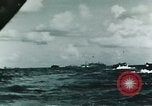
Troops make amphibious landings and injured soldiers are treated on a Pacific island.
Amphibious attack by the U.S. forces on an island in the Pacific during World War II. A U.S. battleship underway in the Pacific Ocean. Naval guns firing at Japanese positions. Landing crafts loaded with soldiers approach the island. Aircraft in flight drop bombs. An armored vehicle drives into a beach. U.S. troops wade inland during combat. Marines ducking behind bushes before an explosion takes place on the beach. Dead Japanese soldiers’ bodies lying on the ground. A firing rocket launcher on USMC M-2-4 1-ton cargo truck. Vehicles driven inland. A soldier fires a gun. Soldiers filing out of grass. They carry ammunition. Flames come out of a Flamethrower. The soldiers sit in a trench. Injured soldiers are treated in the jungle. Medics carry a patient on a stretcher. A jeep is driven away. Tanks move in a line. Soldiers on a battlefield.
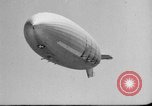
A sailor hanging on a cable attached to USS Akron in flight over Camp Kearny, San Diego, California.
The U.S. Navy Zeppelin, USS Akron (ZRS-4)in flight over Camp Kearny, San Diego, California. she drops mooring cable to crew of about 100 sailors on the ground. Part of the cable breaks, and three sailors are left dangling on the remaining cable. They are pulled up as the Akron rises and two of the sailors fall to their deaths. One sailor (Navy Apprentice Seaman, C.M. Cowart) remains secure on the cable and is reeled into the airship. Captain of the airship, Lieutenant Commander, Charles Emery Rosendahl, gives a public statement following the accident.
A crew fires anti tank gun and uses a flame thrower on a building in Ermita district of Manila in the Philippine Islands.
U.S. 503rd Parachute Infantry Regiment soldiers advance for the invasion of Corregidor in the Philippine Islands during World War II. A crew fires a 37mm anti tank gun from inside a building through a window of a building in Ermita district of Manila. An M-4 tank advances. Soldiers take position and fire artillery. Smoke in the background. The soldiers use a flame thrower on a building housing the Japanese.
Japanese bombers strike Port Darwin, Australia, during World War II.
Japanese bombing of Darwin, Australia in World War 2. Animated map showing line of Japanese attack from the RyukYu Islands to Darwin, Australia. Japanese MitsubishiG4M1 (Betty) long range bombers being readied at a Japanese air base. They take off on mission to bomb Port Darwin.Those on ground wave goodbye to them. View through nose greenhouse of a bomber. Bombers in formation. View of pilot and copilot in cockpit. More views of formation flying over clouds. Pilot with hands on control yoke. A note in Japanese fastened to the cockpit window. Crew members take lunch break while underway. Crew of bomber seen in warm clothing and on oxygen, as they proceed at a higher altitude.Radio operator keys message. Gunner at his station. The bombers begin their bomb run over Port Darwin. Bomb seen dropping from the aircraft, and striking the airfield of the Australian Naval Base on the coast.
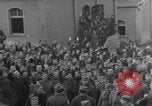
Group of US, Czech, Russian, Yugoslavian prisoners cheering, waving and laughing at liberation of OFLAG XIII-B Camp Hammelburg (WW2)
Freed Allied prisoners of war at OFLAG XIII-B, known as Camp Hammelburg, outside of Gemünden, Germany during World War II. A group of United States, Czech, Russian, Yugoslav prisoners of war standing together along with the liberating 14th U.S. Armored Division soldiers. Two prisoners talk to each other. The prisoners cheering, waving and laughing. Two prisoners walk down the road smiling; one waving a copy of Yank Magazine, the other a chunk of bread. U.S. Amry M-4 tank crashes through barbed wire fence of Camp Hammelburg. A group of freed prisoners gathers. Several prisoners stand and pose. Mass gathering of elated former prisoners. Freed prisoners of war dash toward U.S. soldiers and embrace them. (Note: This was the conclusion of the originally failed "Operation Hammelburg", initially attempted by "Task Force Baum," under Captain Abraham Baum, ten days prior. Inmates at the camp included the recently injured and captured Captain Baum, and Lieutenant Colonel John K. Waters, son in law of U.S. Army General George Patton. LTC John Waters was injured during the initial rescue attempt 10 days prior and was hospitalized and not seen in this film.)
CRITICALPAST.COM: About Us | Contact Us | FAQs - How to Order | License Agreement | My Account | My Lightboxes | Shopping Cart | Advanced Search | Featured Collections | Website Terms & Conditions | Privacy Policy ©2026 CriticalPast LLC.
License Agreement |
Terms & Conditions |
Privacy Policy
©2026 CriticalPast LLC.