


 Francais
 Deutsch
 Italiano
Refine Your Search
Melville Rhode Island 1943 stock footage and images
- Showing 247 to 252 of 6726 results more
more Hide
Hide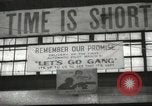
Views inside the Jack & Heintz Company war plant, Bedford Ohio, during World War II
The Jack and Heintz war plant in Bedford, Ohio, in 1943, during World War 2, where the company designed and manufactured various aircraft parts and accessories for the U.S. Military. First scene shows signs inside the factory reading : "Time is Short," and "Remember our promise, Delivery of the first automatic pilot March 31." And: "Let's Goo Gang, Its up to us to see that its kept." A picture of a war plant worker and a soldier with a machine gun is below the signs. Worker seen in a lab coat, smoking a pipe as he works at a machine. Behind him are two drawings of reclining pinup girls and a sign reading: "Quiet Please, War worker resting." Closeup of worker's hand machining a very small part.
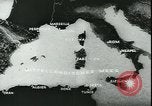
Views of Southern France, under German occupation in World War 2
Film opens with map showing lower France and Mediterranean areas. However, it shows images covering primarily the French Riviera (or Côte d'Azur) under German occupation during World War II, in 1943 or 1944. German infantry march along a road. A flight of German FW-190 Fighter airplanes flies inland from the Mediterranean Sea and crosses low above a harbor. Change of scene shows a single fighter plane buzzing the Marseille Port. (It looks like a P-47 with invasion stripes. But It does not draw any anti-aircraft fire.) Camera tracks it from vantage point at the Marseille Basilica, high above the harbor. Brief view of the Basilica as the aircraft passes. A glimpse of the Marseille Port below from the Basilica. View of the Marseille Transporter Bridge designed by Ferdinand Arnodin and built in 1905. (It was destroyed after these films were made, in 1944.) A German soldier peering through binoculars in front of a 2 cm Flak 30/38/Flakvierling, quad anti-aircraft gun position. Another one is seen in the background. Several more views of German anti-aircraft and other gun emplacements protecting the Marseille Port, including 88mm guns, heavy machine guns, and Atlantic Wall coastal defense guns. Scene shifts to German soldiers marching near the French Riviera beach and palm trees. Italian cavalry are seen riding in formation, ostensibly from Nice. Italian soldiers in trucks are being transported along the Riviera waterfront. A road sign points toward Toulon at 6.3 kilometers away. (So this location is probably near Sanary-sur-Mer.) View of the Toulon harbor, where the French battleship Provence, scuttled in 1942, is seen settled low in the water at a pier.

USAAF B-25 Mitchell aircraft take off from an air base in China and drop bombs over Hong Kong during World War II.
Although narrator states "General Chennault's United States 10th Air Force," this film actually depicts Chennault's 14th Air Force formed in 1943. Its B-25s and P-40s are shown during an attack on Hong Kong during World War 2 U.S. Army Air Force B-25 Mitchell aircraft take off from an air base in China to attack Hong Kong. The aircraft in flight. Propellers of the aircraft. Aerial view of the area below. Bombs being released over Hong Kong. View of crew in cockpit of B-25.The aircraft landing at an air base in China after the mission. P-40s with tiger teeth paint job parked on the airport tarmac. Aircrews relax with refreshments on the ramp.
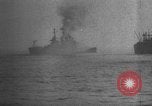
Allied Naval Task Force operations supporting Amphibian assault on Salerno, Italy, in World War II
Opening scene shows the USS Savannah (CL 42), on 11 September, 1943, after being struck by a German remotely controlled glider bomb released from a high flying German aircraft, She was supporting Allied amphibious operations at Salerno, Italy, in World War 2. Next, after fires were put out and smoke cleared, The disabled Savannah is seen sitting low in the water, making way slowly, among other Naval Task force ships in the background. (She made way to Malta under her own steam for emergency repairs.) Views of the Savannah passing as she heads for Malta. A Fletcher class destroyer fires her naval guns at the shore. Attack transports and other support ships are seen nearby. More views of support ships, including the USS Samuel Chase (APA-26). A barrage balloon seen above the convoy in some scenes. Sailors manning a Bofors 40mm anti-aircraft gun aboard a U.S. warship. A British Escort Carrier with number 337 on her bow. Sailors with a Oerlikon 20 mm cannon aboard a warship. The British Escort Carrier seen earlier, (with number 337 on her bow) passes the camera ship. Aircraft are seen on her flight deck. A Navy warship firing 40mm Bofors and 5-inch guns as it lays down a smoke screen.
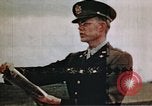
Military award ceremony for members of 351st Bomb Group At RAF Station Polebrook, England, during World War II
During World War 2, Group Adjutant reads 8th Bomber Command orders of the day, on July 7th, 1943. Members of the 351st Bomb Group stand in formation in front of B-17s during an award ceremony. The decorations, including Silver Star, Distinguished Flying Cross,and Soldiers Medal, are arranged on a table for presentation. The recipients are lined up at attention. Narrator points out Bombardier Stevens receiving the DFC and other airmen and their awards.

The U.S. Army Quartermaster Corps store procured supplies and enlisted men are trained in quartermaster operations (WW2)
The United States Army Quartermaster Corps in the United States during World War II. A diagrammatic comparison of army manpower of 8,000,000 in December 1943 as against 1,750,000 in December 1941. A diagrammatic representation of huge increase in volume of obligated procurement in 1942 as against 1941. Men wheeling carts of supplies at a store. Men carrying supplies coming down a gangway from a ship onto a dock. Soldiers with guns standing on the dock. Soldiers moving through a wooded area. Men carrying the procured materials for storing. Officers watching the men. Two soldiers wearing their uniforms. People and vehicles moving on a city street. A signboard on a building reads 'Office of the Quartermaster General War Department'. The headquarters building in view. A map of the U.S. showing locations of different procuring offices across the nation. Men and women working in an office at the headquarters. Petroleum, Subsistence and Textile sections at the headquarters. Officers working in the headquarters. Men getting into a truck. Enlisted men being trained in various quartermaster operations at a training center.
CRITICALPAST.COM: About Us | Contact Us | FAQs - How to Order | License Agreement | My Account | My Lightboxes | Shopping Cart | Advanced Search | Featured Collections | Website Terms & Conditions | Privacy Policy ©2026 CriticalPast LLC.
License Agreement |
Terms & Conditions |
Privacy Policy
©2026 CriticalPast LLC.