


 Francais
 Deutsch
 Italiano
Refine Your Search
Melville Rhode Island 1943 stock footage and images
- Showing 259 to 264 of 6726 results more
more Hide
Hide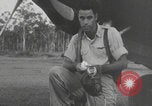
United States Army Air Force 339th Fighter Squadron Pilots in the South Pacific preparing for take-off during WW2.
The United States Army Air Force pilots of the 339th Fighter Squadron, who intercepted and shot down Imperial Japanese Admiral Isoroku Yamamoto in 1943 during World War II. Captain Tom Lanphier, is seated under an aircraft, cleaning his goggles. View of Captain Lanphier, smiling. Another United States Army Air Force Pilot, Lieutenant Rex T. Barber, wearing helmet and goggles, adjusts his straps. Another pilot, Lieutenant Besby Holmes, leaning his back on an aircraft, adjusts his helmet and laughs. Lieutenant Douglas S. Canning puts on a life vest and smiles. Lieutenant Delton Goerke chews and smiles as he looks at the camera. Lieutenant Julius Jacobson adjusts his helmet and smiles. Pilot in cockpit gives an “OK” hand gesture facing the camera before closing the cockpit canopy. Another pilot salutes facing the camera before closing his cockpit canopy.
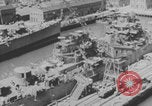
Naval guns and torpedoes manufactured, USS Wisconsin launched (WW2)
Steel used for ship building and war materiel manufacture in the United States during World War 2. Shipbuilding at a dock. Sign says “U.S. Naval Advance Base Depot”. A steam locomotive pulls a 16 inch naval gun from a war production factory. Men move newly made Navy torpedo via overhead conveyor. Men building torpedoes in a factory. A huge engine is being lifted by an overhead crane. War production workers on factory floor building items for U.S. Navy. A United States Naval officer speaks with a factory executive. Narrator mentions importance of scrap metal for use in ship building. The launching of the Iowa-class battleship, USS Wisconsin (BB-64), in the Philadelphia Navy Yard on December 7, 1943. Assisted by Rear Admiral Melo F. Draemel, Mrs. Margaret Roche-Goodland, wife of Wisconsin Governor Walter S. Goodland, successfully breaks a bottle of champagne over the ship's bow. The USS Wisconsin starts down the dry dock during launch.
Bodies of Polish victims and their personal effects during the exhumation of mass grave in Katyn Forest (WW2)
Bodies of Polish victims of the 1940 Katyn massacre during World War II. A corpse found from the 1943 exhumation of the mass grave. More remains of Katyn massacre victims. Exhumed corpses lie on the ground. A man shows the corpse of a Polish military officer. Men digging and carrying a corpse on stretcher. A man uncovers a corpse. The man inspects the corpse’s wallet for identification. Polish banknotes and identification papers on wooden table. Pictures of family members and identification cards belonging to Katyn massacre victims. Thousands of corpses exhumed in Katyn Forest. The Red Cross flag is also seen.
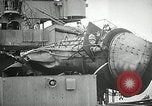
Damaged USS Louisville and men overhaul it in Okinawa, Japan.
Damaged USS Louisville (CA-28) hit by Japanese Kamikase in World War 2. Damaged forward stack of the ship. Float of its scout plane left on catapult, is jettisoned. Large stack of the USS Louisville knocked down. Engine of seaplane blown up by explosion on the signal bridge. Man welds in superstructure. View of other men working to repair damage to the Cruiser.. [Note: The following eyewitness account of the kamikaze attack was recorded by Seamen 1st Class, Enrico Trotta, who was a crew member on the USS Louisville (CA-28) from 1943 to 1946, "At 1923 (hours) two planes which were identified as friendly flew around and one kamikaze dove onto the battleship USS Mississippi BB 41. The other kamikaze plane turned to the Louisville and started to make a run on us. I was on No. #4 - 20 mm AA gun mount on the port side below #2 main battery and I fired 58 rounds to set the kamikaze plane on fire prior to hitting the Louisville’s front smoke stack bending and twisting it and killing 9 men on the 40 mm gun mount mounting on the forward superstructure tripod about 140 feet from our gun mount. The kamikaze also cut our sea plane off and left only the pontoon on the catapult. Three other 20 AA mm gun crews opened up firing 4, 11, and 20 rounds as well. We were not told to fire for we did it on our own. We were only manning the guns at the time and were not on general quarters. Later, the officers came by and said good job."]
Research Bell towed out to M-2 Buoy Jamestown Island in Narragansett Bay, Newport.
Underwater Research bell at Newport shipyard in Newport. Workers on deck handle hoses and lines. Two personnel converse with each other standing in front of Research Bell. The bell lifted by sling. Research bell lowered two blocks from where it was hoisted. Men work around the bell. Raymond Edwards opens the hatch door and enters inside. He does final check up of all equipment. Small tug toes bell on a barge en route to M-2 Buoy off Jamestown Island in Narragansett Bay. Barge with Research Bell aboard towed out to M-2 Buoy.
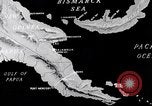
Soldiers pack supplies and parachutes at an Australian Parachute Packing Depot in Papua New Guinea.
March 1943: A map shows Salamaua in Papua New Guinea. An aircraft drops supplies with parachutes over hills. An Australian parachute packing depot. Soldiers pack parachutes on tables in rows. Stacked Australian parachutes to deliver rations, American parachutes used for Ammunition, and 24 foot parachutes for regulation. White parachutes used for medical supplies, blue ones used for rations and red used for ammunition supplies. Aerial view of Goodview, an area of conflict. A soldier radios the requirements to base. Another soldier delivers the plan to the depot. Soldiers pack mortar ammunition. The fuses and sheets are packed together in boxes. Soldiers put boxes into sacks, tie the sacks and attach parachutes. Soldiers pack canned meat: lay straw in big cans, put small cans into those, seal the big cans, secure them with a wiring machine, and attach parachutes. Sacks of rice are put into copper sacks, their mouths tied. Soldiers pack rations including onions, bacon and potatoes for delivery. Supplies are loaded onto trucks and transferred to the aerodrome. (World War II period).
CRITICALPAST.COM: About Us | Contact Us | FAQs - How to Order | License Agreement | My Account | My Lightboxes | Shopping Cart | Advanced Search | Featured Collections | Website Terms & Conditions | Privacy Policy ©2026 CriticalPast LLC.
License Agreement |
Terms & Conditions |
Privacy Policy
©2026 CriticalPast LLC.