


 Francais
 Deutsch
 Italiano

Refine Your Search
Melville Rhode Island 1943 stock footage and images
- Showing 253 to 258 of 6735 results more
 Hide
Color Sound
Last part of a U.S. Army Air Forces film to prepare aircrews for bombing raid on Ploesti oil facilities in Romania in World War II
Training and motivational film for U.S. Army Air Force crews preparing for the bombing of the Ploesti (or Ploiesti) oil fields in Romania, (Operation Tidal Wave) of August 1943. Final part of a training film to brief U.S. Army Air Forces aircrews in preparation for their bombing raid on the Ploesti oil refineries in Romania during World War 2. Formation of bombers is seen flying toward oil derricks in the oil fields. Aerial views of the oil fields and refineries. Oil storage facilities. Closeup of oil workers at a drilling rig. German officers walking in snow, ostensibly seeking places to obtain oil to fuel their wartime operations. German Field Marshal Erwin Rommel and other Nazi officers examine a chart in Africa. German prisoners taken in North Africa. Large numbers of German prisoners walking across the desert. A flight of several German Messerschmitt Bf 109 fighter planes in formation. Italian Dictator, Benito Mussolini, walking with an entourage in an Italian colonial region of Africa. He climbs aboard an open rail car on a small gauge railway. Accompanied by others, the rail car is pushed along the track by Colonials in white garb. German Field Marshal Fedor von Bock, who commanded German forces attacking the Soviet Union in Operation Typhoon, is seen visiting a German base. Next, Lieutenant Colonel James "Jimmy" Doolittle has his hands on the fins of a bomb while posing with his flyers when underway in the Pacific, aboard the USS Hornet (CV-8) for their daring raid B-25 bombing raid on Tokyo, Japan. View of a B-25 taking off from the Hornet. An American B-17 flying fortress, bomber taking off for a daylight raid in Europe. President Franklin D. Roosevelt, speaking on radio, saying "We believe the Nazis and fascists have asked for it. And they're going to get it." Oil storage tanks ablaze with heavy black smoke rising.
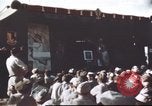
Commander of the 376th Bomb Group Libya, North Africa, briefs air crews for mission against Nazi aircraft production complex, WW2.
U.S. Army Colonel Keith K. Compton, commander of the 376th Bomb Group in Libya, North Africa briefs his Army Air Force aircraft crews for the first Allied bombing mission against the Nazi German ME-109 (Messerschmitt Bf 109) aircraft manufacturing plant south of Vienna at Wiener-Neustadt, Austria, in World War 2. The map that Colonel Compton is using shows the air routes to and from the target. The mission will commence early the next day, on 13 August 1943. An unrelated scene shows U.S. Army and Army Air Force men conversing with an Australian soldier in a summer uniform.
The Director of the WAVES (Women Accepted for Volunteer Emergency Service) christens USS Franklin (CV-13) in Newport News.
U.S. Navy ships launched in the United States during World War II. Lieutenant Commander Mildred H. McAfee, USNR (US Navy Reserve), Director of the WAVES (Women Accepted for Volunteer Emergency Service) breaks a bottle of champagne on the bow of a carrier and christens USS Franklin (CV-13) in Newport News, Virginia on 14th October, 1943. A destroyer is launched at the Great Lakes. The destroyer is turned into an upright position. Shipyard workers cheer. A ship is launched sideways.
U.S. Army Air Forces B-17F Flying Fortresses bomb targets in Regensburg, Germany during 'Shuttle Mission' of World War II.
Strategic bombing attack 'Shuttle Mission' by B-17 Flying Fortresses of the U.S. Army Air Forces on August 17, 1943 over Germany during World War II. A formation of B-17Fs over Germany. Vapor trails left by the airplanes. Aerial view of a German city. Smoking targets. B-17Fs over the Alps. A B-17 aircraft with a damaged tail flies over Regensburg, Germany. A B-17 aircraft with a damaged nose. Aerial view of African coastline. Mountainous terrain of Algiers, Algeria. Aerial view of barracks in Algiers. B-17Fs land on a field.

U.S. recruits being classified for assignments and being informed about the progress of World War II and why they fight.
New U.S. army recruits seated at benches in the classification center, taking notes, as an instructor at a blackboard tells them how to fill out their classification questionnaires, during World War 2. View of machines processing the questionnaires. Hollerith 88 column punch cards being sorted by machine. Newspaper article about the Air Force efforts to improve classification and assignments of new airmen. A recruit being counseled. An Airmen in barracks, filling out a post card form to complain about his assignment. Servicemen working with sewing machines and at long cobbler's benches repairing shoes. U.S. soldiers in pith helmets, laying communications cable from a truck. A soldier recording information about a shipment of supplies. Soldiers filling 5-gallon "jerry cans" with fuel from a hose. Others serving at a communications center in woods. A soldier fastening a cable to a tank. Soldier standing on a truck. Large group of soldiers gathered to listen to a lecture about explosives. Army draftsmen at their work tables. Soldiers using information and training materials.(Narrator states these materials are often ignored.) An army newsmap for Monday, August 31, 1942 posted on an Army office wall. A sergeant points to July, 1943, on a current calendar next to it, illustrating that the newsmap is long out-of-date. View of another news map and narrator notes they are produced weekly. An officer speaking to an auditorium of soldiers. A soldier arranging his personal gear. Infantry on field maneuvers, firing rifles as they advance across a field. Soldiers firing a Browning water-cooled machine gun; a mortar; and a 105mm M101A1 howitzer. The sergeant using a newsmap to brief his staff about the progress of the war. Opening frames of a War Department Film Bulletin, and soldiers in a theater, watching the film. Opening frames of the film,"Why We Fight," that goes on to show animated map of the German advance across Europe in World War 2. Scenes of German forces on the move, towing artillery, riding on tanks, and entering towns as they invade countries of Europe. Women and children running in streets under bombardment, and civilians fleeing from their homes during aerial bombing. A Bombed out city and civilian corpses lying on the ground. Women in Poland, identifying their dead and grieving over them. German Heinkel He 111 aircraft dropping bombs. Norwegians evacuating the city in trucks, and other vehicles and on foot, during the German invasion. A squadron of German Messerschmitt Bf-109 aircraft in flight. German Ju-87, Stuka dive bombers diving on targets. Civilians rushing to a bomb shelter, and other refugees boarding a truck to evacuate. More He-111 bombers dropping bombs. A Ju-52 trimotor transport (type used to transport German paratroopers). Buildings ablaze in a town. Large formations of German aircraft of various types flying overhead. Building destroyed and burning from bombing. Ju-87s flying close past the camera.

Soviet navy coastal defense gun is fired during World War II
Commander of Soviet Artillery battery descends stairway through wooded area and gives orders to Navy coastal defense artillerymen accompanying him. Brief glimpse of steel turret housing a 12"/52 (30.5 cm) gun (railroad gun). Soviet officer using set of dividers and charts to plot firing plan. He phones instructions to naval gun crew, who remove cover from gun barrel. Entire area is wooded, and the gun is covered in tree branch camouflage. Steel side of gun turret contains Russian (cyrillic) writing and the date: 1943, Next sequence shows turret rotating and barrel elevating as gun positions to fire. Sailors carry several powder bags that they place on a roller conveyer along with a shell. All are brought to the gun breech and loaded. Views of the gun being fired, and explosions of shells in distance.
CRITICALPAST.COM: About Us | Contact Us | FAQs - How to Order | License Agreement | My Account | My Lightboxes | Shopping Cart | Advanced Search | Featured Collections | Website Terms & Conditions | Privacy Policy ©2026 CriticalPast LLC.
License Agreement |
Terms & Conditions |
Privacy Policy
©2026 CriticalPast LLC.