


 Francais
 Deutsch
 Italiano
Refine Your Search
Melville Rhode Island 1943 stock footage and images
- Showing 265 to 270 of 6726 results more
more Hide
Hide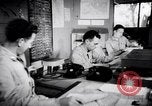
C-47 Skytrains and P-38 Lightning fighters drop supplies with parachutes over Greenview in Papua New Guinea.
March 1943: Australian and American soldiers in Salamaua in Papua New Guinea. Trucks loaded with supplies move to the aerodrome. The Depot officers radio A3 of the 5th Air Force Headquarters, who in turn contact the 54th Troop Carrier Wing for airplanes. Brigadier General Prentiss monitors the mission with Colonel Hampton. Board shows duties of the Troop Carrier Wing. The pilots and crew are briefed for the mission. Soldiers leave in jeeps at dawn for the aerodrome. The pilots are given the time for take off. Supplies are loaded. Planes are ordered off ground. Douglas C-47 Skytrains and P-38 Lightning fighters taxi and take off. Pilot scouts the skies for change in weather and danger. Planes over drop area in Greenview, marked by parachutes from earlier drops on the ground. Soldiers put supplies onto ramps and prepare for the drop. Pilot gives the signal and supplies are dropped. (World War II period).
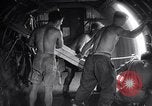
Soldiers drop supplies from C-47 Skytrains over Salamaua in Papua New Guinea.
March 1943: Soldiers in Douglas C-47 Skytrains prepare to drop supplies for American and Australian troops over Salamaua in Papua New Guinea. Aerial view of drop point in Salamaua with parachutes from previous drops visible on the ground. Supplies with and without parachutes descend to the ground. Planes fly low over the drop area. Parachutes with medical, food and ammunition supplies. C-47s fly low over the drop area. Planes fly over the peninsula. (World War II period).
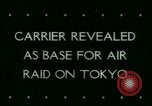
Lt. Col. James Doolittle directs the Doolittle Raid on Japan and receives an award from Madam Chiang Kai-Shek.
From a 1943 newsreel covering the Doolittle Raid on Japan in April 1942. United States Navy aircraft carrier USS Hornet (CV-8) in Japanese waters. B-25 Mitchell medium bomber planes lined up on the deck of the carrier. Lt. Col. James Doolittle and Hornet skipper Captain Marc A Mitscher with the 80 volunteers seated near a 500lb bomb on board. He ties a Japanese medal (awarded to U.S. officers for humanitarian aid to Japanese people) on the bomb. The carrier in heavy seas 800 miles off the Japanese coast. A Japanese patrol boat is sighted and sunk. The survivors are taken prisoners. The crew readies the loaded bombers. General Doolittle in the cockpit as he leads the takes off. The planes take off in rough weather to bomb Japan. The Yokosuka Naval Base bombed and ablaze. The planes bomb armed plants, rail yards and oil refineries all over Japan. Soldiers examine a wrecked B-25 in Japan. U.S. pilots hold traditional Chinese umbrellas and pose with a Chinese man. Chongqing: Soong May-ling, better known as Madame Chiang Kai-shek, awards General Doolittle and his men for the gallant raid. (World War II period).
Army Signal Corps receive and send messages via various methods in World War II; Pentagon signal center operations.
The role and contribution of the U.S. Army Signal Corps in combat during World War 2. Submarine cables laid down by the Signal Corps. Soldiers operate field army communication equipment for communication within and between units. Soldiers talk over the radio in a military jeep. American soldiers employ communication equipment seated at a table in a camp. A U.S. Army Signal Officer goes through documents. An officer receives a message in Washington DC. The message is relayed from the State Department to the Signal Center in the Pentagon building. Exterior views of the Pentagon building circa 1943 or 1944. Inside the Army Communications Signal Center in the Pentagon, technicians work using various communication equipment. They receive messages punched on tape as the tapes emerge from machines. Workers encoding and decoding secret and confidential messages that run the war. Workers at the 'Traffic Control, Army Command and Administrative System'. Paper messages seen gliding across a track near the ceiling above a signboard. A man inserts and removes cables from switchboard slots. The plans are then passed on in code through a maze of antennas all over the world. An animated map depicts the sending of these messages by radio multi-channels, radio teletypes, and manual radios to the front lines. A vast network of Army communication system from Washington DC to the rest of the world to carry a message around the world in three and a half minutes.

The damaged Hispano-Suiza Aircraft Engine Factory after three attacks by the U.S. Eighth Air Force during World War II.
Results of air assaults by the British Royal and U.S. Eighth Air Forces over industrial areas in and around German-occupied Paris during Wolrd War II. The damaged Hispano-Suiza Aircraft Engine Factory (producer of components for Daimler-Benz, Mercedez-Benz) at Bois Colombe, after three attacks by the U.S. Eighth Air Force in December 1943. The destroyed crankshaft plant, foundry, and tool shop. Aircraft engines overhauled, crafted and ready for shipment, left behind by the fleeing Nazis. Allied soldiers and workers under the bare roof. Damaged equipment and material. Allied officers and civilians survey the damage. Collapsed roof structures. Debris and rubble strewn all over the floor. Bent steel structures. Buildings in the surrounding area. Military jeeps parked in the factory grounds. Damaged structures left standing.
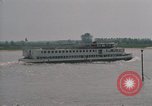
American correspondents visit cemetery in Opijnen, Gelderland, the Netherlands for Memorial Day ceremony honoring U.S. B-17 crew
American correspondents in Netherlands to mark 25th anniversary of Allied invasion of Europe in World War II. A steamer underway in a canal. Views in the village of Opijnen, in Gelderland, the Netherlands. A correspondent and his wife come out of a house. American correspondents near a bus. Houses along a road. An American flag at the walled cemetery in Opijnen, beside its 17th century Dutch Reformed Church, where the crew members of an American B-17 bomber from the 323 Squadron of the 91st Bomb Group (H) of the U.S. 8th Army Air Force are buried; shot down July 30, 1943 by the German Luftwaffe. Gravestones bearing the names of American soldiers who lost their lives when their crippled B-17 was shot down, including: Mike Anthony Perrotta, Hermon Daines Poling, Harold Royce Sparks, Robert Urquhart Duggan, Douglas Victor Blackwood, Americo Cianfichi. U.S. Color Guard marches from a town building toward the cemetery. A woman correspondent takes pictures. An American flag flies at half mast. Men, women and children at the cemetery. Dutch children carry flowers in their hands. The mayor of Opijnen speaks into a microphone. He and a woman place flowered wreaths at the graves of dead American soldiers. Two groups of four U.S. Convair F-102 Delta Dagger aircraft fly overhead followed by four F-104 Starfighters of the Royal Netherlands Airforce. Children walk past the graves. Additional propeller aircraft pass overhead honoring the airmen.
CRITICALPAST.COM: About Us | Contact Us | FAQs - How to Order | License Agreement | My Account | My Lightboxes | Shopping Cart | Advanced Search | Featured Collections | Website Terms & Conditions | Privacy Policy ©2026 CriticalPast LLC.
License Agreement |
Terms & Conditions |
Privacy Policy
©2026 CriticalPast LLC.