


 Francais
 Deutsch
 Italiano
Refine Your Search
Miami Beach Florida USA 1963 stock footage and images
- Showing 7963 to 7968 of 26838 results more
more Hide
Hide
A phosphorus bomb explosion on the USS Alabama and a smoke screen is laid up during a bombing test in the United States.
The U.S. Army Air Service demonstrates the effectiveness of aerial bombing in the United States. A phosphorus bomb explosion on the mast of the USS Alabama battleship. A smoke screen is laid up during the bombing test.
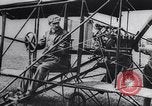
Historic, early aviation pioneers: Glenn Hammond Curtiss, Louis Bleriot, and Lincoln Beachey with their airplanes
American aviation pioneer Glenn Hammond Curtiss sits at the controls of his first aircraft. Two mechanics assist in starting the engines. The first Curtiss aircraft takes off. Louis Bleriot, who was the first to fly across the English Channel, sits at the control of his aircraft in France. Lincoln Beachey, the first man to perform aerobatics in an airplane, dives his first aircraft which is a Curtiss model. Spectators are lined at a fence and watch him flying.
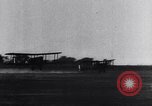
United States Army Air Service being built up before America's entry into World War I
While World War 1 was already underway in Europe, before the United States Air Service began to build up. Two U.S. DeHavilland DH-4 aircraft taking off. A formation of DH-4s in flight. A DH-4 upside down on the ground with soldiers all around it, including one sitting on a rock. Airplanes attacking a barrage balloon aloft, which burns and plummets to earth trailing dark black smoke. A candidate United States pilot undergoing physical testing. He is placed in a spinning chair and spun at high speed. Another pilot candidate performs a visual test with an array of lights on a panel being lit. Prospective Army pilots in U.S. Army uniforms marching and on a flight line with JN-4 Jenny training aircraft. Cadet turns propeller of a Curtiss JN-4 training airplane and the engine starts. Formation of DH-4 aircraft in flight. Lumberjacks in American northwest area of Oregon or Washington state felling a giant spruce tree after cutting it with a two man saw in the Cascade mountain forests. Massive Logs being transported by railroad to logging mills for eventual use in airplane factories. Men and many women war production workers busy working at an American airplane fabricating plant or factory during World War 1.
Manufacture of the famed Liberty engine and U.S. Army Air Service in World War I
The Liberty L-12 engine. Scenes of its manufacture in American war plants. U.S. Air Service crews training in DeHavilland DH-4 aircraft. An airplane falling and crashed, with wreckage seen on ground. Head of the U.S. Army Air Service, General Patrick, and General Billy Mitchell, presenting medals to Captain Eddie Rickenbacker and other fliers of the U.S. Army 94th Aero Squadron, in France, during World War 1.
Various "firsts" in U.S. aviation history from 1918 through 1924; early history of flight and vintage flight scenes
Shows several aviation "firsts" accomplished by U.S. Army Air Service aviators in the period from 1918 through 1924. A close formation of biplanes in flight. President and Mrs. Woodrow Wilson chat with Major Fleet, Officer in charge, on the occasion of the first air mail flight, inaugurated on May 15,1918 between Washington DC and New York.The mail is loaded into the Curtis JN-4 aircraft. Pilot in the cockpit. The aircraft takes off and in flight. Air Service. Mention of aviators helping spot forest fires. Smoke rising from forest fires and mountain ranges. In 1920, U.S. Army Captain St. Clair Streett is seen with some of his Squadron who flew four De Havilland DH-4 aircraft 9,000 miles, from New York City to Nome, Alaska. Two of the men play with pet dogs. Their itinerary is painted on the side of one of the aircraft, along with the names of pilot and mechanic (C.E. Crumline and J.E. Long). In 1923 the first non stop coast-to-coast flight was made in the Fokker T-2 aircraft. . A sign on the aircraft reads 'Army Air Service non stop coast to coast'.First Lieutenants Oakley O.Kelly and John A. Macready board the aircraft, at Roosevelt Field, Long Island, New York, on May 2, 1923. Their Fokker T-2 in flight. Their arrival at Rockwell Field, on Coronado Island (San Diego) California. In 1924, Lt. Russell Maughan is seen boarding his P-1 Hawk airplane at Mitchel Field, on Long Island, New York, and taking off , bound for Crissy Field at the Presidio, San Francisco, California. His goal is the first dawn-to-dusk, coast-to-coast flight. Views of his P-1 Hawk airplane flying over Manhattan, New York City.
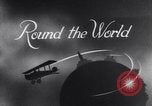
U.S. Army's 'Round the World Flight in 1924, using Douglas World Cruiser aircraft
Documentary about the U.S. Army's flight around the world in 1924, employing four Douglas World Cruiser aircraft. A flag of United States. Crowds gather around around. the four Douglas World Cruisers, named Boston, Chicago, New Orleans, and Seattle, as they prepare to depart from Seattle, Washington, on their expedition. One of the aircraft taking off. All the aircraft in flight over Seattle Washington. Major Frederick F. Martin Commander of the flight. An animated map shows the aerial expedition's route and locations of various accidents and incidents that beset them along the way. View of one Douglas World Cruiser in flight, equipped with floats. The expedition was completed by the Cruiser,Chicago, crewed by pilot, Lt. Lowell Smith and Lt. Leslie Arnold; and by the New Orleans, crewed by pilot, Lt. Erik Nelson and Lt. Jack Harding, who are seen being congratulated by expedition Commander, Major Frederick F. Martin upon their completion of the mission in Seattle, on September 28, 1924.
CRITICALPAST.COM: About Us | Contact Us | FAQs - How to Order | License Agreement | My Account | My Lightboxes | Shopping Cart | Advanced Search | Featured Collections | Website Terms & Conditions | Privacy Policy ©2026 CriticalPast LLC.
License Agreement |
Terms & Conditions |
Privacy Policy
©2026 CriticalPast LLC.