


 Francais
 Deutsch
 Italiano
Refine Your Search
Mig-15 stock footage and images
- Showing 229 to 234 of 681 results more
more Hide
Hide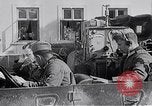
The invasion and siege of Warsaw, Poland by German forces during World War II
The German viewpoint of events during the Polish Campaign in Warsaw, Poland, during World War 2. Ostensibly to spare Warsaw from destruction, German radio operator soldiers wearing headphones, in a mobile communications center, issue an ultimatum from the German High Command, to the Commander of the city of Warsaw, demanding capitulation of defending forces within 12 hours. A German Junkers Ju-52 trimotor transport aircraft parked at a small airport. The aircraft takes off (to disperse handbills with this message.) A German Dornier DO-17 bomber takes off. Next, a German checkpoint is seen clogged with vehicles amd persons attempting to leave the city. Narrator states that only 870 members of the Diplomatic Corps and 1200 foreigners elected to leave. They are seen departing along a road set aside for that purpose by the German High Command. German officers supervise their departure. One, carrying Japanese envoys or diplomatic delegation, bears a large Japanese flag on its roof. Next, the siege of Warsaw begins, with German gunners loading and firing a 305mm siege mortar. They take refuge in a trench behind the weapon when it fires. Other German field artillery firing, including a 75mm field piece, a 15 cm sfh18 german heavy field howitzer and others not seen. German gunners using periscopic range finding equipment and looking through binoculars to direct artillery. A freight train hit by gunfire. More German 15cm sFH 18 guns firing. German troops watching the artillery barrages from a trench. Smoke rising in distance. More sfh18s firing. Smoke clouds forming above the city. Adolf Hitler observing the artillery siege through periscopic binoculars. Tops of the heads of his officer entourage (their uniform caps) as they crowd around Hitler. More smoke rising as the artillery barrages continue. Adolf Hitler holding binoculars as he stands in the company of army officers. He, and they, look up at sound of aircraft overhead. View of Ju-87 Stuka dive bombers low overhead. Aerial view of smoke on ground and formed into billowing clouds above the city. View from cockpit of observation plane, of smoke rising from Warsaw citadel.
Project Thunderstorm undertaken in Ohio, for military observation and understanding of thunderstorm effects on aircraft
Officer sitting at desk reading newspaper during Project Thunderstorm in the Ohio. United States calendar on wall in an Officer's office. United States covered with a large mass of clouds in sky. Officer looking up at clouds. Officers seated in room listening to lecture about the Thunderstorm Project. Instructor gives lecture on various types of clouds which are drawn on blackboard. Officer giving lecture on P-61 which is drawn on blackboard. P-61's parked on runway. Close-up views of cockpit and control areas of P-61. Civilian mounting movie camera on top blister of P-61. Mechanic checking special recording instruments in rear of P-61. Animated drawing of P-61. G3 officers in classroom listen to instructor's lectures. Mechanics install radar installations and transmitters in nose of P-61. Radar device seen spinning inside nose of P-61. United States P-61 in flight. Civilian cataloging motion picture film using a motion picture projector on a desk. Civilian installing motion picture camera in nose of a Northrop F-15 Reporter. Aerial view of Northrop F-15 Reporter in flight. AT-6 parked on runway. Camera installations in rear canopy of AT-6 also for use in surveying storm cloud formations. Pilot approaches AT-6 and climbs into cockpit of AT-6. AT-6 warms up before take off. AT-6 in flight.
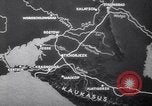
German and Romanian troops fight against Soviets during the battle of Caucasus in World War 2
German film about the Battle for the Caucasus. Opens showing a map of the region, centered on Pyatigorsk. German troops are seen descending from wooded hills above the Kuban river. They launch a rubber raft and start crossing the river in it, as Soviet artillery shells splash in the water near them. Closeup of soldiers paddling the raft. Views from inside one of two rafts being paddled across the river, under artillery fire. German and Romanian soldiers participate in the crossings and make their way through heavy brush on the other side. They throw hand grenades. One Romanian soldier fires a vz.26 light machine gun. Others hunt Soviet snipers hidden in trees. They encounter one and shoot him down with their rifles. View from shore of a raft of Romanian soldiers being pulled by a cable toward the camera. Some are seen crossing the river in a power boat. Closeup of boatman at the tiller of the boat. Views of Romanian soldiers moving along the river bank near houses and roads. They move an artillery field piece along the shoreline. Movements of trucks raise much obscuring dust at the foot of the Caucasus mountains. Romanian troops hunkered down beside a road as a tank moves raising lots of dust in the background. Closeup of a Romanian T-4 tank (or German Panzer IV) advancing toward the camera. German forces with armor, artillery, and vehicles enter the town of Pyatigorsk. German forces setting up positions on a plain, and firing artillery at zero elevation and anti aircraft guns at Soviet positions. Armored vehicles and crews taking a break. German infantry marching in loose formation deeper into the Caucasus. Horses pulling artillery pieces and supplies through the water. A German SdKfz 7 half track proceeding through the water, towing an s.F.H. 18, 15cm field howitzer. A soldier hitches a ride on the hood of a staff car being towed through the water. View of Maikop, an Oil city on North Slope of Caucuses. Local Commissars taken prisoner, being escorted. Soldiers display a captured Bolshevik flag containing image of Joseph Stalin. Captured prisoners being marched, guarded by armed German soldiers on horseback. Scene shifts to German artillerymen setting up in a cornfield for a battle for the oil fields South of Maikop. Artillery firing, with operations continuing into the night. Fires raging at night from Soviet artillery strikes. German infantry advancing in the daylight. SdKfz 7 half tracks towing s.F.H. 18, 15cm field howitzers, past burning buildings. Closeup of infantry and armor advancing through dust and heat.
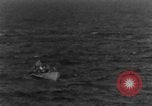
Search for survivors after collapse of U.S. Air Force Radar Station (Texas Tower No. 4,TT-4) in the Atlantic ocean, off Long Island.
Search and rescue efforts after the destruction of Texas Tower Number 4, a U.S. Air Force Air Defense Command Offshore Radar station, in 1961. It was located off Long Island (39degrees48'N 72degrees40'W) and operated by airmen of the 646th Radar Squadron. It had experienced structural difficulties including damage from Hurricane Donna, on September 12, 1960 and was being scheduled for repair or dismantling. The USNS New Bedford and the USS Wasp were in the vicinity, on January 15, 1961, when the storm caused the Tower to collapse and sink.But they were unable to save anyone. In subsequent search and rescue operations, after the storm, The USS Sunbird (ASR-15) submarine rescue ship is seen at the site, along with sailors in a motor whaleboat from the USS Blandy (DD-943). A helicopter from the USS Wasp (CV-18)flies overhead. A scuba diver surfaces near the whaleboat and is taken aboard. A motor whaleboat from the USS Sunbird maneuvers in rough water. Whaleboats seen returning sailors and divers to the Sunbird.

Highlights of Senior Bowl football game between College all stars from North and South at Mobile, Alabama, in 1967.
Several highlights from the 1967 Senior Bowl football game. A crowd fills the sold-out Ladd Peebles Stadium, in Mobile Alabama, for the Senior Bowl game, matching all star football players from the North and the South. Oregon State's Bob Grim is seen running the ball to pick up 25 yards. North's Quarterback hits Iowa State's Eppie Barney for a touchdown, with 1:13 remaining in the 3rd period. South quarterback Terry Southal, of Baylor, passes to Louisiana State's Dick Redding for a touchdown at the 13:12 mark of the 4th quarter. North's Bob Grim takes handoff and runs from the 40 yard line until pushed out of bounds at the South's 15 yard line. Nebraska's Harry Wilson runs the ball for a touchdown in the 4th Quarter. North beats the South 35 to 15. (Note:The final North tally came at the very end of the game with a pass from BYU's Virgil Carter to Nebraska's Pete Tatman. Bubba Smith of Mich. State was a monster on Defense and won the MVP award.)
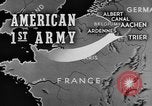
The United States First Army enters Roetgen and supplies are dropped to and retrieved by the Belgian White Army (WW2)
The United States First Army enters Roetgen, Aachen and other German border towns without opposition during World War II. Map showing the capture of the Ardennes, Albert Canal, Aachen, and Trier by the First Army. View of Luxembourg’s Ardennes. A dugout in Wallendorf, in the state of Rhineland-Palatinate. A captured pillbox displays sign in German reads “Der führer besichtigte diese anlage am 15. mai. 1939” (“The Führer visited this facility on May 15, 1939” in English). The town of Wallendorf with heavily damaged buildings from recent Allied shelling. Civilians saving their belongings outside the bombed “Gastwirtschaft von Franz Wenzel” in Wallendorf. Troops on moving M4 Sherman tanks and Jeeps. Soldiers climb the hill and enter Germany. The troops maneuver over fields. Troops occupy the Roetgen, located approximately 16 km (10 mi) south-east of Aachen. 'Roetgen' written on building. White flag on building of 'The Deutsche Reichsbahn'. View of village and huts. Belgian White Army lights fire for supplies by airborne. They gather hay to make bonfires. A White Army soldier with bayonet scans the sky. Another soldier holds a rifle. Soldier watches through binoculars towards plane. A passing bomber drops supplies for the Belgian White Army. Parachutes landing on earth. Supplies and arms are dropped to and retrieved by Belgians. Parachute are rolled and returned to England. Men load supplies into a truck. Horse cart moves away.