


 Francais
 Deutsch
 Italiano
Refine Your Search
Mig-15 stock footage and images
- Showing 427 to 432 of 682 results more
more Hide
Hide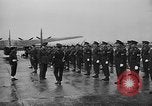
Various Allied Generals assume new commands in Italy during December, 1944, World War II.
On 12 December, 1944, at an airport in Naples, Italy, British General Sir Henry Nathan Wilson inspects an honor guard of American Military Policemen in formation. (Narrator states he is en route to replace the late Field Marshal Sir John Dill, in Washington, DC, USA) A contingent of British troops is also present as part of the honor guard, on the wet airport tarmac. (Narrator states that Wilson will head the British Joint Staff Mission and be personal military representative for Prime Minister Winston Churchill.) He approaches a line of U.S. military officers who salute him. Closeup of General Wilson With U.S. Army Air Forces Lieutenant General Ira C. Eaker, next to U.S. Vice Admiral Kent Hewitt. Also with them (back to camera) is British Admiral Sir John Henry Dacres Cunningham, Commander-in-Chief for the Mediterranean Fleet. Next, General Wilson and his party are seen boarding a British Avro York four-engine Heavy Transport aircraft. View from the ground, of the aircraft cockpit and the engines running as it taxis out for takeoff. Change of scene shows troops gathered in open air battlefield environment. General Mark Clark, now Commander-in-Chief of the Allied 15th Army Group, decorates some members of the 5th Army, as General Lucian King Truscott Jr. (new 5th Army Commander) stands by his side. General Clark says farewell to members of the 5th Army and shakes hands with many of them. (World War II; WW II; World War 2; World War Two)
German view of the beginning of the the Battle of the Bulge in World War II
Beginning of the German counterattack into Belgium, during winter of 1944-45 of World War 2. Opening scenes show German artillery barrages by Grille (Cricket) self-propelled artillery firing 15 cm sIG 33 infantry guns. This is the beginning of German Field Marshal Gerd von Rundstedt's Ardennes Counteroffensive (aka the Battle of the Bulge) in December, 1944. German soldiers riding on Jagdpanzer IV tank destroyer moving forward in Ligneuville, South of Malmedy, Belgium. German infantry walk past a knocked out tank on their way toward the front, where smoke rises ahead. They pass burning American armor and vehicles destroyed by the German Luftwaffe (Air Force). Sounds of artillery fire are heard. Closeup of one soldier carrying an MP44 7.92 x 33 mm (7.92 Kurz) caliber assault rifle. The German infantry move along a ditch parallel to a burning column of U.S. armor and vehicles on the road, where it was wiped out by German aircraft. A United States 3" anti-tank gun abandoned at the roadside. German soldiers retrieve American cigarettes from a knocked out U.S. tank, and share them. At TC:02:00 the German gunner with a belt of ammunition around his neck, is Hans Tragarsky aka Walter Armbrusch, a soldier in the Kampfgruppe Hansen battle group formed during the Battle of the Bulge from SS-Panzergrenadierdivision Regiment 2, an infantry regiment of SS Pz Rgt 2 "Das Reich". (His image is well known but his identity is subject to debate.) German troops relax as they smoke cigarettes. A group of German soldiers sharing cigarettes, atop a Stug III tank destroyer. A German army Type 82 Volkswagen Kübelwagen drives past detritus of combat, near a village church. Glimpse of damage in City of Antwerp from a German rocket.
U. S. reinforces defense of Bastogne, Belgium, during World War II
Opening scene shows people fleeing a German advance toward Bastogne during World War II. American Military Police check the identifications of all persons leaving Bastogne on Highway 15. One Belgian refugee is delayed by an MP Sergeant because he has shaved the moustache that appears in his identification papers. American forces in trucks moving through at a major road intersection. U.S. troops of the 318th Regiment, 80th Infantry Division entering Bastogne in trucks, to relieve defenders there. Some 8th Regiment soldiers are seen patrolling a street where an American flag is displayed on a building with a sign on front reading: "Civil Affairs," and posting office hours. View of U.S. troops moving along sidewalks on both sides of a street in the town.
The ruins and explosion in Aachen, Germany following bombing by Allies in World War 2
Air and Ground Forces cooperation in Aachen, Germany. The ruins and collapsed buildings of Aachen Germany on October 15, 1944, following Allied bombing. Smoke rises from ruins. View of a field area and then a giant explosion as a ground target is detonated with explosives. Large cloud of smoke rises. U.S. Army soldiers inspect exploded area.
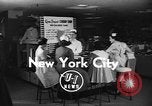
Specially designed and proportioned clothing is shown for overweight girls in New York City.
Fashions in New York for overweight girls. New styles for overweight youngsters are shown. Girls aged 7 to 15 display specially designed and proportioned clothing for heavier weight girls. Plus size girls wearing designed, attractive and inexpensive dresses. The girls gather at the "No Calorie Bar" of the "Lane Bryant Chubby Shop" and drink beverages prepared by a boy working behind the counter.
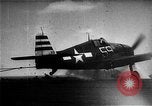
U.S. Navy Grumman F6F-5 Hellcat bursts into flames during landing on USS Randolph. Another F6F gets caught in the flames
U.S. Navy Grumman F6F-5 Hellcat fighter aircraft, from Squadron VF-12, with the number 59 painted on its fuselage, bursts into flames during landing on the deck of the aircraft carrier, USS Randolph (CV-15), in the Pacific near Okinawa. The F6F, piloted by Ensign Lowell Rund, experienced engine problems soon after takeoff and returned to the Randolph. As his F6F snags an arresting cable on the deck of the carrier, his centerline drop tank shackles fail and the 150 gallon fuel tank flies forward into the propeller, bursting into flames that engulf the aircraft. F6F-5 number 58, from the same squadron, gets caught in flames sweeping part of the flight deck of the Randolph. Firefighters carrying hose, respond. Other fire on flight deck seen in the background. They successfully rescue the pilot of number 58, who is seen on deck, as crew members help him remove his flight gear. (Not shown: Ensign Lowell Rund of number 59 was also rescued. He suffered third degree burns on his face and arms.) (World War II period).