


 Francais
 Deutsch
 Italiano
Refine Your Search
Myitkyina Burma 1944 stock footage and images
- Showing 379 to 384 of 6869 results more
more Hide
Hide
U.S. military cemeteries on recaptured islands in the Pacific; aerial bombing of Japan in WW2
Brief views of Allied bombing raids in Japan during World War II. A group of United States Army Air Force aircraft flying over Japan. An army cemetery in front of a building in the Pacific. United States Army Air Force aerial machine gun strafe Japanese positions on the Aleutian Islands. A chaplain praying over a coffin with the American flag draped over it. Aerial view of bombs falling and exploding into Japanese positions in China. Consolidated B-24 Liberator dropping bombs over Wake Island. View of Wake Island. Graves of U.S. troops on Wake Island, Burma, and other recaptured Pacific islands. Allied Airborne Infantry on the jungles of Burma (Myanmar). Gunshots are heard on the background. Two United States Consolidated B-24 Liberator aircraft flying to the Philippines. Allied bombardment of Hollandia (present day Jayapura, Papua, Indonesia). Grave of an unidentified soldier. United States troops land on a beach. A Howitzer is towed across a river. Soldiers rolling a barrel of oil. Snowplow truck clearing snow in front of a bomber. United States troops unload supplies at a snow-covered airbase.
United States war equipment unloaded into India and British forces training and battling Japanese (WW2)
United States Army soldiers in a market area in India during World War 2. American soldiers move about the market place in India, shop for items, and watch a snake charmer at work. Allied war equipment unloaded at a port and carried away on camel carts into Burma. American tanks being unloaded and transported by rail. Camel caravans hauling boxes of rifles and ammunition. Camels pulling wagons filled with armament. Supplies being loaded into U.S. Army aircraft for delivery to the battle front. British Indian troops move up the jungle terrain in Burma and fight against Japanese troops in World War II. British troops guarding a border railroad. Some British soldiers pop out from a hidden trench at a railroad line with rifles ready (likely training operation). View of an Indian river that narrator says is mined. Indian sappers wire wooden rafts with explosives to float out. American airmen on airfield with Indian temple in background are seen briefing Chinese pilots in training at the airbase. Closeup views of faces of Chinese pilots. Fighter aircraft and bomber aircraft taking off to hold open the Burma road from the air. Aerial view of aircraft propeller spinning on airborne aircraft with Indian city in background. Allied aircraft bombing Japanese positions.
Problem of getting U.S. supplies to China during Japanese aggression in China during World War II.
A film titled 'Coming Kunming' based on the problem of getting supplies to China and the activities of U.S. Troop Carrier Command during World War II. Japanese troops march into a Chinese town during Sino-Japanese war. They advance during an invasion. A map highlights the Burma Road linking Burma with China and Kunming, Yunnan and Lashio as its terminals. A Chinese woman works on the road. Trucks move along the road. The Ledo Road as an alternative to the Burma Road which had been cut by the Japanese Army. U.S. Army Air Force B-24 Liberator bombers in flight over the Himalayan Mountains. Inadequate dock facilities in Calcutta, India. A map details transportation problem. Native labor is used for the construction of a U.S. air base in India. Building of rail road lines. Chinese laborers work in China. Cargo ships underway at sea.
Chinese Chairman of Foreign Trade Commission K.P. Chen inspects tung oil dump in Yunnan, China (WW2)
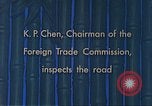
A film shows the Burma China Road as vital link between China and Burma during World War II. Chinese Chairman of Foreign Trade Commission Kwang Pu Chen, also known as K.P. Chen, with other Chinese officials walk out of a building. The Chairman's car moves along the Burma Road. He inspects tung oil storage dump. Oil drums in the area. K.P. Chen and other Chinese officials walk over drums. Chinese workers load the oil drums on a truck. Trucks loaded with the drums leave the dump.
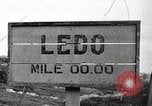
Construction and completion of the Ledo Road from India to China during World War II
Film opens showing road sign reading: "LEDO Mile 00.00." Scene shifts to rail lines at terminus of the Assam-Bengal railroad in the Indian Province of Assam. Surveyors are seen working in jungles. Engineers use machetes and construction machinery, like caterpillar tractors, to cut through the dense growth. Others saw and chop down trees and use explosives to clear the land. Explosives are seen detonating and tractors clearing the debris. Earth moving equipment and jack hammers being used to form a roadbed. View of two engineers setting and detonating a charge in a rock. A steam shovel loads earth into a dump truck. Road scrapers work in parallel to smooth the dirt roadbed. View of road after monsoon rains reduced one roadbed to a sea of mud and another inundated by water. To avoid these problems, rebuilding efforts begin by construction of causeways and bridges. Teams of workers lay planks for this. Closeup of worker tightening a clamp on a pontoon bridge under construction. Work gangs rolling and placing heavy logs as part of a bridge. Workers use a crane to lift segment onto a steel bridge under construction. Men bulding wooden and steel truss bridges. Aerial views from an airplane flying over various sections of the finished Ledo Road. A truck covered by a painted canvas reading: First Convoy over the Ledo Road, Pick's Pike Lifeline from India to China." Brigadier General Lewis A. Pick, Chief Engineer for the project, is seen, next, shaking hands with Lieutenant General Daniel Isom Sultan, Commander India-Burma theater, as he prepares to lead the convoy. View of the convoy starting out, led by the decorated truck. (Narrator states the road was now called, "The Stillwell Road." Views of the trucks proceeding and crossing causeways and bridges. Aerial view of the road twisting and turning across the high mountains. The convoy arriving in Kunming China greeted by Chinese troops and flags. Later, the convoy drives through the city streets of Kunming, with General Pick standing in a jeep, leading the way, and crowds of Chinese people cheering from the sidelines. In final scene, General Sultan states that the next project is a pipeline along the road.
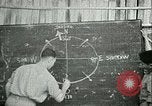
American and Burmese instructors train Burmese students in the uses of a compass and medical procedures during World War II.
U.S. OSS (Office of Strategic Services) officers train Burmese recruits in Burma during World War II. The students learn the uses of a compass and medical procedures for helping wounded comrades. A Burmese instructor shows them a compass and demonstrates its uses. The students listen as he gives instructions. The instructor demonstrates the uses of a compass on a map on the table. A Burmese recruit stands on a table as another wraps a bandage around his foot to demonstrate medical procedures. An American instructor and the other students observe. The American instructor then demonstrates tying of a bandage around the head. The Burmese instructor guides the students to follow the same steps. The American instructor looks on as the recruits demonstrate plastering a broken arm. He guides the students.
CRITICALPAST.COM: About Us | Contact Us | FAQs - How to Order | License Agreement | My Account | My Lightboxes | Shopping Cart | Advanced Search | Featured Collections | Website Terms & Conditions | Privacy Policy ©2026 CriticalPast LLC.
License Agreement |
Terms & Conditions |
Privacy Policy
©2026 CriticalPast LLC.