


 Francais
 Deutsch
 Italiano
Refine Your Search
Naha Okinawa Ryukyu Islands 1945 stock footage and images
- Showing 217 to 222 of 9403 results more
more Hide
Hide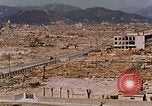
Buildings destroyed on an island between Motoyasu and Tenma rivers in Hiroshima, Japan as a result of the atomic bomb explosion.
Physical damage caused due to atomic bomb explosion in Hiroshima, Japan on August 6, 1945. Bridge across a river as vehicle moves over the bridge. Island between Motoyasu and Tenma rivers. Rubble spread all over the area with wooden huts. Buildings partially damaged by the atom bomb explosion. (World War II period).
Preparations for bombing, and bombing of Tokyo, Japan, by the U.S. Army Air Forces in World War II.
From "The Last Bomb", shows U.S. Army Air Forces conventional bombing of Japan in 1945, during World War 2. Map shows take off points in Saipan, Guam and Tinian. Guam Island shores. Houses and mountains in Guam. Civilians in village. U.S. military equipment, ammunition, vehicles and aircraft parked at airfield. Men around tents. Men at airfield engaged in morning activities. B-29 aircraft parked and others taxi at airfield. Technicians work on aircraft engines. Men manning B29s. Men board B29s. Sign reads 'Headquarters XXI Bomber Command'. General Curtis LeMay around chart planning raid on Japan's industrial areas. Other officers in room. Officer stand up as General Curtis leaves. Officers discuss the plan of attack. Bombs including GP bombs transferred at airfield. Submarines speed up in water to take up positions. Officers at headquarters in discussion. Officers talk on phone. Officer around flight status panel carry out visual progress of the flights. Officer marks positions. Time table for statistics of each wing on wall. B29s taxis for take off at airfield.
Invasion of Corregidor by U.S. 503rd Air Regiment and 24th Division during World War II.
Battle of Corregidor fought between U.S. troops and Japanese troops in Corregidor, Luzon Island, Philipinnes during World War II. Japanese troops lower the U.S. flag and raise the Japanese flag after the fall of Corregidor in 1942. U.S. troops in Japanese prison camps. Invasion of Corregidor on February 16, 1945 by U.S. 503rd Air Regiment and 24th Division. A U.S. convoy underway at sea. U.S. naval battleships attack shore targets. Planes take off from an airfield. U.S. 503rd Air Regiment dropped by parachutes. Paratroopers land in Corregidor. U.S. 24th Division comes ashore in amphibious vehicles, troops land and fight their way inland.
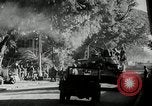
Brutalities against prisoners, officials gathered in 1949 in Palace of Nations for Third Geneva Convention; discussion of Geneva Conventions.
Film from 1965 shows scenes that span from early 1940s through mid 1960s. Film opens showing armed conflict in Laos and South America. Soldiers firing rifles in jungle areas. Armed men running across a field and in a town in Cyprus. Heavy armor engaged in conflict and buildings burning in undisclosed location. Riots in Congo with a crowd of men beating another man. Armed Republic of South Vietnam soldiers (ARVN) moving through jungle in Vietnam War. A Viet Cong fighter shot as ARVN troops attack a hut. People fleeing in streets of Cuba as government soldiers engage armed revolutionaries under Castro. A civilian woman suffering a seizure as Red Cross workers attempt to carry her. Burned body of dead tank crew soldier atop a tank. Medical corps persons moving wounded on a stretcher. Various views of ARVN with captured Viet Cong in Vietnam. Narrator discussion about Geneva Conventions and Counterinsurgency. View of the Palace of Nations building in Geneva Switzerland. Scene shifts to inside, in 1949, where delegates of 59 nations are gathered to develop new rules expanding the original 1929 Geneva Conventions, in order to better protect prisoners of war, wounded prisoners, noncombatants and others caught up such internal conflicts. View from ground of German paratroopers during World War 2, jumping from Junkers Ju-52 trimotor transport planes. Closeup of German soldiers leaping from a plane and descending in parachutes. Japanese soldiers surrendering to Americans on a Pacific Island in World War 2. Several scenes of massacre victims lying on the ground, victims of Nazi German brutality in Europe during World War II. Survivors of a Nazi concentration camp near the time of its liberation in 1945. A U.S. Army medical corpsmen help one to a stretcher. Executed prisoners of war. Courtroom of the Nuremberg trials. Seen in the front row of Nazi leaders are: Hermann Göring, Rudolf Hess, Joachim von Ribbentrop, Wilhelm Keitel, Ernst Kaltenbrunner, Alfred Rosenberg, Hans Frank, Wilhelm Frick, and Julius Streicher. Seated behind them are: Karl Dönitz, Erich Raeder, Baldur von Schirach, Fritz Sauckel, Alfred Jodl, Franz von Papen, Arthur Seyss-Inquart, Albert Speer, and Konstantin von Neurath. Scene shifts to the postwar trial of Japanese Lieutenant General Masaharu Homma, in the Philippines. Prisoners with hands bound, in an unidentified Asian conflict, being herded into an open truck. Views of the document constituting the 3rd Geneva Convention of 1949, addressing treatment of prisoners and of parts directed to "conflicts not of an international character." Views of a traumatized civilian driver wounded and a female passenger killed in in his car (appears to be in Cuba or Latin America). Armed gunmen have the man leave the car. A man lays the body of the woman beside the car. Scene shifts to a group of surrendered Vietcong fighters with their weapons stacked. Wounded combatants being carried on stretchers. American survivors of a Japanese prison camp receiving a good meal after being rescued - this is possibly in the Philippines in 1945. Many of the American prisoners are gaunt and emaciated and malnourished. Narrator recites list of activities prohibited by Geneva conventions, as images show these activities: A ditch filled with victims of massacre. Hostages being taken in an internal conflict in an African country. Prisoners being beaten by non-uniformed civilians in and humiliated in public. A recently liberated prison with a former prisoner in striped uniform beating a man as a group is marched away (likely a World War 2 concentration camp with a liberated prisoner beating a former Nazi guard). Death sentences being rendered without due process. A court in Cuba. A boy pointing at a lineup of prisoners. A prisoner shot.
Sailors aboard USS Intrepid continue to extinguish fire and clean-up after Japanese kamikaze plane attack of 16 April 1945
USS Intrepid (CV-11) aircraft carrier underway in the Pacific Ocean during World War II, near the Ryuku Islands, in support of operations on Okinawa. U.S. Navy sailors on the deck of the aircraft carrier with fire hoses. Sailors work to extinguish fire after a Japanese kamikaze aircraft crashed into the ship. Smoke rises from the carrier. Men clear wreckage of the aircraft. Intrepid's 20 mm guns fire at enemy planes.
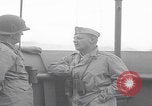
General Andrew D. Bruce and Admiral Ingolf Kiland inspect the Kerama Retto islands (WW2)
U.S. Admiral Ingolf Norman Kiland (Commander of amphibious operations) and Major General Andrew D. Bruce on a ship off the Kerama Retto (near Okinawa Island) in Japan during World War 2. Admiral Kiland and General Bruce talking to each other. General Bruce and Admiral Kiland use binoculars to inspect the Kerama Islands. Closer view of Admiral Kiland. An officer speaks to General Bruce and Admiral Kiland.
CRITICALPAST.COM: About Us | Contact Us | FAQs - How to Order | License Agreement | My Account | My Lightboxes | Shopping Cart | Advanced Search | Featured Collections | Website Terms & Conditions | Privacy Policy ©2026 CriticalPast LLC.
License Agreement |
Terms & Conditions |
Privacy Policy
©2026 CriticalPast LLC.