


 Francais
 Deutsch
 Italiano
Refine Your Search
Naples Italy 1943 stock footage and images
- Showing 367 to 372 of 4566 results more
more Hide
Hide
Army Signal Corps receive and send messages via various methods in World War II; Pentagon signal center operations.
The role and contribution of the U.S. Army Signal Corps in combat during World War 2. Submarine cables laid down by the Signal Corps. Soldiers operate field army communication equipment for communication within and between units. Soldiers talk over the radio in a military jeep. American soldiers employ communication equipment seated at a table in a camp. A U.S. Army Signal Officer goes through documents. An officer receives a message in Washington DC. The message is relayed from the State Department to the Signal Center in the Pentagon building. Exterior views of the Pentagon building circa 1943 or 1944. Inside the Army Communications Signal Center in the Pentagon, technicians work using various communication equipment. They receive messages punched on tape as the tapes emerge from machines. Workers encoding and decoding secret and confidential messages that run the war. Workers at the 'Traffic Control, Army Command and Administrative System'. Paper messages seen gliding across a track near the ceiling above a signboard. A man inserts and removes cables from switchboard slots. The plans are then passed on in code through a maze of antennas all over the world. An animated map depicts the sending of these messages by radio multi-channels, radio teletypes, and manual radios to the front lines. A vast network of Army communication system from Washington DC to the rest of the world to carry a message around the world in three and a half minutes.
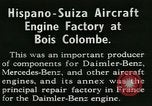
The damaged Hispano-Suiza Aircraft Engine Factory after three attacks by the U.S. Eighth Air Force during World War II.
Results of air assaults by the British Royal and U.S. Eighth Air Forces over industrial areas in and around German-occupied Paris during Wolrd War II. The damaged Hispano-Suiza Aircraft Engine Factory (producer of components for Daimler-Benz, Mercedez-Benz) at Bois Colombe, after three attacks by the U.S. Eighth Air Force in December 1943. The destroyed crankshaft plant, foundry, and tool shop. Aircraft engines overhauled, crafted and ready for shipment, left behind by the fleeing Nazis. Allied soldiers and workers under the bare roof. Damaged equipment and material. Allied officers and civilians survey the damage. Collapsed roof structures. Debris and rubble strewn all over the floor. Bent steel structures. Buildings in the surrounding area. Military jeeps parked in the factory grounds. Damaged structures left standing.
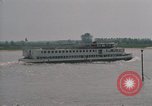
American correspondents visit cemetery in Opijnen, Gelderland, the Netherlands for Memorial Day ceremony honoring U.S. B-17 crew
American correspondents in Netherlands to mark 25th anniversary of Allied invasion of Europe in World War II. A steamer underway in a canal. Views in the village of Opijnen, in Gelderland, the Netherlands. A correspondent and his wife come out of a house. American correspondents near a bus. Houses along a road. An American flag at the walled cemetery in Opijnen, beside its 17th century Dutch Reformed Church, where the crew members of an American B-17 bomber from the 323 Squadron of the 91st Bomb Group (H) of the U.S. 8th Army Air Force are buried; shot down July 30, 1943 by the German Luftwaffe. Gravestones bearing the names of American soldiers who lost their lives when their crippled B-17 was shot down, including: Mike Anthony Perrotta, Hermon Daines Poling, Harold Royce Sparks, Robert Urquhart Duggan, Douglas Victor Blackwood, Americo Cianfichi. U.S. Color Guard marches from a town building toward the cemetery. A woman correspondent takes pictures. An American flag flies at half mast. Men, women and children at the cemetery. Dutch children carry flowers in their hands. The mayor of Opijnen speaks into a microphone. He and a woman place flowered wreaths at the graves of dead American soldiers. Two groups of four U.S. Convair F-102 Delta Dagger aircraft fly overhead followed by four F-104 Starfighters of the Royal Netherlands Airforce. Children walk past the graves. Additional propeller aircraft pass overhead honoring the airmen.

Destroyer Escort USS Frament, DE 677, is built and launched. Destroyer Escorts fitted out, readied for shakedown cruise
U.S. Destroyer Escort USS Brennan, DE-13,underway. U.S. navy crew aboard the ship. View at shipbuilding area of Bethlehem Steel in Quincy, Massachusetts. Keel is laid and shipbuilders busy on day 60 of construction of DE-677, the USS Frament. Scenes of construction. Welding steel plate. DE-677 is christened USS Frament and launched on June 28, 1943. Destroyer Escorts at pier, being fitted out. New ship's crew assembled on pier and boards for shakedown cruise. Supplies and munitions loaded on board the ship, including ammunition, depth charges, and torpedoes ("tin fish").
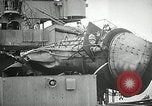
Damaged USS Louisville and men overhaul it in Okinawa, Japan.
Damaged USS Louisville (CA-28) hit by Japanese Kamikase in World War 2. Damaged forward stack of the ship. Float of its scout plane left on catapult, is jettisoned. Large stack of the USS Louisville knocked down. Engine of seaplane blown up by explosion on the signal bridge. Man welds in superstructure. View of other men working to repair damage to the Cruiser.. [Note: The following eyewitness account of the kamikaze attack was recorded by Seamen 1st Class, Enrico Trotta, who was a crew member on the USS Louisville (CA-28) from 1943 to 1946, "At 1923 (hours) two planes which were identified as friendly flew around and one kamikaze dove onto the battleship USS Mississippi BB 41. The other kamikaze plane turned to the Louisville and started to make a run on us. I was on No. #4 - 20 mm AA gun mount on the port side below #2 main battery and I fired 58 rounds to set the kamikaze plane on fire prior to hitting the Louisville’s front smoke stack bending and twisting it and killing 9 men on the 40 mm gun mount mounting on the forward superstructure tripod about 140 feet from our gun mount. The kamikaze also cut our sea plane off and left only the pontoon on the catapult. Three other 20 AA mm gun crews opened up firing 4, 11, and 20 rounds as well. We were not told to fire for we did it on our own. We were only manning the guns at the time and were not on general quarters. Later, the officers came by and said good job."]
Montage of scenes related to the China-India-Burma theater during World War II
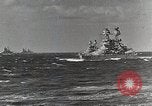
Two U.S. Pennsylvania class battleships underway at sea, with other warships in background, during World War 2. One fires to starboard with her 14-inch guns from the forward triple turrets. U.S. Army Air Forces B-24 Liberator bombers flying in formation over mountains. Glimpse of General Douglas MacArthur with General Joseph (Vinegar Joe) Stilwell in gunner's station of a bomber. Montage of brief glimpses showing U.S. forces engaging Japanese forces in: amphibious assaults; firing weapons in New Guinea and other Pacific islands. U.S. warship firing naval guns. U.S. ship firing at attacking Japanese aircraft, with sky full of black flak clouds. Admiral William (Bull) Halsey. Mitsubishi A6M Zero kamikaze aircraft blown up close to flight deck of U.S. aircraft carrier. It misses the ship and crashes in flames, exploding in the water, astern. U.S. General Joseph Stilwell, Madame Chiang Kai-Shek, British Allied commander Lord Louis Mountbatten, and Chinese Generalissimo Chiang Kai-Shek, photographed together in India. Chinese Generalissimo Chiang Kai-Shek seated for a picture with U.S. President Franklin D. Roosevelt. Camera moves back revealing British Prime Minister Winston Churchill, and Madame Chiang Kai-Shek, also seated. Behind them stand key allied military leaders, including (from the right) Field Marshal Archibald Percival Wavell, Commander-in-chief in India; Admiral Louis Mountbatten, Supreme Allied Commander of South-East Asia forces; George Giffard — commander of Eleventh Army Group; U.S. General Daniel Isom Sultan, deputy to General Stilwell; General Joseph Stilwell, Commander China-Burma-India (CBI) Command; and General Albert Coady Wedemeyer, Chiang Kai-Shek's Chief of Staff. General Joseph Stillwell is seen stepping from a military cargo plane, and being greeted by another officer. Stilwell is wearing a campaign hat. He has the CBI patch on his jacket shouder. A B-24 Liberator bomber takes off from a Chinese base at Liuchow, or possibly, Luiliang, China. (ostensibly carrying Chinese soldiers to India for training). U.S. marked P-40 aircraft are parked beside the runway. They display the shark teeth nose art of the Flying Tiger All volunteer Group of Claire Chennault. But this is 1944 and the aircraft are from the U.S. 23rd Fighter Group. Chinese soldiers are seen being armed and trained in India, with modern small arms. They are also seen fording a river with military supplies and moving in jeeps through jungle-like settings. Various views of Ledo Road construction in Burma. bulldozers, trucks, caterpillar tractors, explosives and men are shown in construction work. A jeep rides along a muddy section of the new road while U.S. and Chinese soldiers patrol on either side to protect it. Allied soldiers firing a small field piece. A C-47 aircraft airdrops supplies to the road builders. General Stilwell, standing with a Chinese officer, looks skyward at the aircraft. A C-46 Commando plane taking off from a field in India carrying supplies. Men loading a jeep aboard a C-46, plus ammunition and other supplies. Rare sight of supplies being loaded into nose cargo compartment of the one-of-a-kind XC-108A transport plane (modified B-17 bomber, tail number 41-2593). A formation of USAAF C-45 transport aircraft flying "over the Hump." Chinese P-36 Hawk aircraft in formation demonstrate firepower. Newly trained Chinese pilots marching and walking on flightline where solid-nose B-25s and P-40s are parked. Chinese and American pilots wave to each other from their P-40 aircraft. A B-25 takes off flanked by two P-40s. Bombs being dropped by Chinese B-25s. Japanese ship being strafed by Chinese fighter plane. Chinese laborers at work building an airfield without machinery. A large group pull a paving roller by hand. Chinese troops in combat with Japanese forces. One firing a Czech ZB vz. 26 light machine gun. Madame Chiang Kai-Shek addressing the U.S. Congress, 18 February, 1943.