


 Francais
 Deutsch
 Italiano
Refine Your Search
Nevada United States 1936 stock footage and images
- Showing 13069 to 13074 of 27248 results more
more Hide
Hide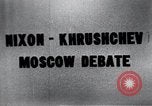
Richard Nixon and Nikita Khrushchev debate on economic systems of countries in Moscow, Russia.
Television broadcast of so-called "Kitchen Debate" between then U.S. Vice President Richard Nixon, and Soviet Premier Nikita Khrushchev, at the opening of the American National Exhibition at Sokolniki Park in Moscow on July 24, 1959. Ron Cochran, news journalist, introduces the event. Nikita Khrushchev states that Russia wants to live in peace. He states the level of development Russia has reached in 42 years and compares it with American development of 150 years. He speaks on the economic system of capitalism. They discuss communism and capitalism. Khrushchev expresses his gratitude for the presence of Richard Nixon at the event. Nixon points to the growth in color television. They discuss development in communication. He says that everything Nikita Khrushchev says will be broadcast in the United States in English.
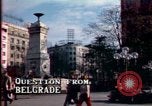
Hosts answer questions on Reagan's visit to Cancun,foreign policies to Nicaragua and America's trade policies in Washington DC
Television broadcast of Henry Trewhitt and Harry Ellis answering to the questions from a studio in Washington DC. A viewer asks a question from Belgrade. Cancun, Mexico: View of the coast of the city. President of the United States Ronald Wilson Reagan disembarks from the aircraft. The president with the officials. Harry Ellis speaks about the conference of industrial powers and of the developing nations. A viewer asks question from Oslo about the President's foreign policies to Nicaragua. People in Nicaragua. Henry Trewhitt states that the U.S. will not bear the socialist Sandinista government in Nicaragua. A viewer asks question from Seoul about America's trade policies. Harry Ellis speaks about the export of steel to Korea. Steel poles hooked are loaded on a transporter at dock. An overhead crane moves a furnace containing molten steel. Harry Ellis states that the president Reagan will work on protecting steel and automobile industry.
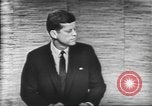
During a presidential election debate in Washington DC, Kennedy comments that its proper to express regrets to nations.
The second Kennedy-Nixon Presidential Debate in Washington DC, United States . Edward P. Morgan of ABC News asks Democratic candidate Senator John F Kennedy about sending apologies or regrets to General Secretary of the Communist Party of the Soviet Union Nikita S Khrushchev over the U-2 reconnaissance aircraft incident. Kennedy answers that if it could save the summit conference it would have been proper to express regrets. He speaks that the U-2 flights were proper from the point of view of protecting their security. But they were not in accordance with the international law. He speaks about the regrets expressed to Castro, to Southern Russia and to Eastern Germany under the Eisenhower Administration during the past years. He mentions the regrets expressed by the Soviet Union and the Chinese Communists to the U.S. over incidents. He states about they should have a stronger military force and should increase their strength all over the world. Republican candidate U.S. Vice President Richard M. Nixon presents his views and states that Senator Kennedy is wrong in thinking that Khrushchev might have continued with the summit conference if the U.S. had expressed regrets. He disagrees with Kennedy's analogies that the U.S. is a strong country and can express regrets for any wrong doings. He also disagrees in expressing regrets to anybody for doing things which has the support of the Congress and which is right from point of view to protect the security of the U.S. (This 4 part debate is sometimes called the Great Debate)
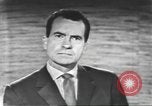
During a presidential election debate in Washington DC, Kennedy and Nixon give their views on the importance of party labels.
The second Kennedy-Nixon Presidential Debate in Washington DC, United States. Harold R Levy of Newsday asks Republican candidate U.S. Vice President Richard M Nixon to comment on the importance of party labels. Nixon answers and talks about Democratic and Republican Presidents. He says that the party label is not important, it is the belief and the leadership qualities of the presidential candidate that are important. He states that it is the people who determine and elect their presidents. He disagrees with Kennedy's statement that his party has not proposed programs. He mentions the programs proposed by his party in fields like education, housing and defense that would lead to the overall development of the nation. Democratic candidate Senator John F Kennedy presents his views and states that party labels are important as they tell about the programs and the candidate. He says that the Democratic party has stood for progress, people's welfare, strong foreign policy and national defense. He compares the approaches used by Democratic presidents with those used by the Republican presidents. He concludes that in the past years the Republicans have opposed housing, care for old age, federal aid to education and minimum wage. Moderator Frank McGee thanks the candidates and mentions future program details.
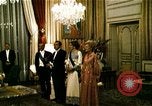
President Richard Nixon poses with Shah of Iran Mohammad Reza Pahlavi for pictures in a palace in Tehran, Iran.
U.S. President Richard Nixon attends a state dinner the Niavaran Palace (Tehran Province Tehran District 1 Niavaran St, Niavaran Square, Iran) in Tehran, Iran. President Nixon, the First Lady of the United States Pat Nixon, Shah of Iran Mohammad Reza Pahlavi and his wife Shahbanou Farah Pahlavi pose for pictures after the dinner. President Nixon, the Shah of Iran, and their wives are dressed in formal wear for a state dinner.
U.S. President Richard Nixon addresses people and speaks about the American music in Nashville, Tennessee.
The opening of the Grand Ole Opry house in Nashville, Tennessee. U.S. President Richard Nixon present with his wife at the ceremony. Nixon addresses the people. He talks about the American music. He states that the country music has a magnificent appeal all across the country. He talks about some of the Hollywood stars, singing some of the more modern music that is hard to understand. He also talks about some of the men who served the United States in Vietnam and were prisoners of war. They were being entertained at the White House. They had been in prison for more than 6 years. He further states that the American music talks about family, it talks about religion, the faith in God that is very important to the country and particularly to the family life. He says that the country music radiates a love of the Nation, patriotism. People applaud as he ends his speech.
CRITICALPAST.COM: About Us | Contact Us | FAQs - How to Order | License Agreement | My Account | My Lightboxes | Shopping Cart | Advanced Search | Featured Collections | Website Terms & Conditions | Privacy Policy ©2026 CriticalPast LLC.
License Agreement |
Terms & Conditions |
Privacy Policy
©2026 CriticalPast LLC.