


 Francais
 Deutsch
 Italiano
Refine Your Search
Nevada United States 1936 stock footage and images
- Showing 13075 to 13080 of 27248 results more
more Hide
Hide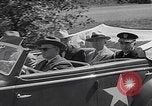
President Harry S. Truman and officials inspect damage in Berlin before the Potsdam Conference (WW2)
United States President Harry S. Truman visits Berlin for the Potsdam Conference at the end of World War 2 in Europe. President Truman, Admiral William D. Leahy, Secretary of State James F. Byrnes, sit in open car to view Berlin in ruins. Berlin buildings and façade are destroyed from heavy bombing. Ruins of the Reich Chancellery (Wilhelmstraße 77 10117 Berlin Germany) is seen. President Truman’s car passes by the Berlin Victory Column or Siegessäule (Großer Stern, 10557 Berlin, Germany). Closer view of the Berlin Victory Column, featuring the Victoria statue on top. Large portraits of President Truman, Russian Premier Joseph Stalin and Prime Minister Winston Churchill on a Russian reviewing stand on Berlin’s Unter den Linden Avenue. President Truman’s convoy approaches the Brandenburg Gate (Brandenburger Tor Pariser Platz, 10117 Berlin, Germany), damaged by heavy bombing. Cars driving on the Unter den Linden Avenue. The Berliner Schloss (Schloßpl. 1, 10178 Berlin, Germany) with significant damage. The Secret Service stand on running boards of President Truman's car. President Truman greets a man from his car. President Truman, Admiral Leahy and Secretary of State Byrnes talking. A huge pile of rubble stands in front of a damaged building. Crowds of men and soldiers surround President Truman and his car. Soldiers with cameras take photographs. Secret Service men running alongside President Truman’s car. President Truman’s car passes by a Nazi-style building, driving into the Autobahn. A Military Police vehicle, which acts as guard, follows behind President Truman's car heading to Potsdam.
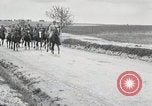
African American soldiers of 369th Infantry, 93rd Division, U.S. Army marching on road in Maffrecourt, France, during World War I
African American soldiers of the 369th Infantry Regiment, 93rd Division ("Harlem Hellfighters"), United States Army, march in formation along a road in Maffrecourt, France, in World War 1. They are led by mounted officers, and a brass band (likely under the direction of band leader Lt. James Reese Europe). Unit leaders salute as they pass the camera. Mules pull several artillery pieces and caissons. Several medics march with stretchers. The U.S. flag is the only one carried by the color guard. No unit colors are seen. The 369th Infantry soldiers wear French helmets because they were assigned to the French Army during the war, as the U.S. Army (American Expeditionary Forces) did not permit African Soldiers in combat.
U.S. Army soldiers guard German SS-Totenkopfverbände (SS-TV) prisoners of war being held near a village.
United States Army soldiers guarding a group of German SS prisoners of war who are being held near a village. Cameraman slate indicates location of "Wittring" (presumably Wittring France, just outside the German border, in the Moselle region), but U.S. government record accompanying the film indicates "Wittring, (?) Germany" (sic). A wheel cart is seen on the street. The German prisoners of war have SS markings on their right lapel and also the SS skull insignia on the cap, identifying them most likely as part of the SS-Totenkopfverbände or SS-TV; also called Death's Head units. (Theories on these captured soldiers include: 1) SS-TV units were primarily in charge of administering the Nazi Concentration Camps in World War II. Hinzert Concentration Camp was possibly the closest camp to Wittring. Perhaps these soldiers came from it or another camp; 2) They may have been part of the 3rd SS Panzer Division. Reportedly, whole platoons and elements of the 3rd SS Panzer division were not following orders and were giving up prior to the Budapest and Vienna battles to avoid Soviet captivity, as early as Jan 1945). Prisoners rub their hands to warm them in the cold. Camera shows a close-up view of one of the prisoners, as an American soldier attaches a Prisoner of War identification tag over around the neck of the prisoner.
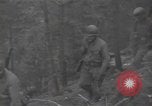
Review of U.S. Army Combat Team operations during the Korean War
Operation of a U.S. Army Combat Team from the Eighth United States Army (EUSA) during the Korean War. Infantry soldiers walk through rocky mountains carrying guns. Soldiers look through binoculars at observation posts and relay targeting information to artillery. U.S. Army artillery firing on enemy positions. Infantry dug in on a trench line. U.S. Army grasshopper observation aircraft in the sky scouting out target sites. Views of artillery being loaded, aimed, and fired, including by a group of African American soldiers. Tanks and infantry on the move together as an Armored Infantry Unit. Narrator discusses relationship between infantry troops and tanks and how they work together as a team. Mortar units aiming and firing. At an airfield, weapons are loaded onto planes including P-51 Mustang aircraft and jets. Planes being fueled. 5 inch rockets and 50 caliber machine guns are loaded, along with Napalm and demolition bombs. View of pilots in combat briefing and then exiting briefing to fly mission. P-51 Mustangs taking off from airfield. Mustang fighters in the air and views of Mustangs firing on enemy positions with guns and bombs. Air-Ground Liaison Team shown in a jeep on the ground providing targeting information to planes via radio.
UN Charter signed in San Francisco Conference; President Harry S. Truman addressing General Assembly; Franklin Roosevelt speech about peace
Delegates arrive in San Francisco for United Nations Conference for World Organization in San Francisco, California. U.S. President Truman arrives by airplane at the conference and is met by representatives from U.S. delegation including Stettinius. Delegates from other countries are also present and greet the President including Jan Smuts of South Africa and William Lloyd Mackenzie King of Canada. Views of presidential motorcade traveling through streets of San Francisco in a parade-like environment, with crowds lining the sidewalks and cheering. Delegates sign the United Nations Charter during the conference. First to sign is Dr. Wellington Koo from China, signing with a traditional Chinese brush. Also shown signing is Gromyko from the Soviet Union, Lord Halifax from Great Britain, and the delegation from France led by acting delegation chairman Joseph Paul-Boncour. Next is Edward Stettinius and Senator Tom Connally, Senator Arthur Vandenberg, Commander Harold Stassen, from the United States. U.S. President Harry S. Truman addresses the general assembly. Representatives of different nations like Lord Halifax of Great Britain, Mackenzie King of Canada, Jan Christian Smuts of South Africa, Andrei Gromyko of Russia and Pandit Jawahar Lal Nehru of India can be seen. Flashback to President Franklin D Roosevelt, shortly before his death, addressing Congress about the coming San Francisco Conference. Roosevelt speaks, expressing his hope that Congress and the American People would "accept the results of this conference as the beginning of a permanent structure of peace, upon which we can begin to build, under God, that better world in which our children and grandchildren -- yours and mine - children and grandchildren of the whole world -- must live and can live."
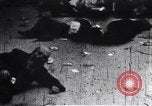
Atrocities committed by Nazis against Jews in Germany, submitted as evidence "Exhibit USA-280" during the Nuremberg Trials
Portions of a damaged film. Excerpted from original shown during the Nuremburg trials and submitted as "Exhibit USA 280." Nuremberg trial transcripts of 13 December, 1945 include the following excerpted descriptions of the footage spoken by U.S. Commander William J. Donovan: "This is a strip of motion pictures taken, we believe, by a member of the S.S., and captured by the United States military forces in an S.S. barracks near Augsburg, Germany...We have not been able to establish beyond doubt in which area these films were made...The film offers undeniable evidence, made by Germans themselves, of almost incredible brutality to Jewish people in the custody of the Nazis, including German military units. It is believed by the prosecution that the scene is the extermination of a ghetto by Gestapo agents, assisted by military units...This film was made on an eight millimetre home camera...The pictures obviously were taken by an amateur photographer...it is burned...This is a silent film....I wish to...direct the Tribunal's attention to certain of the scenes. Scene 2: A naked girl running across the courtyard. Scene 3: An older woman being pushed past the camera, and a man in S.S. uniform standing at the right of the scene. Scene 5: A man with a skull-cap and a woman are manhandled. Scene 14: A half naked woman runs out of the crowd. Scene 15: Another half-naked woman runs through the house. Scene 16: Two men drag an old man out. Scene 18: A man in German military uniform, with his back to the camera, watches. Scene 24: A general shot of the street, showing fallen bodies and naked women running. Scene 32: A shot of the street, showing five fallen bodies. Scene 37: A man with a bleeding head is hit again. Scene 39: A soldier in German military uniform, with a rifle, stands by as a crowd concentrates on a man coming out of the house. Scene 44: A soldier with a rifle, in German military uniform, walks past a woman clinging to a torn blouse. Scene 45: A woman is dragged by her hair across the street.
CRITICALPAST.COM: About Us | Contact Us | FAQs - How to Order | License Agreement | My Account | My Lightboxes | Shopping Cart | Advanced Search | Featured Collections | Website Terms & Conditions | Privacy Policy ©2026 CriticalPast LLC.
License Agreement |
Terms & Conditions |
Privacy Policy
©2026 CriticalPast LLC.