


 Francais
 Deutsch
 Italiano

Refine Your Search
Nevada United States 1936 stock footage and images
- Showing 20401 to 20406 of 35683 results more
 Hide
Color Sound
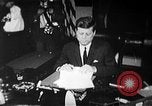
In the US, President Kennedy receives a message from Soviet Premier Khrushchev about dismantling of missiles in Cuba.
Events in the United States during the Cuban Missile Crisis of October 1962 when the United States and the Soviet Union confronted each other with nuclear destruction. U.S. President John Kennedy signs a quarantine order. U.S. Air Force B-52 Stratofortress bombers take off. U.S. Air Force interceptors and fighters take off from U.S. aircraft carriers at sea. Radar dishes moving. A U.S. battleship underway at sea. A U.S. aircraft intercepts a Soviet tanker and allows it to proceed. U.S. reconnaissance aircraft over Cuba. U.S. Air Force SAC (Strategic Air Command) bombers are prepared for a take off. U.S. missiles are prepared. Head Quarters of American Air Defense Command shows interiors of a control room. People wait for news. Exteriors of the White House in Washington DC. Exterior of the Kremlin in Moscow, Soviet Union. A press announcement about a message that President Kennedy has received from Soviet Premier Khrushchev saying that he will dismantle missiles in Cuba.

President Franklin D Roosevelt poses with the cabinet members and introduces them at the White House in Washington DC.
New members of Roosevelt's cabinet in the United States. U.S. President Franklin D. Roosevelt poses with the cabinet members in the White House. The President introduces the members of his cabinet. He introduces Hill, U.S. Postmaster General Farley, U.S. Attorney General Cummings, Perkins, Dern, Swanson, Wallace, Roper and Ickes. Claude A. Swanson is U.S. Secretary of the Navy. U.S. Secretary of Agriculture is Henry A. Wallace. George H. Dern is appointed as U.S. Secretary of War. U.S. Secretary of the Interior is Harold L. Ickes. U.S. Secretary of Commerce is Daniel C. Roper. Frances Perkins is appointed as U.S. Secretary of Labor.

The launch of the U.S.S Tennessee, a battleship in New York.
The launch of the USS Tennessee (BB-43) battleship in New York. Scene of the navy yard. A large crowd gathers to watch the ship. The battleship in the sea. Other ships in the background.
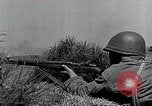
Role of American women in the military; WACS, nurses, and other military roles for women in World War 1 and World War 2
The role of women in the armed forces in the United States. A U.S. Army sniper fires a 1903 Springfield rifle on the Korean front during the Korean War. A woman in the Women's Army Corps (WAC) inspecting such a rifle in the U.S. Several Patton Tanks moving up a hilly road in Korean War. A WAC testing the turret of a Patton tank. U.S. Army women at desks as they work with Army men in an office. Picture depicts Molly Pitcher, wife of a fallen U.S. Revolutionary War artilleryman. Depiction of George Washington at desk. Depiction of Clara Barton, an American nurse with a wounded soldier. Reenactment of Clara Barton working with another women. A man holds the flag of the American red cross. Actual footage of a Wright Brothers aircraft in flight. Women in long dresses pushing an early model of car. A group of American soldiers in World War I running on a battlefield.. U.S. Army troops wearing gas masks and firing rifles from trench in World War I. American women war production workers assembling belts of machine gun bullets during World War I in a munitions factory in the United States. A nurse tending a wounded soldier. A woman nurse helping place a wounded soldiers into an ambulance in Europe, in World War I. Nurses in an operating theater in a hospital during World War I. Women march in victory parade at end of World War I. Women's suffrage demonstration by suffragists (sometimes called suffragettes) in front of the White House and then women and men entering a polling place to vote around time of of 19th amendment giving women the right to vote in 1920. Aviatrix Amelia Earhart climbing down from an airplane. Swimmer Gertrude Ederle on an award stand. U.S. Navy Vought SB2U-2 planes in flight as they drop bombs. Scene of Pearl Harbor attack by Japanese during World War 2. Army nurses look out from deck of ship in World War II. Soldiers fire artillery. View of mountains and scenes of combat on islands in the Pacific during WWII. General Mark Clark awards nurse Silver Star medal. Repatriated Army nurses, who were prisoners, are loaded onto an aircraft by means of a fork lift. In 1942, President Franklin D. Roosevelt signs legislation establishing the Women's Army Auxiliary Corps (WAAC). Secretary of State George Marshall and others witness the signing. Depiction of Godess Athena. Women volunteering for WAAC move in a line carrying bags. American women in military uniform marching. WAAC volunteers being processed. Women receive physical exams and receive inoculations. WAAC personnel being trained: working on X rays, in medical pharmacy laboratories, food service, and radio work. Women on board warships in World War 2.
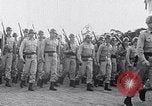
United Nations Security Council meeting to protect South Korea and preparation by US Marines and Army for Korean War.
United Nations meets to organize military action for protection of South Korea from Communist North Korea. United States troops in Tokyo, Japan prepare to advance to Korea. U.S. Army forces are seen passing in review before General MacArthur and General Omar Bradley in Tokyo, Japan. Back in the United States, a B-29 bomber, "moth balled" by being entirely encased in "cocoon" plastic since after World War 2, is rolled onto an airfield. Air force personnel remove the heavy plastic from the body and tires of the B-29, revealing its World War 2 nose art name "Lucky 13" (which had been among B-29 aircraft of the 25th Air Service Group in World War II). Navy Vought F4U Corsair aircraft with folding wings are unloaded from giant containers in aircraft hangars. A group of the F4U aircraft lined up at an airfield. Military equipment being loaded onto waiting ships, and carried by soldiers at a warehouse area. Units of the 1st U.S. Marines answer the call, are seen piloting amphibious vehicles in the ocean and onto the dock landing ship USS Gunston Hall (LSD-5) . Canadian sailors are seen boarding ships and Candian Navy destroyers leave British Columbia for Korea. Women and children wave form dock. Destroyers underway in sea. White, African American, and Hispanic young men in the United States are seen standing in lines at a United States Army enlistment office, answering the call to serve as new recruits in the Army. A group of new recruits raise their right hands and take an oath of service. U.S. President Harry S Truman speaks to a meeting of the Reserve Officers Association meeting, indicating that the only reason for this action is to hopefully arrive at the peace in the world that was hoped for when the United Nations was created. He leaves and shakes hands with officers. At Security Council meeting of the United Nations in Lake Success, New York, the President of Council, Arne Sunde, of Norway, invites Korean Ambassador to join table. Ambassador Chang comes and sits. The United Kingdom representative presents resolution which the body votes on (United Nations Security Council Resolution 84). It is passed by 7 to 0 in favor. The U.S. is asked to designate a military commander for the United Nations forces. The Korean ambassador, Chang Myon, expresses gratitude to the UN Security Council.
British Prime Minister Winston Churchill in many meetings before and after America's entry into World War II
Opening slate reads: "Quebec Conference August 1943." The English battleship, Prince of Wales, is seen in fog off the Coast of Newfoundland, in August 1941. View of sailor on fore-deck of the British ship. View inside engine room of the ship where sailor manipulates her power. Closeup of engine crankshaft stopping as she drops anchor in Placentia Bay. View of Prime Minister Winston Churchill, greeting U.S. President Franklin D. Roosevelt aboard the Prince of Wales. He proffers a letter to the President, from the King of England. View of Roosevelt and Churchill seated on deck with their respective military leaders standing behind them. Admiral Ernest King, U.S. Chief of Naval Operations converses with U.S. Army Chief of Staff, George Marshall, as they stand behind Churchill and Roosevelt. Wider camera view shows the larger military entourage accompanying the Prime Minister and the President. Glimpse of prisoners and enslaved workers taken by Nazi Germans in Europe. Glimpse of bombs falling from an airplane. Classic film views of the Japanese attack on Pearl Harbor in December 7, 1941. Bombs exploding along "Battleship Row." Heavy smoke rising from the bombed ships. The USS Arizona tilted heavily and burning. Camera pans along the path of destruction, as the voice of President Roosevelt is heard in the background, asking the Congress to declare that the Japanese attack created a state of War between the United States and the Japanese Empire. View of President Roosevelt speaking to the U.S. Congress. Seated behind him are Vice-President Henry Wallace and Speaker of the House, Sam Rayburn. Glimpse of Congress members applauding. Change of scene shows President Roosevelt and Winston Churchill meeting in Washington, DC, in December of 1941, during World War 2. Views of war preparations in the United States, including the building of new war production plants and facilities. A large steel ingot being forged into an artillery gun barrel. Machinist at work turning a gun barrel on a lathe in a munitions factory. Views of manufacturing plants in operation and steel being made. A railroad train carrying new Army trucks. Another meeting of Churchill and Roosevelt in Washington, D.C. June, 1942. Standing behind them is President Roosevelt's special assistant, Harry Hopkins, a British naval officer, and an American navy Captain. American soldiers boarding a troop ship, and closeups of them as they enter the ship, looking out of portholes, and waving from the ship's deck. Glimpse of Washington Monument and its image in the reflecting pool in Washington DC. Closeup of a book entitled, "Time Table for Invasion." General George Marshall with several of his generals doing preliminary planning. Series of scenes involving senior military officers engaged in war planning. A convoy of warships is seen at sea during the Operation Torch Allied invasion of French North Africa during 8–16 November, 1942. Views of Allied Navy ship guns firing. Allied troops riding in landing craft, and advancing from beached craft on shore of Algiers. Aerial view of a flight of Douglas Dauntless bombers in formation. "Bombs away" view from Allied airplane dropping bombs. Allied troops firing camouflaged antiaircraft guns from sandy positions near shore. Enemy shells or bombs exploding nearby. Two U.S. Army soldiers holding a document in French entitled, "Message from the President of the United States.
CRITICALPAST.COM: About Us | Contact Us | FAQs - How to Order | License Agreement | My Account | My Lightboxes | Shopping Cart | Advanced Search | Featured Collections | Website Terms & Conditions | Privacy Policy ©2026 CriticalPast LLC.
License Agreement |
Terms & Conditions |
Privacy Policy
©2026 CriticalPast LLC.