


 Francais
 Deutsch
 Italiano

Refine Your Search
Nevada United States 1936 stock footage and images
- Showing 20413 to 20418 of 35683 results more
 Hide
Color Sound
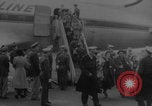
Hungarian refugees escaping from 1956 Hungarian Revolution arrive in Camp Kilmer; President Eisenhower during his second inaugural speech.
Hungarian refugees from the October 1956 Hungarian Revolution (also called Hungarian Uprising) disembark from an American Airlines plane after landing safely in the United States. Entrance to Camp Kilmer, New Jersey, where the Hungarian refugees were resettled. Hungarian refugees get off a bus. A Hungarian man holds his infant daughter with a pacifier. The camera moves to another Hungarian man, wearing a black hat. A Hungarian girl smiles, some of her front teeth missing. United States Army Sergeant Stuart Queen speaks to the camera. United States President Dwight D. Eisenhower speaks during his Second Inaugural Address at the East Portico of the United States Capitol in Washington DC. View of a radio tower. Radio tower view from the inside. View of the top of the Chrysler Building in New York City. Cars pass by modern apartment blocks with antennas on top of building. Television antenna on house roof. Man adjusts television as his wife watches from their couch in living room. A man and his wife, holding their baby, watches the inauguration speech of United States President Dwight D. Eisenhower on television from their family living room. Two women and a child watch United States President Dwight D. Eisenhower’s speech on television. Family of a woman and her children listen to Eisenhower’s speech from a radio in their living room. Bombing on a street in Budapest during the 1956 Hungarian Revolution. Men firing in Budapest. A tank fires in a park. Apartments getting devastated from firing. Hungarian man aims his gun and fires at a car. Men fire on a Budapest street. Doctor and paramedics carry an injured on a stretcher behind a tank. “Budapest is no longer merely the name of a city, henceforth it is a new and shining symbol of man’s yearning to be free”, said United States President Dwight D. Eisenhower from his second inaugural speech.
American pioneers conquer the west in the 1800s, compared to 1940s workers
The U.S. Capitol dome at night. Montage of U.S. Declaration of Independence with view of U.S. founding fathers at time of American Revolution. Reenacted depiction: 17th century immigrants or pilgrims arriving in the U.S. on large sailing ships. Group of men marching while carrying a "Don't Tread on Me" Gadsden flag. Depiction of Betsy Ross with U.S.A. flag. A covered wagon at sunset. 18th century men cutting down trees. 18th century men building a log cabin. Settlers arrive to the remains of their burned out cabin. A stage coach on the U.S. prairie. A covered wagon in the midwest. A stage coach traveling through grass lands. 18th century depiction of a western town in the United States. A white man and a Native American Indian man driving the last spike to complete a railroad as the steam locomotive starts. An 18th century steam locomotive passes by. Actual footage of external view of 1940s factory or production plant. Inside 1940s factory men are building engines. Wide shot of workers entering factory. New York City street scene. Los Angeles street scene. A rancher mends a barbed wire fence. Cowboys-ranchers on their horses. Fisherman pulling in nets on shore. Tobacco farming. Leather worker. Shirtless worker wielding a pick axe. Plant worker turning a large valve. A woman painter with a maritime village scene...perhaps Provincetown. A woman scientist in a laboratory. A 1940s family at the dinner table. Farm laborers harvesting melons. Man drives a tractor with woman riding behind him.
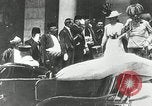
America mobilizes for World War I and confronts demobilization afterwards
Opening scene shows Austrian Archduke Franz Ferdinand and his wife, Sophie, Duchess of Hohenberg. Newspaper swirls into the image, with headline announcing their assassinations. Glimpse of railways guns firing. View of a ship's bow as it sinks beneath the ocean, is covered by newspaper headline announcing the sinking of the RMS Lusitania, by a German submarine. U.S. President Woodrow Wilson at his desk. Newspaper headline reads: "U.S. Declares War !!" U.S. soldiers marching in Washington, DC, with U.S. Capitol building in background. Newspaper announces: "Yanks are Coming!" American General John Pershing on horseback leading a contingent of the American Expeditionary Forces (AEF). American troops going "over the top" (charging out of their trenches) in France during World War 1. Troops firing French 75 artillery pieces at point blank range. A formation of Allied Airco (de Havilland) DH9 aircraft in flight. Bombs bursting near trenches on the front lines. Renault FT-17 tanks accompanying American infantry on the Western Front. Persons playing roles as employees in the Department of Labor when they served as the War Labor Administration in World War 1. Women in the War Labor Administration working with long paper rolls of personnel records. Women in various war effort endeavors including airplane and arms manufacturing. Men working in a wartime steel plant. Marchers and a band demonstrating for the rights of workers to organize. People celebrating the at the end of World War 1, by gathering in the streets, throwing tickertape, dancing in the streets and waving effigies of the Kaiser. Stern view of the U.S. Army Transport Ship, President Grant filled with American soldiers returning from France at the end of the war. Lettering on stern reads, "U.S.A.T. President Grant" (The ship, AP-29, was originally the German ocean liner Konig Wilhelm II, and seized from Germany on 6 April 1917.) Views of United States soldiers returning home, disembarking, and assembling on a wharf home on American soil. Department of Labor persons assisting returning soldiers and prospective employers. Views of workers on farms, and in factories.

World War 2 film promoting public investment in War Bonds and stamps to aid the war effort and temper inflation
World War 2 era film that also includes some World War 1 scenes. Show girls or chorus girls in follies-like show, costumed as U.S. silver dollars and marching to tune and lyrics alluding to dramatic increase of currency in circulation, over the years. Animation with stacks of coins shows increase in national income from $46 billion,in 1933, to $71 billion, in 1939, and $142 billion in 1943. Back to the "follies dollars," a boy asks why, and then scenes of the Japanese attack on Pearl Harbor,are shown, with U.S. battleships being sunk. Wartime arms plants are shown. An M2A3 Light Tank rolls off a production line. Ships being constructed in a shipyard. B-24 Liberator bombers being built in a factory. Artillery shells being produced. Defense workers receiving their pay. The "follies dollars" group themselves to illustrate the fractions of income devoted to taxes and savings. But other spending is curtailed by wartime shortages. A woman talking with clerk in a drug store. U.S. Army troops crossing a pontoon bridge in open trucks, towing 75mm M1A1 howitzers. Infantry on the march. Animation showing industrial production devoted to war materiel and lots of dollars chasing few civilian goods. A grocery clerk offers to sell a woman customer butter for more than the established price, and she agrees. The "follies" performers then introduce the idea of an "inflationary dollar," and some history of past U.S. inflations. Animated examples of price inflation are shown. Glimpses of World War I scenes are seen, circa 1917 -1918, including: a 12-inch railway gun firing; a huge explosion from shell bursting near the camera; various scenes of United States infantry soldiers and French soldiers in battle action, running to bomb craters for cover and emerging from trenches to go up "over the top" into no-mans land during combat. Meanwhile, singing narration refers to the home front inflation due to competition for limited civilian goods. Map shows Europe and singing narration cites rising prices for food in occupied France and other countries suffering ravages of World War II. Montage of scenes showing needy civilians obtaining food in those countries. Animation shows increases, by 1944, in cost of U.S. civilian goods since the Pearl Harbor attack. "Follies" character called "Double-duty dollar," appears explaining he serves the war and curtails inflation on the home front by being saved through investments in War Bonds and stamps.

American civilians realize their war obligations and contribute to the war effort (WW2)
A World War II-era film shows Americans realize their war time obligations after the attack on Pearl Harbor and Fall of Corregidor in the Philippines. Crowds watch a marching band and newly enlisted soldiers in parade. A smiling woman waves at the marching soldiers. Women in car watch the parade. Tents in camp. Soldiers perform mass calisthenics and train with outdated tanks. Enlisted men learn how to fire machine guns and mortars. United State Army soldiers board a ship for their deployment. A ship departs for the Philippines. Soldiers arrive in the Philippines, a United States commonwealth in Asia. Japanese bombers drop bombs over Pearl Harbor. Civilians running on the streets during a Japanese aerial bombardment. United States Navy sailors firing machine guns and howitzers from ships. A ship explodes from Japanese bombing. A little girl runs to her father washing the car to tell the news about Pearl Harbor. The little girl runs across the street to tell her neighbor about Pearl Harbor. A woman writes a letter. A woman bakes a cake. People leave a church after service. An American soldier is shot by Japanese soldiers in the Philippines. A man reads a telegram. The man drives to a farm house, accompanied by a church minister. The man and minister tell the elderly couple living in the farm that their son was killed in action. Women selling war bonds on the street. A man silences his alarm clock and goes back to sleep. Cars racing on the street. Soldiers and civilians evacuating Manila. Japanese bombardment of Manila. A girl turns on the radio before Christmas dinner. Men and women congratulates a woman outside a law office. More civilians receive telegrams. Dead soldiers in the battlefield. A woman opens the Bible and writes the names of the dead. United States soldiers retreat in the Fall of Bataan. A woman shakes her head in disbelief after being told of a rumor her son was killed in action. A man hangs the United States flag on his porch. A bomb explodes near a makeshift tent hospital. Woman fixes bed. A woman eating on the dinner table alone. A soldier swats a mosquito from his neck in the Philippines. Forlorn men and women. Soldiers fighting in Corregidor. Soldiers surrender to the Japanese forces at Corregidor. A captured American soldier harasses a Japanese soldier while frisking him. He was apprehended by Japanese soldiers on guard. Despondent American civilians struggling after the Fall of Corregidor. A man despondently smokes from his bed. A depressed woman struggles to cut vegetables. A doctor treats civilians for shock and depression. A baseball game. A horse race. Boys playing on the beach. United States and Filipino soldiers march with United States and Philippine flags. People line up for blood donations. Civilians donate old rubber and hats. Men line up to punch their time in at work. Boys helping on the farms. Male teachers volunteer to fix civilians’ appliances and cars after school. A welder working at the shipyard. Civilians walking instead of using cars. An Allied plane landing. A woman sewing. A man opens a package of binoculars. People line up to buy war bonds. A majorette leading a marching band. Newly enlisted men with suitcases marching in parade.
USIA film describing the ways it conducts its world-wide operations
Segment of U.S. Information Agency film describing its world-wide operations. Map shows 217 overseas posts in 17 countries, of the USIA (also known abroad, as the U.S. Information Service). Animated map zooms in on one post, in Rio de Janeiro, Brazil. Aerial view of Sugar Loaf Mountain overlooking the harbor and city. Street scene in Rio. USIA Public Affairs Officer, William A. Wieland, is seen walking along a sidewalk in the city. Next he is seen in the office of Ambassador James S. Kemper, briefing him about USIA activities. View of the Brazilian Foreign Office building. Mr. Wieland meets with the Chief of the Cultural Division there. Book stacks in the USIA Thomas Jefferson Library in Rio de Janeiro. Mr. Wieland conferring with a librarian. He is also seen at the USIA broadcast facility in the U.S. Embassy. Film shifts to street scene in Cebu, the Philippines. A building displaying American and Philippine flags, is labeled: " United States Information Service." Inside, and American and a Filipino worker give bundles of literature to local workers for distribution. One, a bus driver, carries his bundle onto his open-sided bus, displaying the name, "Cebu, Autobus." He waves as he drives away. The USIA Public Affairs Officer is seen visiting the Mayor of Cebu City, Vincente S. del Rosario; giving a news release to the editor of a newspaper; broadcasting on local radio;and socializing with local editors. USIA drive a mobile movie van into a remote village where many children are playing. They set up a screen and projector. Almost everyone in town attends the showing. Scene shifts to USIA headquarters building at 1778 Pennsylvanis Avenue,in Washington, DC. Director Theodore Streibert holds a staff meeting. View of President Eisenhower addressing U.S. public media leaders about confronting the Soviet Union with truthful information about the U.S. and the West, on April 16, 1953,in Washington, DC. A USIA technician transmitting text of the speech to its public affairs officers around the world. Views of newspapers carrying the story in Paraquay, Ireland,Algeria, and Burma. The President's speech was printed in a pamphlet entitled "The Peace We Seek," ahd sent abroad where it was translated into Arabic,Japanese, Persian, and 20 other languages. Four million copies were distributed. Posters about the speech were also distributed.
CRITICALPAST.COM: About Us | Contact Us | FAQs - How to Order | License Agreement | My Account | My Lightboxes | Shopping Cart | Advanced Search | Featured Collections | Website Terms & Conditions | Privacy Policy ©2026 CriticalPast LLC.
License Agreement |
Terms & Conditions |
Privacy Policy
©2026 CriticalPast LLC.