


 Francais
 Deutsch
 Italiano

Refine Your Search
Nevada United States 1936 stock footage and images
- Showing 20419 to 20424 of 35683 results more
 Hide
Color Sound
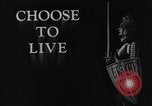
Cancer awareness film includes dramatization of woman with cancer and describes early cancer treatments of surgery and radium.
An awareness film about cancer by U.S. Public Health Service, United States, titled 'Choose to Live'. Dramatization shows a woman's experience with cancer. Building of United States Public Health Service in Washington D.C. Thomas Parran, Surgeon General, U.S. Public Health Service speaks about cancer and victims of cancer. View of women work at telecommunications, man at farm and men in urban area -- anyone can be vulnerable to cancer. He tells the probability of death from cancer. He talks about a woman Mary Brown. Her family sits at a dining table and has a breakfast meal together. She waves goodbye. Brown finishes her household work and looks at a meeting note. Meeting for cancer awareness at a club. A doctor talks about diseases. He compares its hazards with deaths in the World War. He discusses scientific investigation and research against cancer. Scientists work in laboratories. Lab worker run experiments injecting mice with chemicals. Beakers, test tubes, distillation equipment, mouth suction tube seen. Scientist looks through microscope. Atom smashing machine in a laboratory. He talks about National Institute of Health, National Cancer Institute and the Capitol. Bill designating one month each year as Cancer Control Month signed by U.S. President Franklin D. Roosevelt. A doctor prepares for surgery. A team performs a surgery. An X-Ray machine. Control panel of the X-Ray machine. The third method of treatment is by the use of radium. Shows sand equal to all the radium available in the U.S. Man takes out radium from lock, he puts it on an applicator and takes it to a treatment room. Nurse measures the treatment area of patients body to apply radium treatment. Radon mercury forces gas. Man cuts pieces and collect it. Men sit at a cancer clinic. Man talks with a doctor. Doctors examine and treat cancer patients. Doctor observes X Rays. Doctor shows and explains the symptoms of cancer. Scientist study in a laboratory. Men women at a public meeting. Cancer awareness banners.
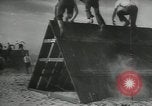
Training of American draftees before World War II; also Japanese attack on Pearl Harbor and Roosevelt's request for declaration of war.
United States soldiers and new recruits at a camp in the U.S. before outbreak of World War II. New recruits and U.S. Army soldiers in training run obstacle course. Soldiers in their uniforms march through the camp area. Tents in the background. Newly drafted U.S Army soldiers learn to fire weapons on firing range using artificial wooden rifles. U.S. soldiers seen training with wooden replica machine guns and using empty Adelphi beer cans as substitute artillery ammunition for training purposes. Teams of soldiers compete in moving a giant ball. They compete in blindfolded boxing on their knees. Lacking adequate war materiel for training, they make do by pretending that trucks are tanks and labeling them with such signs. They pretend with wooden guns and throw flour sacks instead of grenades. Scenes of the Pearl Harbor raid by the Empire of Japan on December 7, 1941. Views of the USS Arizona being hit and various ships on fire soon after the attack. United States President Franklin D. Roosevelt is seen addressing Congress, where he asks for a declaration of war against Japan.
During a presidential election debate in the US, John F Kennedy and Richard Nixon comment on the necessity to defend Berlin.
The third Kennedy-Nixon Presidential Debate in the United States. Moderator Bill Shadel introduces the candidates and tells that candidates will not share the same platform. Republican candidate U.S. Vice President Richard M Nixon is in a Los Angeles studio and Democratic candidate Senator John F Kennedy is in New York. He also introduces the panel of correspondents who will question the candidates. The panel includes Frank McGee from NBC News, Charles Van Fremd from CBS News, Douglass Cater from Reporter magazine and Roscoe Drummond from New York Herald Tribune. Frank McGee asks Kennedy whether he would take military action to defend Berlin. Kennedy answers and says that the U.S. has contractual right to be in Berlin coming out of the conversations at Potsdam and of World War II. He states that the United States must meet its commitment on Berlin in order protect the security of Western Europe. He concludes by saying that the U.S. will meet its commitments to maintain the freedom and independence of West Berlin. Nixon disagrees with Kennedy's statement that the Republicans are trigger-happy and lead the nation into wars. He talks about the Democratic presidents who led the U.S. into wars. He concludes and states that he thinks there isn't any question about the necessity of defending Berlin.
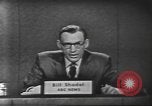
During an election debate in the US, Kennedy and Richard Nixon talk about a hypothetical invasion by the Chinese Communists.
The third Kennedy-Nixon Presidential Debate in the United States. Charles Van Fremd from CBS News asks Republican candidate U.S. Vice President Richard M. Nixon that if he were the president would he launch a war if the Chinese Communists began an invasion of Quemoy (Kinmen) and Matsu Islands and if he would authorize the use of nuclear weapons if regular conventional forces failed to halt the invasion. Nixon answers and states that it is irresponsible for a presidential candidate to indicate the course of action and the weapons he would use in the event of such an attack. He states that he would not say in advance how the U.S. would respond. He states that the Chinese Communists do not want just Quemoy and Matsu or Formosa (Republic of China or Taiwan), but the world. He concludes that defense of the free world territories and not surrender will lead to the path of peace. Democratic candidate Senator John F. Kennedy talks about a treaty to defend Formosa (Taiwan) and the Pescadores Island. He states that the U.S. would meet its commitment to Formosa. He disagrees with Nixon's suggestion that the United States should go to war if Quemoy (Kinmen) and Matsu islands are attacked as the treaty does not include these two islands. He concludes and says that the U.S. would defend if Formosa (Taiwan) or the Pescadores Island is under attack.
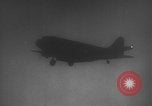
Ships and airplanes navigate in fog, submarine depth charged by destroyer (WW2)
Douglas C-47 Skytrain flying in fog. A radar mobile station with rotating radar dish. C-47 lands on airfield under low visibility conditions. A fighter landing on aircraft carrier deck of a United States Navy aircraft carrier. Large U.S. battleship at sea. Sailor wearing deck-communications helmet. Close up of interior ship siren sounding. United States sailors wake up and jump out of bunks while siren sounds. A radar dish rotating onboard a ship. Hands actuating fire control triggers on a battleship. Multiple U.S. naval ships firing guns night and day. Battleship hit by guns. Battleships firing artillery on enemy ships and shorelines of islands. Submarine underwater. A U-boat submarine periscope seen above water surface. A United States Navy crew operates radar gunnery control system in destroyer, tracking a nearby submarine. Navy captain with sailor at the helm on destroyer. Destroyer shoots depth charges into water. Depth charge flying in air and then detonating in the ocean shortly after its release. Explosions under water destroying the U-boat submarine. Consolidated PBY Catalina flying above a naval flotilla. United States ships navigate through fog. (World War II period)

African American people, lifestyle, and housing in South Carolina during the Great Depression
African American life in rural South Carolina, in the southern United States in the mid 1930s, during the Great Depression. Houses at a distance and a car in front. Cars move on the road. People move in front of simple frame and shack houses, in relative poverty. African American man leans down from balcony of a house. Bicycle parked in front of a house. African American man and woman talk at the entrance of a house. Black children in front of a house. Young African American boy helps cleans the exteriors of a house with a broom. Two boys wrestle at the edge of a street, on the ground. Woman carries a sack on her head. Two women run inside the house, seemingly after becoming frightened of the cameraman. Woman snatches the child back into the house. A Black child carries a bucket in his hand and another child follows. African American people gathered outside a building with cars in front. Two African American men walk in front of houses. African American life in South Carolina, United States. Houses at a distance and a car in front. Cars move on the road. People move in front of the houses. African American man leans down from balcony of a house. Bicycle parked in front of a house. African American man and woman talk at the entrance of a house. African American children in front of a house. African American child cleans the exteriors of a house with a broom. African American man lay on the ground. Woman carries a bag on her head. Woman and child run inside the house after becoming frightened of the cameraman. African American child carry bucket in his hand and another child follows. African American people gathered outside a building with cars in front. Two African American men walk in front of houses.
CRITICALPAST.COM: About Us | Contact Us | FAQs - How to Order | License Agreement | My Account | My Lightboxes | Shopping Cart | Advanced Search | Featured Collections | Website Terms & Conditions | Privacy Policy ©2026 CriticalPast LLC.
License Agreement |
Terms & Conditions |
Privacy Policy
©2026 CriticalPast LLC.