


 Francais
 Deutsch
 Italiano

Refine Your Search
Nevada United States 1936 stock footage and images
- Showing 20977 to 20982 of 35682 results more
 Hide
Color Sound
ARVN soldiers being evacuated by helicopters after Operation Lam Son 719.
ARVN (Army of the Republic of Vietnam) soldiers assembled for evacuation after Operation Lam Son 719 in Laos during the Vietnam War. South Vietnamese soldiers on a hill top near Route 9. U.S. soldiers signal U.S. Army Bell UH-1 Iroquois (Huey) helicopters for landing. South Vietnamese soldiers hold onto their helmets and board waiting choppers under direction of ARVN officers. U.S. Army crew members assist them in boarding. A Vietnamese officer supervises as a line of soldiers moves along to board the helicopters. Military vehicles at the camp. U.S. soldiers talk to Vietnamese soldiers. ARVN soldiers seated in the UH-1s. U.S. soldiers in protective goggles around the helicopters with rotor blades spinning. Soldiers seated in helicopters as they take off. A military ambulance in the background. A U.S. Army CH-47 Chinook helicopter in flight. A UH-1 on ground. Military jeeps approach the helicopter. The ambulance driven away. An air ambulance helicopter lands on the field. A soldier checks the rotor blades atop the helicopter. U.S. soldiers stand around. Aerial view of the area around Route 9. A convoy moves along Route 9. Tents and military vehicles at the camp. U.S. and ARVN soldiers around stationary choppers. Construction material and dug up patches.
Montage of scenes involving military equipment and operations emphasizing signal corps communications
'The Signal Corps Fights' depicts the role and contribution of the U.S. Army Signal Corps in combat and war. Montage of military equipment and combat scenes (some staged). Opens with glimpses of: massed formation of U.S. Army soldiers; similar formation of bombs in a munitions factory; row of P-47 fighter planes parked on an airfield; a huge radar antenna; battery of U.S. 120 mm M1 anti-aircraft guns; troops marching toward the camera; Martin B-26 Marauder aircraft dropping bombs, that explode on the ground; formation of German He 111 bombers in flight; U.S. battery of 120mm anti-aircraft guns firing; gun camera views of U.S. fighter strafing German aircraft on the ground, and attacking a German Messerschmitt bf 109 head-on (The tail is blown off and the pilot bails out at the last instant); fire engulfing some soldiers. Next, a soldier is seen at a large signal corps field telephone switchboard, and other communications switchboards are shown with operators. Momentary glimpse of troops, ostensibly engaged in combat. A soldier communicating from under a camouflage netting, and one holding a rifle and talking in a phone as he strings wire from a spool in his backback. A german soldier ostensibly cutting a U.S. communications cable that he discovers in the field. A U.S. soldier crawling along the line to find and repair the damage, followed by a staged "attack" by the German soldier. They engage in a knife fight. Soviet infantry advancing on the Eastern Front. Soviet T-34 tanks advancing. Soviet soldiers engaged in combat. An unusual U.S. tank with two guns, and side protection over track wheels. M3 Stuart light tanks going down hill with infantry in france during World war 2. Hand of signal corps soldier using a key to send morse code message. Soldier in bunker using field telephone. Signal corps soldiers communicating with field switchboards during combat. Momentary glimpse of German Messerschmitt bf 109 and another aircraft speeding past. Bomb exploding. Huge clouds of black smoke billowing, behind camouflaged German military vehicles parked. Twisted frames of German wrecked vehicles and rail cars. Huge number of German soldiers marshaling to retreat from advancing Allies. German officers conferring.
Soldiers of the 1st Infantry Division in England and during the invasion of Normandy and subsequent campaigns toward Germany (WW2)
Soldiers of the 1st Infantry Division training in England under General Clarence R Huebner, in preparation for the D-Day Normandy invasion in World War II. U.S. Navy ships underway at sea. Heavy naval guns bombard the coast of France on D-Day. U.S. Army soldiers seen during assault on Omaha beach with heavy losses on D-Day. U.S. soldiers and tanks encounter heavy German resistance in the "hedge rows." American soldiers digging trenches with shovels and picks and treating wounded comrade. Dead German soldier lying in street as Americans enter the town of Caumont (Caumont l'Eventé). Frenchman civilian pours wine for American soldier after they liberated Caumont l'Eventé from the entrenched German forces. An American helps a French civilian woman to reach a safe place crossing rubble. Damaged French houses along the sides of street. During rest, a soldier gives another a haircut, and another writes a letter. U.S. Air Force B-17s fly overhead and bomb near St. Lo, France on July 25, 1944. Other U.S. Army artillery units, the 4th and 9th Divisions, and General Patton's tanks provided support so the 1st Infantry (First Infantry or Big Red One) could occupy the area. Army combat engineers dig up mines and use construction equipment to clear debris. Wrecked houses and rubble. U.S. soldiers keep advancing through towns and eat and rest as they can. Road sign reads: "Coutances." First Infantry goes through Mortain, Etampes, Meaux, Soissons and across the Belgian border. German prisoners of war walk with their hands raised. German soldier digging out of fox hole. Siegfried Line and dragons teeth. Strong German resistance encountered at Aachen. Tanks fire in the field. House to house fighting in Aachen. Surrender of Aachen. A German flag laying in the street is run over by a U.S. military vehicle. German resistance is heavy during battle scenes in Battle of Hürtgen Forest. German and American artillery are seen in Hurtgen Forest. U.S. wounded treated. The 1st Division is pulled out for rest at the rear, in Belgium.
Allied Forces in Battle of Casablanca and North Africa in World War II
Operation Torch in World War 2. Allied invasion convoy off Casablanca, Morocco. American troops on ship's deck, cleaning and checking their rifles. Closeup of a wire from the Invasion Task Force Commanders, listing signals that will tell of the French forces' decisions. Closeup of U.S. troops boarding Higgins Boat from a transport ship. Rear Admiral H. Kent Hewitt on the USS Augusta (CA-31). U.S. President Roosevelt, Free French Commander, Charles de Gaulle, and French General Giraud, all issue calls for French forces not to resist Allied invasion. View of triple turret 8-inch guns on the USS Augusta. Sailors in their bunks. Suddenly guns from the shore begin firing on the invasion convoy. Shells explode in water near convoy ships, as sailors man battle stations and begin returning fire on Casablanca. French defenders signaled friendly attitude by directing searchlights vertically. British spitfire aircraft launch toward Algiers, from Gibraltar. British troops in an amphibious landing at Algiers on November 8, 1942. View of French Admiral Jean Darlan. Allied troops enter Algiers. American airborne troops parachute from C-47 transport aircraft over Oran, Algeria. Next section covers Battle of Casablanca: Allied warships fire at Vichy French ships and aircraft and more troops head to shore in landing craft. Sailors firing anti-aircraft guns from landing craft, at enemy aircraft overhead. A U.S. carrier-based SBD Douglas Dauntless aircraft as it descends in the sky. French sailors load 380mm guns on battleship Jean Bart and fire her guns. Glimpse of French Shore defense guns firing with shells exploding in waters offshore. Gunners aboard U.S. warship loading a heavy gun. Angered over British attack on the French Fleet in 1940, Admiral Daran refused to negotiate with the British. Inserted footage of French battleship Dunkerque exploding during British attack on French fleet at Mers-el-Kébir, July3, 1940. A tank driving ashore from a landing craft. Closeup of a French soldier (from the rear) firing his rifle at invading Allied troops. Allied medical corpsmen on the sandy shore, running with a litter. A jeep pulling a towed artillery field piece ashore from the surf. Medical corpsmen carrying a wounded on a stretcher. Allied troops fighting defenders in Casablanca. Animated map shows German invasion of Vichy France. View of Philippe Pétain, Head of Vichy France. View of Admiral Darlan saying goodbye to U.S. Lieutenant General Mark Clark after secret meeting of the two. Officers of German Armistice committees departing a North African city. Cheering crowds are happy to see them depart in a truck. French crowds cheering American troops. British Lieutenant-General Kenneth Anderson arriving at Algiers. French General Henri Giraud salutes. General Dwight D. Eisenhower salutes. Parading color guard with flags of France, Britain, and the U.S. Animated map shows German forces pouring into Tunisia. View of German troops on deck of a ship and at ship's anti-aircraft positions. General Eisenhower conferring with British and French allies. Camels used on rough terrain. American writes "Tunis Toonerville." in chalk. Allied troops sitting on floor of freight rail car with door open as old steam engine moves the train. Animated map shows German and Allied supply lines. A U.S. Douglas A-20 Havoc bomber landing on an airstrip. Numerous German warplanes parked in Tunisia. U.S. M2 tanks and other military vehicles moving along narrow mountainous roads. Locomotive transporting mules in stock cars. C-47 transport airplanes drop British and American airborne troops. Commandos disembark from ships at Bone, Algeria. Allied aircraft parked on a captured enemy airfield, under attack by German Dornier Do 17 and Heinkel He 111 bombers. A Parked American B-25. Allied soldiers firing small arms and anti-aircraft guns at German planes.

King Saud goes to meet his son Prince Mashhoor at the Walter Reed Army Medical Center in Washington DC.
King Saud bin Abdulaziz Al Saud of Saudi Arabia during a state visit in Washington DC, United States. View of Pentagon River Entrance, from Columbia Island, across the water. Honor guard at Pentagon. King Saud arrives at the Pentagon. United States Secretary of Defense Charles Erwin Wilson and Admiral Arthur W. Radford greet the king. View of the White House. King Saud and U.S. President Dwight D. Eisenhower discuss problems of mutual concern and defense against aggression. Cars parked outside the Walter Reed Army Medical Center (1010 Butternut St NW, Washington, DC 20012, United States). King Saud with his son, Prince Mashhoor Ibn Saud (Mashhoor bin Saud bin Abdulaziz Al Saud) in the hospital. The king hosts a party in honor of President Eisenhower. King Saud talks to U.S. Vice President Richard Nixon. Earl Warren, Chief Justice of the US, shakes hands with the King. Under Secretary of State, Lloyd Henderson, meets the King. King Saud talks to President Eisenhower. Sailors at the United States Naval Academy (121 Blake Rd, Annapolis, MD 21402, United States) salute the Arab ruler by firing guns. His Majesty inspects a U.S. Marine Corps guard of honor. The King is escorted by the Superintendent of the Naval Academy, Rear Admiral William R. Smedberg, III, who presents him a plaque, as memento of his visit. The King watches a college basketball game between the US Navy Academy team and Duke University. College athletes compete in basketball game. Spectators seated in an indoor stadium. The Arab ruler leaves the academy after the match. He gets in a car. He visits the hospital to meet his son. Little Prince Mashhoor salutes the people of America. King Saud waves at the people. The Arab King and the Prince leave the hospital and return to Blair House where visitors continue to arrive, including, His Excellency, Charles Malik of Lebanon; Greek Ambassador George V. Melas; and Ambassador Nazrollah Entezam of Iran. His Royal Highness, Crown Prince Abd al-Ilah of Iraq, seen seated with King Saud. Exterior of Saudi Arabian Embassy. A children's party inside the Embassy attended by children from the Washington diplomatic corps and "hosted" by Prince Mashhoor Ibn Saud who receives a bicycle. King Saud and President Eisenhower at the White House. The King departs Washington airport on the Columbine II, Presidential C-121 aircraft.
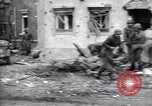
Allied 9th Army units advance into heart of Germany during World War II
Allied 9th Army advancing beyond Munich, Germany, during World War II. U.S. soldiers firing mortars from a street and a cemetery. Allied troops crossing a pontoon bridge across a river. U.S.soldier, from 102nd Infantry Division, leads line of German civilians to safety, as troops and vehicles enter the town of Erkelenz. U.S. troops fill the streets and sidewalks of the town as they pass through. Prisoners of war and forced laborers are freed by advancing Allied forces. Group is seen wearing berets. One wears a fez. Boxes of Red Cross foods intended for American prisoners are found opened and used by Germans in Eppendorf, Germany. On February 28th, 1945, soldiers of the 2nd Battalion, 413th Regiment, 104th Infantry Division,find the boxes in German military billets and throughout the town. Views of boxes with "American Red Cross Prisoner of War Food Package," written on them. Units of the 1st Allied Army are seen driving directly toward Cologne, Germany. A Sherman tank is seen completely covered by U.S. infantrymen, riding on top. U.S. infantrymen cross stream on makeshift steel bridge. Infantrymen take cover in railroad culvert as tanks of U.S. 3rd Armored Division move forward to deal with intense German resistance. Incoming artillery shell squeals overhead and explodes nearby out of camera view. U.S. troops take shelter behind brick wall. U.S. troops occupy abandoned German trenches. A commanding defensive view from one of the trenches. On March 2, 1945, troops of the 83rd Infantry Division, advancing toward Cologne, pass through town of Neusse. Sign on wall reads: "Mit Hitler zum Sieg." Another reads: "Wir kapitulieren nie!" U.S. troops reach the Rhein River. Telephoto lense view shows city of Dusseldorf and its bridges, spanning the Rhein (Rhine) River.
CRITICALPAST.COM: About Us | Contact Us | FAQs - How to Order | License Agreement | My Account | My Lightboxes | Shopping Cart | Advanced Search | Featured Collections | Website Terms & Conditions | Privacy Policy ©2026 CriticalPast LLC.
License Agreement |
Terms & Conditions |
Privacy Policy
©2026 CriticalPast LLC.