


 Francais
 Deutsch
 Italiano
Refine Your Search
Nevada United States 1936 stock footage and images
- Showing 21091 to 21096 of 27248 results more
more Hide
Hide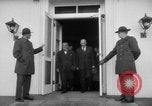
President Eisenhower bids farewell to Mexican President Adolpho Ruiz Cortines, at Greenbrier Resort, West Virginia
West Virginia State Troopers hold doors as U.S. President Eisenhower and Mexican President, Adolpho Ruiz Cortines, come out of the Greenbrier Resort in White Sulphur Springs, West Virginia. The Mexican President waves and smiles. Secretary of State, John Foster Dulles, joins them, standing behind President Cortines, and Mexican delegate to the UN, Luis Padilla Nervo, stands next to President Eisenhower . They smile for cameras, and the two Presidents shake hands. They then walk to a car parked at the curb, and President Cortines gets in and drives away.
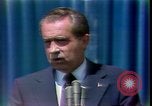
U.S. President Richard Nixon responds to a journalist's question regarding the Watergate tapes in San Clemente.
U.S. President Richard Nixon talks about the Watergate tapes during a press conference in San Clemete, California. He is questioned by a journalist on the exposure of the tapes, and a survey which revealed that he was wrong to make the tapes. President Nixon responds stating that he isn't surprised since Americans do not approve of recording conversations. He talks about the recording capacity in the White House and Camp David, and dismantling and resetting of the system for national security reasons. He also states that the system has existed during the time of President Lyndon Johnson and President John F. Kennedy.

U.S. President Richard Nixon address' s the American citizens on the nation's economy in Washington, D.C.
News correspondent covers the President's address on the nation's economy in Washington, D.C. From the White House office the President shares his thoughts with the citizens upon the country's economy. He talks about the 3 subjects of public interest- the job, income and cost of living. He briefly talks about the problems that the nation is facing and the reasons behind them. He introduces the program which deals with these problems. The first step involves the recognition of problem. There exists a transition between the peacetime economy and a wartime economy. Labors and the businessmen prefers the peacetime economy. He states that his government takes the responsibility to cut down the expenditure in order to strongly restrain current economy, this would in turn raises the price gradually and thus not affect the businessmen, common men and industry badly. They have also decreased the Federal spending as per the previous years figures and will do the same in coming years as well. He talks about his actions against the inflation. They include- to appoint the National Committee on productivity to check how well the resources are being used, has instructed the Counsel of economic advisers to prepare a periodic inflation alert, establishment of purchasing and review board to review all the government actions. The President briefly talks about the actions he will take and those which he wont take. He states that at this time the Congress and the President should co-operate each other on the common welfare programs. He requests the Congress to help him by passing the legislation related with people's job and cost of living and to act on the one which have been already submitted to it by the President. He asks the Congress to join him on the way of cutting down the government spending. He also talks upon the significant happenings taking place in the American economy. The President believes that in the next 5 years the American consumer will be able to buy 20% more than what he does today.

U.S. President Richard Nixon addresses American citizens on the nation's economy in Washington DC.
U.S. President Nixon addresses the American citizens on the nation's economy in Washington DC. The White House. The President in his office. He talks about the 3 subjects of public interest- jobs, income and cost of living. He briefly discusses the nation's problems and their causes. He introduces a program which deals with these problems. The first step involves the recognition of causes. There exists a transition between the peacetime economy and a wartime economy. Labors and the businessmen prefer the peacetime economy. He states that his government takes the responsibility to cut down the expenditure in order to strongly restrain the current economy. They have also decreased the Federal spendings. He talks about his actions against the inflation. They include- appointing the National Committee on Productivity to check how well the resources are being used, instructing the Counsel of Economic Advisor to prepare a periodic inflation alert and establishing a purchasing and review board to review all the government actions. The President briefly talks about the actions he will take and those which he would not take. He states that at this time the Congress and the President should co-operate each other on common welfare programs. He requests the Congress to help him by passing the legislation related with peoples' jobs and cost of living and to act on the one which have already been submitted by him. He asks the Congress to join him on the way of cutting down the government spendings. He also talks about the significant happenings taking place in the American economy. The President believes that in the next 5 years American consumer will be able to buy 20% more than what he does today. The White House in Washington DC.
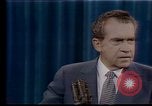
President Nixon answers a journalist questions during a news conference in Orlando, Florida.
U.S. President Richard Nixon answers journalist George Gill questions regarding the Watergate issue in Orlando, Florida. George asks the President about his realization of the fact that 2 of the 9 Watergate tapes did not exist and his delay in disclosing this matter to the Federal Court and public. The President responds that on September 28th or 29th he came to know about the non-existence of those two conversation tapes. His secretary has listened to 7 tapes and has made notes for him. On October 26th they were determined about the non- existence of those two tapes. He directed White House Counsel Joseph Fred Buzhardt to carry out investigations. On 27th Buzhardt reported that he could not find those two tapes. He had arranged a meeting with Judge John Sirica. The President talks about his 5 minutes conversation on June 20th with the Attorney General John Mitchell. He had called to cheer him up. The conversation on April 15th with John Mitchell was not recorded because the call was made from family quarters where recording is not allowed. He talks about the shorter recording capacity of tape machines. Due to which his complete conversation with U.S. Secretary of State Henry Kissinger did not get recorded. The only evidence available for this were his hand written notes. He mentions the difficulty in hearing those recorded tapes due to non-sophisticated recording system. He states that he knows what is there in those recorded tapes. He believes that the tapes will prove that he did not have any knowledge of breaking of the Watergate issue, that he had not authorized anybody on clemency nor had he any knowledge regarding the payment of blackmail money. He talks about his conversation with the White House Counsel John Dean.
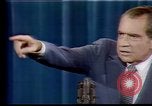
A journalist questions President Nixon about the Watergate investigations during a news conference in Orlando, Florida.
A journalist questions U.S. President Richard Nixon about the Watergate investigations during a news conference in Orlando, Florida. The journalist asks the President about his plans to tell the American people about the case with regard to his credibility on this matter. The President briefly talks about new special prosecutor Leon Jaworski. He has not talked to him regarding the Watergate issue. He states that Leon cannot be removed easily. He says that Leon is educated, independent and cannot be removed easily unless the democratic leaders of the Congress agree that he should be removed. He states that when Assistant Attorney General Henry E. Petersen was removed from his position the case was almost 90% ready. After 6 months the case could not be brought to any conclusion under the special prosecutor. It is time for the case to be brought to a conclusion because the reputation of suspected men which has been damaged in the hearings could not be recovered.
CRITICALPAST.COM: About Us | Contact Us | FAQs - How to Order | License Agreement | My Account | My Lightboxes | Shopping Cart | Advanced Search | Featured Collections | Website Terms & Conditions | Privacy Policy ©2026 CriticalPast LLC.
License Agreement |
Terms & Conditions |
Privacy Policy
©2026 CriticalPast LLC.