


 Francais
 Deutsch
 Italiano
Refine Your Search
Nevada United States 1936 stock footage and images
- Showing 24019 to 24024 of 27246 results more
more Hide
Hide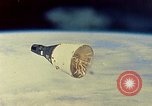
NASA Gemini spacecraft reentering the Earth's atmosphere and being recovered after splashdown in the ocean
A NASA Gemini spacecraft in orbit. Views of earth from window of a Gemini XII spacecraft in space as it reenters earth's atmosphere from orbit carrying astronauts Lovell and Aldrin back to earth. Hot particles burn off the oblative heat shield of the spacecraft. Short montage of Gemini entry images. Momentary view of striped parachute billowing above, as seen from inside a spacecraft. The Gemini spacecraft seen from a helicopter, as it descends over water during recovery. The spacecraft splashing down and its parachute collapsing in the water. Recovery personnel parachuting from a helicopter, which also drops a life raft and supplies, close to the floating space capsule. Astronauts being helped into rafts and then hauled up into the recovery helicopter. A Titan II launch vehicle taking off from Kennedy Space Center, Florida.
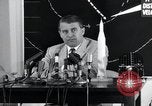
German rocket physicist Wernher Von Braun lectures at press conference about space launch vehicles
German rocket physicist Wernher Von Braun gives recorded and broadcast lecture about Space Launch vehicles. He sits at a table containing models, including one of the Juno II space launch vehicle. Speaking in German, he addresses an audience, discussing capabilities of the Juno 2 vehicle and requirements for achieving escape velocity and other facets of space flight. He refers to the Explorer I satellite in his remarks. After Dr. Braun completes his comments, he stands and leaves, revealing a chart illustrating the ideas of his talk. Also seen is a blackboard listing velocities that have already been achieved by rockets and noting the escape velocity needed to achieve earth orbit. These blackboard notes are all written in English. German scientist, Albert Zeiler, is seen momentarily at a seat in front of the blackboard.
An enemy aircraft bombs a tank and men cover tanks with net to avoid enemy detection in World War 2
World War II training film about use of flat net to avoid enemy detection. An enemy aircraft in flight. The aircraft bombs the tank on a desert. Men cover the tank with net. Men place sticks to make the shape of the tank look irregular. A man fixes the net on ground. Aerial view of broken terrain.
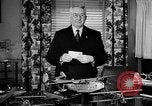
Early 1900s American aviation scenes; American flight pioneers speak about their associations with the Wright Brothers
Aviation pioneer, aircraft designer and builder, Glenn L. Martin, at his desk, stands behind a model of the Martin M-130 Clipper flying boat. He reads a 1910 postcard from the family doctor to his mother, warning that her son (Glenn) will kill himself if he persists in his aviation endeavors. Next, one of Martin's earliest employees and collaborators, Donald Douglas, Sr. is seen with his dog. He says his first memory of things in aviation, was seeing the first Wright airplane demonstrated for the Signal Corps in 1908, at Fort Myer. Period film shows the Wright Flyer airplane with twin rear propellers turning. Next view shows Orville Wright along with military officers and officials, standing near the launching tower (from which a propelling weight would drop). Orville Wright is seen climbing aboard the airplane, after the first flight demonstration, as Lieutenant Lahm joins him to be the first military officer to ever fly in an airplane. Next, the weight is seen falling from the launching tower, propelling the airplane along a single track to take off. It is seen flying above spectators at the Fort Myer drill field. View of a U.S. Army balloon in flight overhead. Scene shifts to pioneer Army balloonist, Roy Knabenshue, who was hired by the Wright Company in 1910. He holds a photograph of a balloon, and identifies Walter Brookins, in the photograph. (Brookins was taught to fly by the Wright brothers and became the first instructor for their Exhibition Team.) Knabenshue extols the skills of Brookins as a Wright Company pilot, along with Arch Hoxsey and Ralph Johnson. While Khabenshue is speaking, views of a Wright Flyer in the air at Fort Myer are seen.
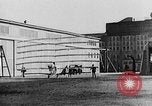
Early experimental failures in airplane development. Lawrence Sperry and his "Messenger" airplane
Film showing early history of flight with many early unsuccessful flying machines. As Igor Sikorsky speaks, in the background, about such earlier failures, the first scene shows a early 1900s seven wing airplane, with its propeller turning, being pushed by several men. Suddenly the the entire thing collapses into a heap, as the men run to safety. They quickly return to check on the occupant. Next, an experimental four-rotor helicopter is seen lifting above the ground, successfully, but not otherwise controllable. Then a contraption (labeled "Sky Car") employs a pulsating umbrella. It jumps up and down but does not accomplish anything else. A tricycle gear contraption, using an array of sails, and displaying the number, 691, moves along under power, but does not ever leave the ground. A helicopter of sorts, with several different size rotors falls sideways, as the pilot is adjusting it. He steps away to safety. Another glimpse of the "Sky Car." A wing-flapping contraption that does nothing else. Aviation pioneer, Lawrence Sperry, moves his early biplane up to a gasoline pump to refuel. He holds the fuel hose to his gas tank while another man pumps the fuel. Next, his airplane taxis along a public road, followed by a motorcyclist. The aircraft takes off. Sperry piloting his small single-place bi-plane "Messenger" aircraft, is seen flying above the U.S. Capitol dome, on March 22, 1922. Next, he lands on the Capitol Plaza and quickly turns the aircraft so it actually ascends several Capitol steps, before rolling back to park. Sperry climbs from the cockpit and is greeted by policemen and officials who surround him and congratulate him. (Sperry perished flying across the English Channel in 1924.) View of the Great Dome on Building 10 at the campus of MIT (Massachusetts Institute of Technology). Dr. Jerome Hunsaker, pioneer aeronautical engineer and educator, is seen in a laboratory. He speaks of beginning the aeronautical engineering education program at MIT in 1913, with Donald Douglas as an assistant.

Montage of scenes showing American civilian mobilization on the home front, life in the Navy, war scenes and demobilization after war.
View of a U.S. battleship heading toward the camera at high speed. Images of hip's wake becoming gradually more turbulent as camera focuses closer upon it in successive views. U.S. sailors in uniform. The first wears a the Silver Star medal. The next wears a Navy Cross medal. The third sailor wears a Cross medal with red and gold ribbon. A petty officer and two sailors posing together, each one displaying Cross and star medals, respectively. The scene fades to this last three, wearing civilian clothes in a flashback to the beginning of World War 2. The three watch as a draftsman lays out a Roll of Honor for a place called Middletown. Townspeople cheering at an outdoor sporting event. Next they sit and watch a tennis match. Next, many are seen as sailors scrubbing the deck of a battleship. Scene shifts to a Navy Wave guiding a C-45 aircraft into parking position. Another one is parked behind her. Next a "white shirt" on deck of an aircraft carrier is seen directing an aircraft with signals. A Douglas Dauntless aircraft is parked on the deck behind him. Abrupt change of scene shows a wounded sailor being attended by a physician. Members of a Navy ship's crew enjoying a swim, hanging out on a boom extended from their ship, and using rubber rafts and a dinghy as they enjoy recreational time allowed by the Captain. A sailor in a dining hall relishing a large piece of chicken. In contrast, a sailor at an antiaircraft station eats hastily. Twin guns are silhouetted behind him. Sailors getting dressed to go on shore leave. Photos of pinup girls displayed on locker behind them. They leave, but one sailor remains behind, on some kind of restrictions. Sailors on deck in formation as they are inspected by officers. One asks a sailor to adjust his hat and also examines his tie. A sailor sitting alone by a lake in Central Park, New York City. A sailor standing watch in setting sun. A chief Petty officer instructing a sailor on wearing his hat. Successive closeups of the imposing face of the Chief. that transitions into the face of a Lieutenant Junior Grade who is yelling at a sailor. Scene shifts to actual World War 2 battle footage scenes as Navy crew battles fire in an aircraft carrier's Island during naval combat in the Pacific. Hose lines are stretched across the flight deck and smoke envelopes the ship. Injured are carried to place of safety. Another scene aboard a U.S. Navy ship in World War 2, shows a Navy Chaplain praying over sailor who was killed, followed by a ceremonial burial at sea for the dead. U.S. Marines fire rifle salutes as coffins slide out from under American flags to carry the fallen sailor into the sea. As the nation demobilizes after the war, various "rabble-rousers" begin to cause trouble. One is seen speaking before a group of women, who seem influenced by his remarks. Scene shifts to aerial views from a low-flying airplane revealing the total destruction and rubble over miles of a German city, probably Berlin, from Allied bombing and shelling during World War 2. Views of suffering survivors of World War II (especially children) in various parts of the world. Emaciated and starving children in a war-torn area.
CRITICALPAST.COM: About Us | Contact Us | FAQs - How to Order | License Agreement | My Account | My Lightboxes | Shopping Cart | Advanced Search | Featured Collections | Website Terms & Conditions | Privacy Policy ©2026 CriticalPast LLC.
License Agreement |
Terms & Conditions |
Privacy Policy
©2026 CriticalPast LLC.