


 Francais
 Deutsch
 Italiano
Refine Your Search
New Mexico United States 1946 stock footage and images
- Showing 13495 to 13500 of 30777 results more
more Hide
Hide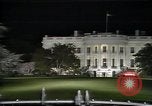
President Ronald Reagan gives a speech on the Defense Budget at the White House in Washington DC.
U.S. President Ronald Reagan at the White House in Washington DC. President Ronald Reagan gives a speech on the Defense Budget and on the need for increased defense spending. He speaks about the Defense Program America needs. President Reagan states that the American security should be prepared for all situations. He presents various comparison charts depicting weapons of the Soviet Union versus the United States. An animation shows 'Intercontinental Missiles'. Intermediate Range Weapons from 1978-1982. An animation shows the difference in production of submarines, artillery and weapons between the United States and the Soviet Union. Labeled reconnaissance photograph shows the Soviet Communications Intelligence Facility in Lourdes, Cuba. Aerial reconnaissance photos of the Soviet Weaponry Sandino Airfield in Nicaragua. An airfield under construction in Grenada. President Reagan in his speech states that the American military force should be ready to respond to any emergency situation. An animated graph shows the percent of budget from 1960-1980 dedicated to defense versus social services, with defense spending falling proportionally as spending on social programs increased. At the end of the speech President Ronald Reagan asks for America's prayers and support.
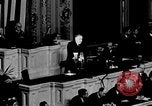
U.S. President Roosevelt emphasizes on increasing expenditure on Army during his annual message to the Congress,Washington D.C.
Congress hears U.S. President Franklin D Roosevelt's annual State of the Union message in Washington D.C. President Roosevelt talks about how no one expects the United States to send American youth again to fight on the soil of Europe (to be involved in World War 2) and he asserts that is still the United States position "for nobody expects such an undertaking." He recalls that President George Washington warned against entangling foreign alliances. He calls on congress to levy sufficient additional taxes to meet emergency spending needs for national defense (due to threat of war). Members of the Congress clap during President's State of the Union speech.

U.S. President Franklin Roosevelt addresses the nation regarding the lend lease aid to Britain (WW2)
U.S. President Franklin Roosevelt addresses the nation from Washington DC in World War II. Clip includes portion of his "Great Arsenal of Democracy" speech. Roosevelt states that the United States is determined to aid Britain through the Lend Lease program. He states that the United States will be in constant danger if the Axis powers win the war. The U.S. must supply England and Europe with arms. “We must be the great arsenal of democracy… I believe that the Axis powers are not going to win this war. I base that belief on the latest and best of information.” President Roosevelt said.
President Roosevelt addresses the U.S. Congress in Washington DC, seeking to limit use of U.S. products by belligerent nations.
President Franklin D Roosevelt addresses the Congress in Washington DC, United States. Roosevelt explains the essence of the foreign policy of America. He states that America has always tried to limit armament and aimed at peaceful solution of disputes. He says that United States believes in equality and popular rule. He also speaks about the steps America would take in event of a war including the practice of discouraging use of American products by belligerent states.
The U.S. President Franklin Roosevelt takes the oath of office at the White House, Washington DC (WW2)
United States President Franklin Roosevelt takes the oath of office and delivers the inaugural address at the White House, Washington DC during World War II. 7000 guests arrive for the 1945 inauguration. Snow covered land. Wounded soldiers from the nearby hospital are invited as guests. Crowd lines up in the backyard of White House. President Roosevelt's grandchildren stand at stairs with Harry Hopkins. Secretary of War Henry Stimson and Mrs Stimson, Secretary of Navy James Forrestal and Mrs Forrestal, Secretary Harold Ickes, Chief Justice of United States Harlan Stones, Admiral of fleet Ernst King, General George Marshall and Mrs. Marshall, Secretary of State Edward Stettinius and his wife among the guests. Vice President Wallace swears Harry Truman. President Roosevelt states in his inaugural address that they will get victory in war.

U.S. propaganda film depicts Japanese people and culture, and describes early diplomacy efforts with Japan (WW2)
A United States World War II propaganda film depicts Japanese psychology and living habits. Japanese mythology explains the origin of the Imperial Family. Japanese people celebrate the 2600th anniversary of mythological founding of Japan in 1940. Men, women, and children parade with Japanese flags. A man wearing Sendaihira hakama formal wear leads crowd chanting. A huge crowd gathers for the celebration. United States Secretary of State Cordell Hull visits Japan. Secretary Hull arrives in a conference to discuss about peace in the Pacific Theater. U.S. President Franklin Roosevelt speaks about the diplomatic efforts to maintain peace in the Pacific Theater. President Roosevelt seated on a ship with General Douglas MacArthur on one side and Admiral Chester Nimitz on the other. Japanese Ambassador Kichisaburō Nomura hands a document to Ambassador Hull after the attack on the Pearl Harbor had begun one hour earlier (unbeknownst to the meeting attendees). The document states the Japanese Government's wish to continue negotiations for peace. Scenic views in Japan. Japanese people on bridge in a scenic garden. A Japanese man carries his son on his back. Japanese women wearing kimonos hold parasols. A woman tucks her child to sleep. Japanese soldiers in China committing atrocities against Chinese civilians. Shovel scoops up soil to bury dead Chinese civilians. Two men shot at point blank range. Bodies of slain Chinese children seen following attacks. Japanese general disembarks from a plane and salutes. “We must know them as they are.” the narrator reminds audience.
CRITICALPAST.COM: About Us | Contact Us | FAQs - How to Order | License Agreement | My Account | My Lightboxes | Shopping Cart | Advanced Search | Featured Collections | Website Terms & Conditions | Privacy Policy ©2026 CriticalPast LLC.
License Agreement |
Terms & Conditions |
Privacy Policy
©2026 CriticalPast LLC.