


 Francais
 Deutsch
 Italiano
Refine Your Search
New Mexico United States 1946 stock footage and images
- Showing 1399 to 1404 of 30776 results more
more Hide
Hide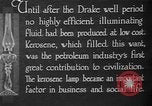
A man and a woman talk in the light of a kerosene lamp in the United States. Also shows the 1893 DeWitt Clinton replica locomotive and train in operation.
The world struggle for oil is depicted. Use of components of oil in homes and in railroads in the United States is shown. A dramatization shows the effect of a kerosene lamp on social life. A woman seated in a chair near a table in a room. A kerosene lamp in a corner. A man opens the door of the room and walks in. The woman gets up and welcomes the man. They both walk to a seat and sit down. Another woman enters the room. The man stands to greet her. She increases the light of the lamp and then leaves the room. The man decreases the light of the lamp. The man and the woman talk. The 1893 replica of the 1831 DeWitt Clinton steam locomotive is shown in operation with its three carriage train, in New York City. The DeWitt Clinton was the first railroad locomotive to operate on the Mohawk & Hudson Railroad in New York. The reproduction seen here was built in 1893 by the New York Central Railroad for the Columbian Exposition in Chicago. This footage was shot on July 17, 1921 when the DeWitt Clinton train was preparing for a trip to another exposition in Chicago. On this day it ran several times from 96th to 116th streets in New York City. New York Central employees are seen on the drain, dressed as passengers would have been in 1831. This replica was later displayed at Grand Central Terminal in New York City, and is is now on display at The Henry Ford museum in Dearborn Michigan. It was acquired by Henry Ford in 1934, in an agreement with the New York Central that it would continue to travel to events on occasion.
German prisoners of war peel potatoes and tend garden at a camp in United States.
German prisoners of war in the United States during World War 2. Prisoners peel potatoes and tend garden in United States. The German prisoners peel potatoes. The prisoners tend garden. Prisoners plant new plants in garden.
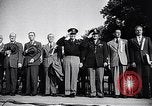
Eisenhower is appointed as the president of Columbia University and Harry S. Truman with him in the United States.
A biographical documentary shows the life of Dwight David Eisenhower who was the President of the United States from 1953 to 1961. Dwight David Eisenhower and officers salute. Others stand near him. Eisenhower with his wife Marie Geneva Doud “Mamie” Eisenhower attend the birth of their granddaughter, Susan Eisenhower. Eisenhower and his wife coos over baby Susan as her mother Barbara holds her. He walks with his wife. Soldiers holding flags salute. Dwight David Eisenhower in a car salutes them. He sits with a woman. In 1948 he is appointed as the President of Columbia University in New York. He walks with other professors. He is being honored and appointed as the president by other personnel. He addresses the students. In Washington: A plane taxis. Dwight David Eisenhower comes out of a car. Cameramen click pictures. Dwight David Eisenhower wearing a hat stands. He enters a building. He opens his coat. He is greeted by U.S. President Harry S. Truman. The United States Capitol building.
Soldiers of the United States Army having a meal at an Army camp and marching on a bridge during World War I.
Draftees of the United States Army at an Army camp during World War I. Cooks prepare food for the new recruits in training at an open mess area. Draftees move slowly carrying utensils for food. Cooks give meal to all the draftees, spooning out beans onto plates. Group of World War I soldiers of the United States Army carrying their rifles, march past a bridge. A boy in uniform walks beside them.
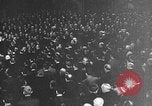
Varying sentiments about war and labor in lead up to World War 2. Roosevelt delivers his war message in the United States.
Disturbances and conflicting views about war versus isolationist approach in the United States prior to World War II. Officials speak about lend lease and officials with anti-war involvement stance advocate protectionism. Speakers include Senator Gerald P. Nye. and Senator Burton K. Wheeler. Wendell Willkie speak advocating a unified approach. Senator Joshua B. Lee of Oklahoma speaks. United States President Franklin D. Roosevelt addresses the Congress and delivers his war message. Pacifist student protestors on street in front of the White House with anti-war banners that read 'Peace Mobilization'. Counter demonstrators also picket, including a man with a sign, "We Americans Protest Communists Picketing the White House." Vehicles drive past in front of the White House. A group of women anti-war protestors are seen seated at an event, and together they pull down black veils in front of their faces. German Bund officials (German-American Bund) are seen meeting at an outdoor rally, and then again at Madison Square Garden in New York City in 1939. A band plays and the leader Fritz Julius Kuhn gives a brief speech during which a protestor leaps the stage and is beaten down by Bund members. Workers on streets protesting for various labor rights. They march and picket on a street. Demonstrators for other causes in American society in the early 1940s, including a woman demonstrator who carries a sign advocating civil rights or equal rights that says "Did Lincoln Free the Slaves?" Clip ends with scenes of violence at various labor strikes, including scabs (strike-breakers) being attacked, beaten, and hit by strikers, and authorities directing water hoses on strikers to repel them away from a building gate.
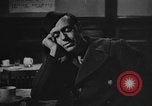
Model community, growth in cities, and town meetings in the United States.
A U.S. Army soldier seated on a chair takes a nap. A cup kept in front of him on the table. Children walking on sidewalk in small town America. Downtown view of small Indiana town. View of an American family of a small town seated in dining room for a dinner meal. Children exit a one room school house. Both a well-kept high school building and a rural simple school are shown, with boys and girls in bare feet exiting the poor rural school down a wooden ramp. Men lined up for work. Children playing in slum and tenement areas in poverty stricken areas. Quick views of skyscrapers, new schools, buildings, colleges (including view of Rice University in Houston Texas) and art galleries in the United States, including the National Gallery of Art entrance. A Texan in a cowboy hat delivers a John Randolph famed "Texas Brag" saying, "If all the hogs in Texas were one big hog, he could dig the Panama Canal with three roots and a grunt.” The National Gallery of Art in Washington, D.C. Labor organizer John L. Lewis, president of the United Mine Workers of America (UMW) states, "The American Federation of Labor can help if it will, it can uphold anything, but we shall carry on." An American town hall meeting in progress. (World War II period).
CRITICALPAST.COM: About Us | Contact Us | FAQs - How to Order | License Agreement | My Account | My Lightboxes | Shopping Cart | Advanced Search | Featured Collections | Website Terms & Conditions | Privacy Policy ©2026 CriticalPast LLC.
License Agreement |
Terms & Conditions |
Privacy Policy
©2026 CriticalPast LLC.