


 Francais
 Deutsch
 Italiano
Refine Your Search
New Mexico United States 1946 stock footage and images
- Showing 24397 to 24402 of 30777 results more
more Hide
Hide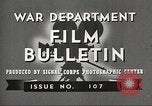
"Movies at War" about Motion picture films being made by and for the U.S. Army during World War II.
Moviemaking and distribution by the U.S. Army during World War 2. Scenes of New York City skyline at night and street scenes in daytime. U.S. Servicemen in South Pacific, the arctic, and in Egypt. Soldiers marching and watching training films.Scenes on set of training film being made about care of wounded. Soldiers checking out films and motion picture projection equipment at an Army library. Comments regarding popularity of the "Fighting Men," "Why we fight,"and other series of war time motion pictures. Soldier technicians inspecting and repairing films and equipment. Discussions and sample slates of films translated into various languages. Views of soldier actors, producers, directors, and technicians enter movie studio buildings to produce films.
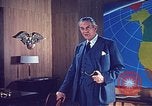
North American Air Defense System (NORAD) being exercised
Actor Raymond Massey in an office discussing importance of American military readiness. Street scenes in Manhattan, New York City. View from buiding overlooking Times Square in Mahattan, with Astor Hotel at left. Camera pans up (northward). Shift to North American Air Defense (NORAD) command center in Colorado Springs, Colorado, where U.S. Air Force men and women mark aircraft positions on plexiglass status board. During this exercise,NORAD Commander,General Laurence S. Kuter,USAF,with NORAD Deputy Commander, Canadian Air Marshal Roy Slemon, at his side, picks up phone to alert defense forces. View of DEW line radar site where men monitoring radar screens pick up returns from two incoming bombers. A NORAD radar picket ship at sea and sailor inside detecting incoming bombers on his radar screen. An airborne Lockheed EC121 Radar picket aircraft and crew member inside detecting targets on his radar screen. Views of personnel at various NORAD centers sending and receiving detailed information about the detected aircraft. Canadian and U.S. officers communicating on "red telephone." General Kuter and Air Marshal Slemon, consulting in NORAD headquarters command center. A Navy Captain on the "red phone." Klaxon horn alerts Royal Canadian Air Force intercepter crew who scramble to their aircraft. Canadian Avro CF-100 Canuck interceptors taking off. General Kuter and Air Marshal Slemon engaged in the NORAD command center. Unidentified 4-star Air Force General using "red phone." SAC bombers on airborne alert. Air Force officer alerts interceptor squadron. Pilots scramble and run to their F-102 aircraft. F-102, tail number 53-107 taxiing from hangar. Pilots quickly entering their aircraft and being secured in cockpits. F-102s taxiing at high speed.BOMARC missile readied. Civil defense officials issue air raid alert.
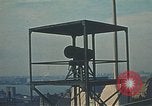
Fictional enactment of U.S. actions in response to enemy bomber attack against North America
Cold war, nuclear war preparedness film. Air raid alarm sounding and civilians in New York City running down into subway for shelter. Surface-to-air BOMARC missiles raising into firing position. Civil Defense Air Raid Warden, in white helmet, directing people to shelter. BOMARC and NIKE-Hercules missiles readied for launch. F-102 interceptor aircraft in flight. NORAD personnel monitoring radar displays. Formation of F-102s and closeup of a pilot in a cockpit. Activities of personnel inside NORAD command Center, coordinating defense forces. NORAD Commander, General Laurence S. Kuter, on "Red Phone" for conference call receiving White House authority to strike back. SAC bomber crews scramble to their bomber aircraft. B-47s and B-52s taking off. NORAD headquarters authorizing missile sites to commence firing.SM-65 Atlas missiles being launched. Nike-Hercules missiles being raised and BOMARC missiles being fired. Enemy aircraft being destroyed in the air, by missiles. Comments by actor Raymond Massey regarding U.S. military preparedness.
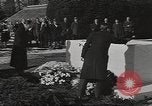
Officials place wreaths at memorial marking the grave of U.S. President Franklin D. Roosevelt, at his home, Springwood, in Hyde Park
Officials and visitors place wreaths at the marble memorial marking the grave of President Franklin D. Roosevelt, in the rose garden of his home, Springwood, in Hyde Park, New York. Cars carrying the visitors drive up to the main house. Several views of Springwood.
Scenes of U.S. Naval aviation in the period between the world wars.
Three Curtiss N-9 Training Seaplanes, ostensibly piloted by student aviators, take off from waterfront at Pensacola, Florida, carrying a news photographer with them. View from rear cockpit of airplane tail and wake in the water as one of the planes commences takeoff. Brief glimpse of a Vought Corsair I (O2U) seaplane atop the Battleship USS Colorado (BB-45) and after it has been lowered to the water at the battleship's stern. Several Navy biplanes landing on the USS Langley (CV-1) as she is underway. A flight of Loening OL-5 amphibian aircraft, as viewed past the tail of one of them, in flight. Fifteen U.S. Navy biplanes flying in formation. A Consolidated P2Y-1 Ranger seaplane taking off from water past an Omaha-class light cruiser. Illustrated map of Hawaii showing location is relation to surrounding major land masses.
Early trials of the Nuclear powered submarine, USS Nautilus with Admirals Carney and Fechteler aboard
Assorted views taken when the CNO visited and sailed aboard the new atomic powered submarine, USS Nautilus during sea trials. A sailor walks along the deck of the USS Nautilus (SSN 571) docked on the Thames river at Groton, Connecticut. It moves away from the dock. Next, Admiral Robert B. Carney, Chief of Naval Operations walks on the deck with Nautilus Captain, Commander Eugene P. Wilkinson. Admiral William Fechteler, former CNO, follows behind them. Crew of the boat is lined up on deck. A sailor raises Admiral's 4-star flag next to the American flag on the Nautilus flag pole. Pier, docks, and waterfront buildings are seen in the background. Sailors pick up lines from deck of the Nautilus and remove the American flag and flagpole from the deck. Admiral Carney descends from the deck through a hatch. Next, the Nautilus is seen, moving slowly away on the calm river. View from on deck looking aft, shows trailing wake as the Nautilus moves at higher speed. Views of sailors at duty stations inside the boat: one in a compartment, monitoring equipment; a lookout in cold weather gear, with binoculars; and a sailor below speaking on an interphone, as Admiral Carney sits next to him. The Admiral standing next to the sailor, conversing with him. Admiral Fechteler standing behind the helmsman as an officer briefs him. Glimpse of Admiral Carney through a hatch. Admiral Carney climbing interior stairway to another deck where he and Admiral Fechteler join Commander Wilkinson who briefs them. A sailor shows Admiral Carney a metal plaque on the wall citing the Nautilus as the sixth ship of the fleet to carry that name, and giving information about that. Glimpse of crew member taking a book from a cabinet. Admiral Carney ducking as he passes through a hatchway. Admiral Carney seated at a table having coffee and conversing with a sailor. Behind them on a wall, is a juke box. The Admirals standing near sailors on a break, playing cards. Admiral Carney looking over the juke box on the wall. Both Admirals signing a log book. The Admirals seated beside one another at the helmsman position.
CRITICALPAST.COM: About Us | Contact Us | FAQs - How to Order | License Agreement | My Account | My Lightboxes | Shopping Cart | Advanced Search | Featured Collections | Website Terms & Conditions | Privacy Policy ©2026 CriticalPast LLC.
License Agreement |
Terms & Conditions |
Privacy Policy
©2026 CriticalPast LLC.