


 Francais
 Deutsch
 Italiano
Refine Your Search
New Mexico United States 1946 stock footage and images
- Showing 2503 to 2508 of 30776 results more
more Hide
Hide
U.S. Marines inspect Japanese flag and unload LCVT in Bougainville, New Guinea during World War II.
United States Marines in Bougainville, New Guinea during World War II. Three Marines inspect a Japanese flag. A Marine attaches a bayonet to Japanese rifle and fires the rifle. Wounded marine on a stretcher being unloaded from a jeep. Marine being carried to a medical center. Another Marine lights up a cigarette for him. Landing area, lagoon and off shore islands. LVT-3 (Landing Vehicle Tracked) off shore as Marines unload a LCVT (Landing Craft Vehicle Tracked) in the foreground.
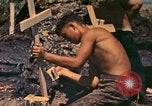
U.S. Marines dig graves and paint crosses at a graveyard in Bougainville, New Guinea during World War II.
United States Marines in Bougainville, New Guinea during World War II. A Marine paints a white cross for a burial yard. A cross at the cemetery bearing a sign that reads' Cemetery no.1' A105 mm Howitzer in foreground on an island. A truck tows a 155 mm Howitzer on a carriage. Landing area and artillery dugout on the shore. Three anti aircraft gun and mount dug in off the shore. Three shell cases lying on ground. Cemetery as men dig graves. A M3A1 tank moves into a jungle. Turret of M3 Stuart tank.
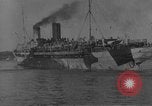
Belgian soldiers who had been fighting against German and Austrian forces, in Russia, in World War I, arrive by ship in Bordeaux, France.
The French line ship, SS Lorraine, in camouflage paint, seen backing into port at Bordeaux, France, on June 24, 1918. Belgian troops of the ACM Corps (Autos-Canons-Mitrailleuses, Belgian armored unit) disembark. They are seen as they walk down a gangway from the ship, in combat uniforms and steel helmets, and carrying their weapons and personal gear. (Note: Soldiers of this armored unit from Belgium fought alongside the Imperial Russian army against German and Austrian troops in 1915 in Russia, during World War 1, before the 1917 Bolshevik revolution, after which they were stranded in hostile territory. They left Vladivostok for the United States on the SS Sheridan, and docked at San Francisco on May 12, 1918. They were warmly greeted as they proceeded across the U.S. to New York city, where they participated in the Memorial Day Parade. After leaving New York City, aboard the SS La Lorraine, they reached Bordeaux on June 24 1918.)

Director Streibert speaks on the purposes of the USIA and Soviet influence; scenes from a Soviet anti-American propaganda film
Theodore Cuyler Streibert , Director of the U.S. Information Agency, speaks on the purposes of the Agency (USIS). The Director seated at a table. He states that there is much misunderstanding about the United States, throughout the world, and Communist entities wish to take advantage of this to spread misinformation about the U.S. As the leading world power for peace, he says the U.S. must tell the world the truth about America. This is the mission of the USIA. A map portrays Soviet dominated areas within the so-called "iron curtain,"encompassing 800 million people. Another map illustrates targets of Communist propaganda employed to facilitate North Korea's aggression against South Korea. A graph illustrates propaganda spending by the Soviet Union and Communist China, primarily to spread misinformation about America. Segments of a Soviet propaganda film about the U.S. are shown. It begins with a map of the U.S. and then shows the Statue of Liberty. Camera pans over Manhattan, showing skyscrapers. A narrator disparages American commercialism, materialism and sensationalism. A lion is seen sitting in a convertible car, looking over a young woman's head. Next are scenes of an American beauty contest, and of women performing precision water skiing. Then an airplane is seen crashing on landing and a car is seen burning. View from trolley car moving along Broadway, from Times Square, in Manhattan, New York City, at night. A follies-style Broadway show. Show girls in bathing suits, walking past the camera. Show girls performing on stage. Another nighttime view of Times Square. Dogs being manicured by groomers. Outdoor soup kitchen scene from the Great Depression in the 1930s with unemployed men receiving food. Hobos or homeless men at a railroad siding. Milk and grain being spilled from containers during a labor and pricing dispute. Scenes of slum area tenement houses with wash drying on lines strung between the buildings. Men playing bocce ball in the yard of an apartment house. Camera pans up the Empire State Building from street level view. African American drummer with other band musicians performing in a civilian band, and scenes of African American musicians in a U.S. Army band. Poor African Americans in the South, at home and doing wash outdoors. Mounted police maintaining order in scenes of a fire and public protest or labor strife (circa 1935) interposed with views of the Statue of Liberty. A Soviet propaganda poster about the Korean War, shows an American soldier walking away from a dead Korean woman whose small child clings to her. Fires burn and a burning airplane falls from the sky in the background. A propaganda cartoon shows "warmongers of the west" being counterbalanced by a Soviet fist on a pair of scales.
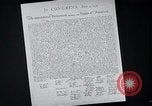
USIA tells the story of America, its democracy and diplomacy through ideas, people and pictures.
USIA tells the story of America. The Unanimous Declaration for the States of America by the Congress on July 4, 1776. The Statue of Liberty in New York. Atomic bomb explodes in Japan during the world war. U.S. troops prepare to defend America. U.S. State diplomats sign documents as they deal with Diplomacy. United States information Agency (USIA) tells the story of America through various means dealing with ideas, people and pictures. A person reads a book, announcers broadcast over radio, and cameramen record events. The USIA seal.
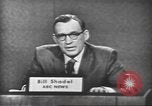
John Kennedy and Nixon talk about steps to improve U.S. economic growth during a presidential election debate in the U.S.
The third Kennedy-Nixon Presidential Debate in the United States. Roscoe Drummond of New York Herald Tribune asks Republican candidate U.S. Vice President Richard M Nixon to comment on declining economic growth and what steps he would take to improve it. Nixon answers that he is not satisfied with the economic growth of the U.S. He compares the nation's growth rate during the Truman Administration and the Eisenhower Administration. He urges for the development of private enterprise sector of the economy. He talks about his program of tax reform which would stimulate more investment in U.S. economy. He talks about the upliftment of the distressed areas and full utilization of resources of those areas. He talks about the adequate use of talents of the Americans and their civil rights. He concludes and states that there has been a continuous development of American economy in the past years. Democratic candidate Senator John F Kennedy states that Nixon has pointed a rise in food prices in his proposed agricultural program which is not true. He comments on the statement given by Nixon on aiding distressed areas and education. He says that the bills of these program have been opposed by the administration. He talks about the lowest rate of economic growth during this administration.
CRITICALPAST.COM: About Us | Contact Us | FAQs - How to Order | License Agreement | My Account | My Lightboxes | Shopping Cart | Advanced Search | Featured Collections | Website Terms & Conditions | Privacy Policy ©2026 CriticalPast LLC.
License Agreement |
Terms & Conditions |
Privacy Policy
©2026 CriticalPast LLC.