


 Francais
 Deutsch
 Italiano
Refine Your Search
Norway 1941 stock footage and images
- Showing 169 to 174 of 1737 results more
more Hide
Hide
Protective measures taken by Americans in Hawaii, after the Japanese attack on Pearl Harbor.
Aftermath of Pearl Harbor attack. People in Oahu, Hawaii, prepare to deal with more air attacks by Japanese. Armed U.S. soldier in sandbagged position, in Hawaii. The territorial governor of Hawaii, Joseph Poindexter, signing a declaration of Martial Law. Four thousand members of Oahu's Civil Defense Committee, dressed in dark bottoms and white tops, wearing steel helmets with "W" on them, standing at attention in formation on grounds of a stadium. Windows in all downtown shops taped to prevent flying glass. Sand bags surrounding a power substation. Huge quantities of barbed wire in a storage yard and strung along the beaches, along highways, around schools, and public buildings of Oahu. A man pushing a lawn mower between sandbagged defense positions in a residential neighborhood. Construction machinery digging defensive trenches. Bomb shelters being constructed of precast concrete. Air raid sirens installed and school children leaving their building and sheltering in deep trenches during a test. Very small children taking shelter in zig-zag trenches and donning gas masks. Huge assemblies of children, and of grownups, all donning gas masks. Little children being dressed in capsule-like "bunny mask" protective gear.One of them crying inside the covering. Crowds of women and children lined up on a veranda waiting to receive these "bunny masks." Military personnel, civilians, and school children, all carrying personal gas masks with them at all times. Innumerable old rubber tires saved in an open yard. Japanese-Americans donating blood to the American Red Cross and lined up to buy war bonds. Soldiers arresting a Japanese resident known to be an enemy agent. Boarded up shops of Japanese-Americans, who had been interned. Japanese-Americans removing all Japanese language signs from their areas. Language school buildings with closed signs. An empty and boarded-up Shinto temple. One Japanese-American replacing his cafe sign with one reading: "Keep 'Em Flying Cafe." U.S. Army troops posted on roadways. The Aloha Tower in camouflage paint. A Lurline steamship leaving port, and being replaced by warships. Prewar view of people enjoying Waikakee beach, and current view of two boys playing in sand near barbed wire barriers. City streets deserted at twilight, as blackout procedures take effect at dusk. Views of darkened homes and palm trees silhouetted against sky at dusk. The "ghost" of a sailor killed in World War II, stands in front of Arlington cemetery, Washington, DC, and converses with the ghost of a soldier killed in World War I. They discuss idealistic notions about ending wars for good. Displays of flags is seen, including: Australia; Belgium; Brazil; Canada; China; Costa Rica; Cuba; Czechoslovakia; Dominican Republic; England; Ethopia; Greece; Guatemala; Haiti; Honduras; India; Yugoslavia; Luxembourg; Mexico; The Netherlands; New Zealand; Nicaragua; Norway; Panama; The Philippines; Poland; Russia; El Salvador; South Africa; and the U.S.A. "V" created in the sky by a skywriting airplane.
Germany invades various nations of Europe during opening years of World War II; civilian refugees evacuating war torn cities.
Past events show German invasions during World War II. German flags in view. German soldiers march. German planes fly in formation during Nazi Party rally at Luitbold Arena in Nuremberg Germany. Adolf Hilter salutes a parade as armored cars and German soldiers pass by. German Luftwaffe aircraft pass overhead in formation during a rally. Comparison shot shows German Wehrmacht army soldiers marching in close ranks, followed by a close up shot of United States Army soldiers marching in close ranks. Both shots shows large numbers of marching soldiers close-up. German Chancellor Adolf Hitler in discussion with Hermann Goering (Göring). They approach a map and then turn their backs. British soldier on lookup watches the sky over London for signs of German bombing raid as parliament buildings and the River Thames are seen in the background. Elevated view of city center, streets, bridges and Russia Orthodox Church in the Soviet Union; possibly Moscow. View of the United States Capitol building in Washington DC. Animated map shows the German positions. Aerial view of devastation from German Luftwaffe bombing of Poland on September 1, 1939. Damaged buildings and houses in Poland due to German bombing in World War II. Polish civilians lined up. Polish people near wrecked horse cart and equipment. Polish citizens carry dead bodies on litters and dig graves for citizens killed in bombing. British people near Big Ben and Parliament buildings on September 3, 1939, the date England declared war against Germany. In London, British children walking toward railroad station near signs that read "To Evacuation Trains", to be evacuated from the London area for safety during the war. Scenes of anguished citizens in England and in France saying goodbye to loved ones including boys and girls being evacuated to safety away from cities, and French women saying goodbye and kissing French soldiers. Close-up view of a French child's arm band with his name and other identifying information, as he leaves in an evacuation. Men leaving for war service. They hug and embrace with emotion. Women wave handkerchiefs at a bus departing with children, then weep. German soldiers march invading Denmark and Norway in April 1940. Sad civilians flee in trucks.
Celebrities help promote American Red Cross blood donor programs and War bond drives during World War II.
Film opens showing a huge crowd gathered in New York’s Madison Square Garden for a rally in support of the American Red Cross, during World War 2. Eleanor Roosevelt, the First Lady welcomes and introduces Princess Martha of Norway. The audience applauds. Scene then shifts for Red Cross activities on the home front. Two Red Cross women remove items from a station wagon in preparation for a local Blood drive. A panel truck parked next to them is marked: “American Red Cross Blood Donor Service.” More Red Cross volunteer women remove items from the panel truck to set up the blood donor activity. View of many persons in beds at a blood donor center. Nurses and Red Cross volunteers working at the center with donors. One of the donors is an active duty sailor in uniform. Complete change of scene to California, where Hollywood stars are seen involved in a war bond drive. Closeup of several, including Irene Dunn, Ronald Coleman, Hedy Lamarr, and Greer Garson. Glimpse of crowd at the bond drive.
Celebration of the 25th Wedding Anniversary of the Queen Juliana and Prince Bernhard and Queen's 53th birthday in Amsterdam.
Royal guests attend the reception for a double celebration in Amsterdam, Netherlands. A large crowd gathered outside the Royal Palace of Amsterdam (Koninklijk Paleis Amsterdam Postbus 3708 1001 AM Amsterdam) to pay tribute to the beloved Queen of Netherlands, Queen Juliana, and her husband Prince Bernhard during their 25th wedding ceremony and the Queen's 53rd birthday. Amsterdam police form a human barricade to control crowd. Views of the Royal Palace Amsterdam. Crown Princess Beatrix and her sisters, Princess Irene, Princess Margriet, and Princess Marijke (also known as Princess Maria Christina), move past the crowd in a royal carriage. The crowd greets the princesses. View of the Amstel Hotel in Amsterdam (Professor Tulpplein 1 1018 GX Amsterdam Nederland). Guests include Queen Elizabeth II with Mohammad Reza Shah of Iran, Iranian Queen Consort Farah Pahlavi with Prince John of Luxembourg, arriving at the state dinner in Amstel Hotel. King of Norway Olav V, Grand Duchess Charlotte of Luxembourg, Prince Philip of Britain, and King Gustav VI Adolf of Sweden, and other royal dignitaries also attend the reception. Fireworks organized for the occasion are seen, framing large sign numbers "1962".

Anston Samuelsten wins the National Skiing Championship against Steve Rieschi at Norge Ski Club in Fox River Grove, Illinois.
The National Skiing Championship at the Norge Ski Club in Fox River Grove, Illinois. The skiing championship begins. Steve Rieschi of Colorado jumps a leap of 184 feet. Spectators cheer the jumpers. Another jumper from Norway Anston Samuelsten jumps a leap of 194 feet. Anston wins the championship against Steve.
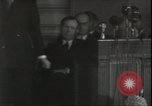
NATO treaty signed in Washington D.C., United States
Representatives of various states sign North Atlantic Treaty Organization treaty (NATO) in Washington DC, United States. Belgian Premier Paul-Henri Spaak, Lester B Person of Canada, Rasmussen of Denmark, Robert Schuman of France, Bjarni Benidiktsson of Italy, Joseph Bech of Luxembourg, Stikker of Netherlands, Halvard M Lange of Norway, Jose Caeiro De Mata of Portugal, Ernest Bevin of England sign the NATO treaty. President Truman shakes hands with Allen W Brakley. Brakley shakes hands with Dean Acheson. Acheson signs the treaty and delivers a concluding speech.