


 Francais
 Deutsch
 Italiano
Refine Your Search
Norway 1941 stock footage and images
- Showing 175 to 180 of 1737 results more
more Hide
Hide
Dignitaries gather to witness the greatest military parade in history in New York City, United States.
The greatest military parade in New York city, United States. Soldiers hold United States flag as they march. People gather in a large number to watch the military parade that lasts over 12 hours. The Allied troops parade. Views of large columns of soldiers marching. Dignitaries salute the troops. Princess Martha of Norway and King George II of Greece salute the troops. British troops and sailors parade. Mechanized equipment move on the parade grounds. Buildings along the sides of the street. (World War II period).
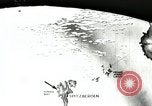
Film shot by Lieutenant Commander Richard Byrd, while circling over the North Pole, with pilot Floyd Bennett, in their Fokker tri-motor airplane.
Byrd arctic expedition to fly an airplane over the North Pole, in 1926. Animated map illustrates the planned Northward course of Lieutenant Commander Richard Byrd and pilot Floyd Bennett, headed to the North Pole, in their Fokker tri-motor airplane. The starting point is Kings Bay, Spitsbergen, Norway, where they took off on May 9, 1926. A slate states that, "Byrd circles the Pole, checking observations and photographing." Scene shifts to images being recorded by Byrd from inside their Fokker F-VII Tri-motor airplane, the "Josephine Ford." One shows the big "F" in the name "Fokker" on underside of the right wing. From there, the camera pans back over the frozen wasteland below, with parts of the aircraft also seen. Another shot shows the aircraft tail (empennage) with mountains in background amidst snow-filled valleys while the airplane is in a gentle right-hand turn. Underside of engine is seen with arctic scenery, passing below.
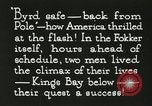
Richard Byrd and Floyd Bennett return from North Pole in Fokker Tri-motor airplane, the "Josephine Ford."
Animated map illustrates the flight course of Lieutenant Commander Richard Byrd and pilot Floyd Bennett, as they return to Kings Bay, Spitsbergen, Norway, from the North Pole, aboard their Fokker F-VII Tri-motor airplane, the "Josephine Ford." Pilot Floyd Bennett is photographed (by Byrd) in full arctic gear, at the controls of the airplane. View from the cabin of the Kings Bay encampment below. View from the ground, of Byrd and Bennett's Fokker aircraft, as it flies over the mooring mast of the Norwegian airship Norge. Next, steam issues from the ship's horn on the funnel of the SS Chantier, as she welcomes the aviators back from the Pole. Expedition team members wave and toss their hats in joy, as the aircraft approaches to land. The Fokker on final approach, with huge snow mountains behind. It touches down in front of the Norge airship hangar (between the hangar and the bay) and turns left, to taxi.
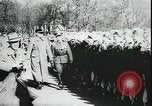
Norwegian troops are inspected by Vidkun Quisling and German officers in the European Theater during World War II.
Norwegian troops in the European Theater during World War II. Minister President of Norway Vidkun Quisling and German officers inspect the troops. A statue in the background. Buildings in the background. Vichy French troops march. They entrain in Marseilles, France. They meet their loved ones and board trains. They bid good bye as the trains leave the station.
German Atlantic Wall coastal defenses. German forces enter the Crimean Peninsula in World War II.
In opening scene, German Field Marshal Erwin Rommel is giving a "pep talk" to senior officers assembled at the Northern part of the German "Atlantic Wall" defenses in Scandinavia, during World War 2. A German sentry is seen in front of a large coastal fortification bearing the name "Skagerrak." Camera focuses on the barrel of a huge coastal gun. Closeup of the sentry. Troops travel on a small gauge railway carrying canisters of propellant and shells to a unique heavy coastal gun installed , near Kristiansand, Norway, overlooking the Skagerak Strait. (The gun is a 28 cm SK C/34 naval gun, similar to those installed on some battleships. But this one was appropriated from an abandoned German Army super-tank project.) An alarm bell sounds in the fort and soldiers respond. Next, huge coastal gun shells are seen being moved on conveyors to the gun. A team of gun operators recite preparation steps out loud as they adjust range, bearing, and other parameters before firing the weapon. Gunners load a shell into the gun breech, followed by several propellant charges. The breech lowers inside the fort as the gun barrel is raised to desired elevation. The gun is fired. More commands are spoken aloud and another round is fired. Glimpse from outside of gun flash at night. Complete change of scene shows a map of Crimean Peninsula. Anti-aircraft guns are shown at coastal areas. A quad-barreled FlaKvierling 38 gun is seen. German forces entering the Crimea. Infantry walk in and others, ride in open trucks.One soldier mans a light gun mounted on the back of a 6-wheeled truck. German soldiers posted on roads directing incoming traffic of trucks carrying troops. Closeups of German soldiers riding in open trucks. A trio of German Army officers watches the incoming troops. Local refugees carry their belongings as they flee from battle fronts.
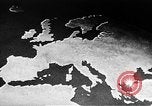
People face drought, rations, closed factories and black marketeers during post-war period in Europe and UK.
A documentary depicts life of people in the post-war ( World War II) economic challenges and hard times in Europe and the United Kingdom. (Before Marshall Plan of 1948). Animated map of Western Europe. Ruins and debris of buildings in cities of Europe damaged during the war.Two women walk past rubble. The damaged buildings. People cross a damaged bridge. A man at work during the construction of a bridge. Men make boats. Smoke comes out from a factory. In the Netherlands, a man in a textile factory works with weaving machinery. Another man paints a machine part. Men at work in the factory. A man and a woman eat food. A French farmer plows a field with the help of two horses. Scene in Norway of boats in a harbor. Norwegian fishermen at a dock. A fisherman untangles a fishing net. People buy food from shops. They walk on a street. People wait in a line for bread ration because of drought of 1947. Loaves of bread on display in store window. A coal processing plant exterior. A small steam locomotive moves on tracks at the factory yard. Close up view of two British coal miners with black soot on faces and bodies as they dig out coal from a mine using a pick axe. Queue of British citizens walk in a line to get coal. A man distributes equal amounts of coal to the British men and women in the queue, who receive a coal ration loaded into a bag. A power plant. A man operates factory controls (controls made in Liverpool), reducing output to lower levels due to power rationing. Different machines at work. View of a large industrial cog wheel slowing to a stop, and a large compressor in a factory slows to a stop. A view of a city. People walk in a street. British men and women enter a food shop in England, with a sign at the doorway indicating that bread is being offered only by ration. A woman feeds hens in a yard. A farmer negotiates with another farmer to sell livestock, but he shakes his head to refuse the offer. People in a city purchase food and other goods in a black market. A woman buying food from a black market seller. She hands him a pile of cash bills in payment. Italian women picking olives beneath olive trees in grove in Italy. A man enters a food shop and speaks to a woman; the shelves in the store are almost empty. A railroad train freight car moves on tracks. A railway freight car factory in Belgium. Men at work in the factory. A man checks a line of completed rail car wheels in the factory. Freight cars lie unused in the factory yard as French customers cannot buy them since the company in Belgium will not accept French Francs in payment. An unemployed Italian man sitting on a wall collects cigarette butts. Weavers in Holland dig in a peet bog as that their weaving jobs are not available.