


 Francais
 Deutsch
 Italiano
Refine Your Search
Ohio-State-football stock footage and images
- Showing 11797 to 11802 of 24492 results more
more Hide
Hide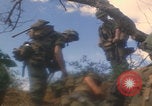
United States soldiers climb a hill side and move through a jungle in Vietnam
Two U.S. Army soldiers help a soldier climb a hill side during the Vietnam War. A soldier is seen wearing a helmet with leaves on it for camouflage. A soldier looking up in the middle of a jungle. A soldier talks over a field telephone while sitting on the ground. Writing on a helmet. A soldier holds a canteen while standing on the field.
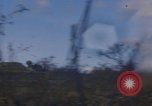
United States soldiers carrying equipment while moving across a field in Vietnam
U.S. Army soldiers running and moving across an exposed, open field during the Vietnam War. A soldier sitting in the middle of a field. Soldiers carry equipment and carefully move across a field. A soldier carries a machine gun. Soldiers climb a hill one by one.
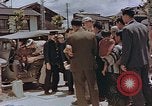
Japanese Military Police controls black market activities between civilians and members of UnitedStates occupation force,Kyoto.
Japanese Military Police acts to control black market activities in Kyoto, Japan. Japanese civilians, two men and a child and a member of the United States occupation force in Japan checked and arrested after being caught doing an illegal transaction.
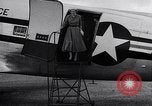
United StateVice President Richard Nixon visits king Norodon Shianouk during his Angkor visit in Cambodia
United States Vice President Richard Nixon arrives at the Siem Reap international airport in Angkor in Cambodia. A Cambodian girl welcomes the Vice President and his wife by presenting floral greetings to them. He inspects an honor guard by Cambodian soldiers. He along with other officials visits King Norodom Sihanouk of Cambodia. After the meeting with the king the he visits an ancient reservoir in Angkor.
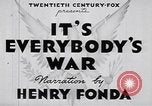
American civilians realize their war obligations and contribute to the war effort (WW2)
A World War II-era film shows Americans realize their war time obligations after the attack on Pearl Harbor and Fall of Corregidor in the Philippines. Crowds watch a marching band and newly enlisted soldiers in parade. A smiling woman waves at the marching soldiers. Women in car watch the parade. Tents in camp. Soldiers perform mass calisthenics and train with outdated tanks. Enlisted men learn how to fire machine guns and mortars. United State Army soldiers board a ship for their deployment. A ship departs for the Philippines. Soldiers arrive in the Philippines, a United States commonwealth in Asia. Japanese bombers drop bombs over Pearl Harbor. Civilians running on the streets during a Japanese aerial bombardment. United States Navy sailors firing machine guns and howitzers from ships. A ship explodes from Japanese bombing. A little girl runs to her father washing the car to tell the news about Pearl Harbor. The little girl runs across the street to tell her neighbor about Pearl Harbor. A woman writes a letter. A woman bakes a cake. People leave a church after service. An American soldier is shot by Japanese soldiers in the Philippines. A man reads a telegram. The man drives to a farm house, accompanied by a church minister. The man and minister tell the elderly couple living in the farm that their son was killed in action. Women selling war bonds on the street. A man silences his alarm clock and goes back to sleep. Cars racing on the street. Soldiers and civilians evacuating Manila. Japanese bombardment of Manila. A girl turns on the radio before Christmas dinner. Men and women congratulates a woman outside a law office. More civilians receive telegrams. Dead soldiers in the battlefield. A woman opens the Bible and writes the names of the dead. United States soldiers retreat in the Fall of Bataan. A woman shakes her head in disbelief after being told of a rumor her son was killed in action. A man hangs the United States flag on his porch. A bomb explodes near a makeshift tent hospital. Woman fixes bed. A woman eating on the dinner table alone. A soldier swats a mosquito from his neck in the Philippines. Forlorn men and women. Soldiers fighting in Corregidor. Soldiers surrender to the Japanese forces at Corregidor. A captured American soldier harasses a Japanese soldier while frisking him. He was apprehended by Japanese soldiers on guard. Despondent American civilians struggling after the Fall of Corregidor. A man despondently smokes from his bed. A depressed woman struggles to cut vegetables. A doctor treats civilians for shock and depression. A baseball game. A horse race. Boys playing on the beach. United States and Filipino soldiers march with United States and Philippine flags. People line up for blood donations. Civilians donate old rubber and hats. Men line up to punch their time in at work. Boys helping on the farms. Male teachers volunteer to fix civilians’ appliances and cars after school. A welder working at the shipyard. Civilians walking instead of using cars. An Allied plane landing. A woman sewing. A man opens a package of binoculars. People line up to buy war bonds. A majorette leading a marching band. Newly enlisted men with suitcases marching in parade.
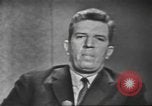
Kennedy and Nixon comment on the Indochina War, Quemoy and Matsu islands, and U-2 flights during their third debate.
Nixon and Kennedy debate questions regarding relations with Communists during the third Kennedy-Nixon Presidential Debate in the United States. Douglass Cater of Reporter magazine asks Republican candidate U.S. Vice President Richard M Nixon to comment whether there was a valid criticism of his statement of foreign policy. Nixon answers and states that the criticism is not valid. Regarding Indochina, he says that the U.S. would not have tolerated Indochina falling under Communist domination. And as a result of that the civil war there ended. He states that he supports the President's position and thinks that the President was correct in ordering the U-2 flights. Referring to Quemoy and Matsu he states that he objects to the constant reference to surrendering these islands. Democratic candidate Senator John F Kennedy disagrees with Nixon's statement on Indochina and states that reason Indochina was preserved was the Geneva Conference. On the question of the U-2 reconnaissance aircraft flights he states that he has never criticized them and never suggested stopping of espionage. On the question of keeping the Communists in doubt about the U.S. defending Quemoy and Matsu he states that the U.S. should meet its commitments to Formosa (Taiwan) and the Pescadores. He concludes by saying that he disagrees with Nixon as Nixon is extending the administration's commitment.
CRITICALPAST.COM: About Us | Contact Us | FAQs - How to Order | License Agreement | My Account | My Lightboxes | Shopping Cart | Advanced Search | Featured Collections | Website Terms & Conditions | Privacy Policy ©2026 CriticalPast LLC.
License Agreement |
Terms & Conditions |
Privacy Policy
©2026 CriticalPast LLC.