


 Francais
 Deutsch
 Italiano
Refine Your Search
Ohio-State-football stock footage and images
- Showing 11809 to 11814 of 24492 results more
more Hide
Hide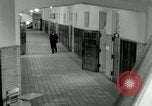
The "Little Rock Nine," 7 years after integrating Central High School, Little Rock, Arkansas, in 1957.
Jefferson Thomas, of the "Little Rock Nine," in a hallway, revisiting Central High School, in Little Rock Arkansas. He looks through a classroom window at a former teacher, Miss Dunn, speaking to a class from a lab table next to an anatomical model. View of Ernest Green sitting with other students in a lab filled with electronic equipment. Much later, as President of the NAACP chapter on campus of Michigan State University, he is seen handing out pamphlets to other students. Views of students congregating on the grounds of the university. One girl holds a poster reading "Give, NAACP Fund Drive." Professor David Gottlieb introduces Ernest Green who steps to a classroom podium to speak to Michigan State students in a lecture room. Green carrying books is seen entering and sitting down in the Michigan State library. In another scene, he enters sociological data into Hollerith punch cards for processing by computer. He walks in the university computer room where tape decks are seen spinning and computer operators are at work. One of the tapes mounted on a drive is labeled: "Ernest Green, Aspirations." Results from his work are seen coming out of a line printer. Green sits in a library and opens the 1960 yearbook of Central High School containing his and Carlotta Walls 'entries. View of Carlotta, in dorm at Denver University, Colorado, where she is a student. Gloria Ray is seen at the Illinois Institute of Technology, where she is a senior majoring in chemistry. Terrence Roberts is seen at the City College of Los Angeles, where he is studying Business Administration. Melba Pattillo, who left college to marry, is seen in two views. Scene shifts back to Central High and Jefferson Thomas, looking at the athletic trophies on display. He (who is narrating this film) states that he will take an exam in Spring to become a Certified Public Accountant. He walks down steps of Central High and camera pans over neighborhood to the State Capitol dome in distance. (Civil rights movement era.)
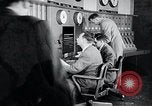
USIA operations like radio broadcast, press edition and Director Streibert explains mission to a committee in U.S.
United States Information Agency (USIA) radio operators operate radio studio controls and set frequencies for transmission and receiving. USIA staff work on gathering additional facts, with newsroom reporters and editors in a press room typing and working on stories, a woman editing motion pictures, typing, printing at USIA. Exterior view of headquarters building of United States Information Service or USIS. People enter and exit the building of USIS. Members of a Citizens Committee and Director Streibert enter into a room. Map of world in room. Citizens seated on sofa. Director Streibert explains U.S.I.A. mission to a citizens' committee and talks about America's history and involvement in the world. One Citizen Committee member smokes a pipe. The Director shows a chart of how "communist propaganda is spread by a vast worldwide machine." Director Streibert explains (via anti-communist propaganda, or reverse propaganda...during Cold War) its mechanism and control exerted via the presidium of the Soviet communist party. View of Soviet Union leaders watching a military parade in Red Square, Moscow, Russia. Khrushchev is among the leaders. Next scenes show Communist rallies and speakers in Korea and then in China. At the Chinese rally, a scene of unrest unfolds as a group filling a large truck enters a rally, jumps down, and inflames the crowd. Communist leader Khrushchev with other Soviet officials debarks an airplane and meets leaders in India. He waves at a welcoming crowd during a visit. View of piles of Motion picture canisters ,magazines, pamphlets and books distributed as propaganda by Soviet Union. High production quality of paper shown. Industrial equipment and industrial farming equipment is displayed in a large exhibit hall for visiting foreign governments and dignitaries to view and consider investment. The Director states that long term Communist goals are world domination, and short term goals include the encouragement of neutralism, dividing and confusing American allies, and isolation of the United States. Director Streibert explains how the USIS works together with the Department of State to communicate American information. He ends the explanation by giving the USIA campaign pamphlets "Atoms for Peace" and "Atomic Power for Peace" ( The Eisenhower plan) to citizens of committee as example of a communication.
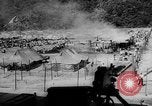
Prison riots in 1952 include North Korean POWs in Koji and U.S. prison riots in Michigan and New Jersey.
Major prison riots of the year 1952. North Korean POW soldiers of the Korean War stage a mass rebellion at POW camps in Koji islands and Pongam Island, off South Korea. U.S. and U.N. guards quell riots at the camps, resulting in death of North Korean prisoners and injuries. Medics are seen treating injured North Korean prisoners. U.N. guards escort prisoners in lines after the riots. Scene shifts to the the United States where damaged prison property in Michigan and New Jersey is seen after prison riots. Broken window glasses and furniture strewn about in a multi-story room of the New Jersey State Reformatory. Scene changes to Southern Michigan State Prison, also called Jackson State Prison, following riots there. Four prisoners including ring leader Earl Ward (second from left) are seen inside the building behind bars, during the standoff where they seized a cell block and held guards as hostages. A prison guard on watch with rifle in hand, looking from an elevated post downward onto a Jackson State Prison courtyard.
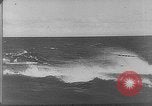
John Edgar Hoover talks about German saboteurs captured in the U.S. and other enemy agents during World War 2.
Opening scene depicts (dramatized) the presence of German submarines off the Atlantic Coast, delivering Nazi German saboteurs of Operation Pastorius to Long Island, New York and to Florida in 1942. View of German submarines in the ocean. A scientist in a FBI laboratory examines explosives found when the sabotage attempt was uncovered, including blocks of TNT and explosives designed to look like lumps of coal. J. Edgar Hoover describes how the explosives were designed to target American citizens and war industries during World War 2. Paddy wagons with military guards standing on read door platforms are seen entering court facility in Washington DC. View inside the paddy wagons of German agents ("submarine saboteurs") being brought to military trial. View of the accused and the military officers of the court sitting in court during the trial. Military judges are seen seated during the trial proceedings. View of a wall of file cabinets and a hand reaching into a cabinet marked "secret." Past events show Adolf Hitler in meetings with his staff. An animated map shows Nazi symbol overlaying an outline of the United States. A United States flag in the background. The director of the FBI (Federal Bureau of Investigation) John Edgar Hoover in the United States. He sits at a desk in his office. He talks about enemy agents, Hitler's desire to punish the United States, and the victory of the United States over them.
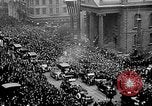
French General Joseph Joffre, Ford Company founder Henry Ford and Pacifist leader Rankin at the Capitol in the U.S.
The United States of America in 1917. A huge crowd on the streets of a city in the United States. A motorcade proceeds on a street, past official looking buildings. People on both sides of the street wave U.S. flags and cheer. French General Joseph Joffre, accompanied by officials, makes his way through a crowd (likely New York City on "Joffre Day," May 11, 1917). A large number of persons surrounding them, wave flags. Scene changes to the dome of the United States Capitol building in Washington DC. People outside the building. A Ford motor car arrives. Henry Ford, founder of the Ford Motor Company, with officials. Henry Ford and Speaker of the House, Congressman James Beauchamp Clark ("Champ") seen seated and talking on a balcony of the United States Capitol building. Officials and members of the Ford party come down the steps of the Capitol and pose for pictures. Among them is Thomas Edison who shakes hands with Congressman Clark. The dignitaries leave in an automobile. Next scene shows suffrage and pacifist leader Congresswoman Jeannette Rankin, (the first woman congressional representative in the United States) holding flowers, with other women suffragists (also called suffragettes) in a carriage. Policemen maintain order among a crowd of demonstrators outside the Capitol. Two mounted policemen begin to urge demonstrators away from the building.
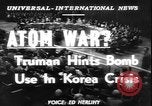
Truman hints potential of atomic bomb use in Korea; At UN, Korea questions Chinese delegates about Chinese aggression in Korea
Korean War and the World politics of the times. United States President Harry S. Truman during an address in Washington D.C. states that United States believes in a peaceful world order. He also hints of nuclear weapons use in Korea if peace is threatened. United States forces in Korea face the Red Chinese armies. Artillery being fired and explosions occur at the front. At the United Nations Security Council meeting in New York representative of Republic of Korea questions the Chinese delegates regarding the Chinese aggression on Korea. United States delegate Warren Austin also expresses worry over the fate of world peace in the light of Korean War.
CRITICALPAST.COM: About Us | Contact Us | FAQs - How to Order | License Agreement | My Account | My Lightboxes | Shopping Cart | Advanced Search | Featured Collections | Website Terms & Conditions | Privacy Policy ©2026 CriticalPast LLC.
License Agreement |
Terms & Conditions |
Privacy Policy
©2026 CriticalPast LLC.