


 Francais
 Deutsch
 Italiano
Refine Your Search
Ohio-State-football stock footage and images
- Showing 11803 to 11808 of 24492 results more
more Hide
Hide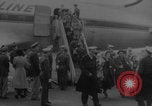
Hungarian refugees escaping from 1956 Hungarian Revolution arrive in Camp Kilmer; President Eisenhower during his second inaugural speech.
Hungarian refugees from the October 1956 Hungarian Revolution (also called Hungarian Uprising) disembark from an American Airlines plane after landing safely in the United States. Entrance to Camp Kilmer, New Jersey, where the Hungarian refugees were resettled. Hungarian refugees get off a bus. A Hungarian man holds his infant daughter with a pacifier. The camera moves to another Hungarian man, wearing a black hat. A Hungarian girl smiles, some of her front teeth missing. United States Army Sergeant Stuart Queen speaks to the camera. United States President Dwight D. Eisenhower speaks during his Second Inaugural Address at the East Portico of the United States Capitol in Washington DC. View of a radio tower. Radio tower view from the inside. View of the top of the Chrysler Building in New York City. Cars pass by modern apartment blocks with antennas on top of building. Television antenna on house roof. Man adjusts television as his wife watches from their couch in living room. A man and his wife, holding their baby, watches the inauguration speech of United States President Dwight D. Eisenhower on television from their family living room. Two women and a child watch United States President Dwight D. Eisenhower’s speech on television. Family of a woman and her children listen to Eisenhower’s speech from a radio in their living room. Bombing on a street in Budapest during the 1956 Hungarian Revolution. Men firing in Budapest. A tank fires in a park. Apartments getting devastated from firing. Hungarian man aims his gun and fires at a car. Men fire on a Budapest street. Doctor and paramedics carry an injured on a stretcher behind a tank. “Budapest is no longer merely the name of a city, henceforth it is a new and shining symbol of man’s yearning to be free”, said United States President Dwight D. Eisenhower from his second inaugural speech.
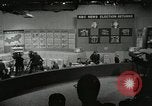
1960 Presidential Election news headquarters operations; results show John F. Kennedy leading over Richard Nixon
The 1960 Presidential Election in the United States. Interiors of a building show NBC News and CBS News Election Tracking headquarters and television studio operations. Board tracking the election result returns. A man behind a camera. Many news employees inside the building. The men preparing to broadcast the results of the elections. Interiors of a television network headquarters shows men and women at tabulating machines and electronic computers. A huge crowd gathered at the Republican Party headquarters. A few men and women beside a tally board updating election results. People in the crowd looking at a board. The board showing Presidential candidates Richard Nixon's and John F. Kennedy's count of votes in states Massachusetts, Michigan, Minnesota and several other states. A woman in the crowd looking through binoculars. The figures show Kennedy leading. The moving ticker bulletin board in Times Square, New York City, is shown reading "Kennedy Overcomes Slow Start, Pulls ahead of Nixon" as the counting continues. The Times Square moving bulletin reads 'Kennedy wins Connecticut's 8 Electoral votes, Sweeps all'. A crowd cheering and shouting 'We Want Kennedy'. The bulletin reading 'Kennedy leads in 17 states with 192 electoral votes'. A CBS news worker beside a map showing the states and the position of Republican and Democratic candidates in each state. A bulletin reading 'Kennedy stage see-saw battle in Virginia'. Men inside the television network headquarters including Walter Cronkite. Close up view of a camera being used to film the television news broadcast. A board showing position of the candidates in the election.
U.S. President Kennedy addresses American people about the buildup of arms in Cuba by Soviets.
Events held in the United States during the Cuban Missile Crisis of October, 1962, during the Cold War, when the United States and the Soviet Union confronted each other with nuclear destruction. Top advisors of U.S. President John Kennedy arrive at the White House. Americans buy newspapers. President Kennedy makes a TV announcement about the crisis and what has been happening. He states that a strict quarantine on all offensive military equipment under shipment to Cuba is being initiated to halt offensive buildup of nuclear arms. He says that all ships of any kind bound for Cuba from whatever nation and port , if found to contain cargoes of offensive weapons, will be turned back. This quarantine will be extended, if needed, to other types of cargo and carriers. He further states that it shall be the policy of the United States to regard any nuclear missile launched from Cuba against any nation in the Western Hemisphere as an attack on the United States, requiring a full retaliatory response upon the Soviet Union. Exteriors of the White House. An electronic billboard flashing news. Americans being interviewed by newsmen along a street.
During an election debate in the US, Kennedy and Richard Nixon talk about a hypothetical invasion by the Chinese Communists.
The third Kennedy-Nixon Presidential Debate in the United States. Charles Van Fremd from CBS News asks Republican candidate U.S. Vice President Richard M. Nixon that if he were the president would he launch a war if the Chinese Communists began an invasion of Quemoy (Kinmen) and Matsu Islands and if he would authorize the use of nuclear weapons if regular conventional forces failed to halt the invasion. Nixon answers and states that it is irresponsible for a presidential candidate to indicate the course of action and the weapons he would use in the event of such an attack. He states that he would not say in advance how the U.S. would respond. He states that the Chinese Communists do not want just Quemoy and Matsu or Formosa (Republic of China or Taiwan), but the world. He concludes that defense of the free world territories and not surrender will lead to the path of peace. Democratic candidate Senator John F. Kennedy talks about a treaty to defend Formosa (Taiwan) and the Pescadores Island. He states that the U.S. would meet its commitment to Formosa. He disagrees with Nixon's suggestion that the United States should go to war if Quemoy (Kinmen) and Matsu islands are attacked as the treaty does not include these two islands. He concludes and says that the U.S. would defend if Formosa (Taiwan) or the Pescadores Island is under attack.
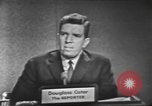
Kennedy and Nixon comment on nuclear disarmament before summit conference during a presidential election debate in the U.S.
The third Kennedy-Nixon Presidential Debate in the United States. Douglass Cater from Reporter magazine asks Democratic candidate Senator John F Kennedy about what sort of prolonged period does he envisage before there could be a summit conference and if he thinks that there could be any new initiatives on the grounds of nuclear disarmament during that period. Kennedy answers and talks about the need of strengthening of U.S. conventional forces and increasing missile production. On the question of nuclear weapon disarmament he states that the new administration should renew negotiations with the Soviet Union. He disagrees with the present administration's efforts regarding nuclear controls and general disarmament. He states that if he would get a chance he would make efforts to provide for control of nuclear weapons testing and begin general disarmament levels. Republican candidate U.S. Vice President Richard M Nixon mentions about his speech on this subject. He disagrees with Kennedy's statement that the administration is not making any effort because this is the highest level of operations in the whole State Department which is under the President himself. Roscoe Drummond from New York Herald Tribune asks Vice President Nixon about defending Quemoy and Matsu islands. Nixon answers and states that the U.S. should not deal with dictators and should not indicate which particular area it would defend. He gives the examples of the Korean War and World War II where the U.S. made a mistake. He says that Kennedy should change his position in this regard and not encourage the Chinese Communist and Soviet aggressors to react. Kennedy says that the treaty with the Republic of China excludes Quemoy and Matsu from the treaty area. He states that the treaty only includes defending of Formosa (Taiwan) and the Pescadores. He concludes that the U.S. should meet its commitments and raise war if the Chinese Communists attack the Pescadores and Formosa.
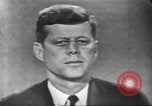
Kennedy and Nixon talk about racial prejudice in the presidential campaign during a presidential election debate in the U.S.
The third Kennedy-Nixon Presidential Debate in the United States. Roscoe Drummond of New York Herald Tribune asks Democratic candidate Senator John F Kennedy to comment on the purpose of the secret domestic militant organization Ku Klux Klan (KKK) in the presidential campaigns. Kennedy answers that the head of the Ku Klux Klan in a statement stated that he would vote for Nixon and not him. Kennedy states that he has never suggested that Nixon has slightest sympathy and involvement with the Ku Klux Klan. Republican candidate U.S. Vice President Richard M Nixon states that it is the Americans who will choose the President. He states that elections are not any test of religion, race but test of a man. He states that Communism is the enemy of all religions and he opposes the Klan organization. He concludes, early in the civil rights movement, that if civilians believe in America they cannot have religious or racial prejudice in the presidential campaign.
CRITICALPAST.COM: About Us | Contact Us | FAQs - How to Order | License Agreement | My Account | My Lightboxes | Shopping Cart | Advanced Search | Featured Collections | Website Terms & Conditions | Privacy Policy ©2026 CriticalPast LLC.
License Agreement |
Terms & Conditions |
Privacy Policy
©2026 CriticalPast LLC.