


 Francais
 Deutsch
 Italiano

Refine Your Search
Panama 1969 stock footage and images
- Showing 187 to 192 of 1052 results more
 Hide
Gas bombs tested on ship's during U.S. chemical warfare tests on San Jose Island.
Tests of non-persistent gas munitions during U.S. chemical warfare tests on San Jose Island, Panama during World War II. Tests of non-persistent gas on ship targets are carried out. A Japanese fleet underway at sea in the Pacific Theater of World War II. Exposed Japanese personnel aboard a ship and Japanese fleet maneuvers at sea help determine the losses of bomb attacks. Expansion of concentrated gas bomb exploding during testing on San Jose Island. A U.S. 6th Air Force bomber aircraft drops bombs on water to determine results. B-24 Liberator bombers in flight. Tests are carried out by dropping bombs over a stationary raft and a barge in water.
Tests of non-persistent gas on ship targets are carried out by U.S. Army at San Jose Island during World War II.
Tests of non-persistent gas munitions during U.S. chemical warfare tests near San Jose Island, Panama during World War II. Tests of non-persistent gas on ship targets are carried out. A stationary ship in water on which tests are to be carried out. Goats are loaded aboard the ship to represent Japanese personnel. Testing stations are set up at the bow, the stern and on varying heights by U.S. Army personnel. A man works with a gas concentration sampling instrument at a testing station aboard the ship. Goats wearing gas masks fitted with Japanese canisters are placed on the testing station. Bombs are loaded on U.S. 6th Air Force B-24 Liberator bombers at an airfield for carrying out the tests. The bombs are dropped from the B-24s near the test ship. Gas clouds cover the target completely after bursts on water. A man examines protected and unprotected goats killed by gas concentration. Attack on various vessels.
The United States aircraft carrier Franklin D Roosevelt (CVA-42) pulls into Balboa pier, Panama
The United States aircraft carrier Franklin D Roosevelt.(CVA-42) Three sailors on the signal bridge talk to each other. One sailor in the background sends out semaphore as he waves two flags. Inside a ship office, a clerk typist transcribes correspondence. flight deck control officer gives instructions referring to a model of the flight deck ("Ouija board"), Pilots in ready room,converse.
A Navy butcher, a cook, a pharmaceutical unit and a hospital on USS Yorktown; and sailors enjoying food in galley
Functions, duties and crew activities aboard 'The Fighting Lady', pseudonym for the USS Yorktown, CV-10, in the Pacific Theater during World War II. Housekeeping activities aboard the ship. U.S. Navy sailors on the deck do exercises and lay under the sun. A man plays with a dog (the ship's mascot, named Scrappy). The ship leaves the Panama Canal. Reserve, specialists and pilots eat food. Non commission personnel stand in a mess line and serve themselves food. They sit at a table and eat food. One of the sailors smokes a cigarette. The non commission personnel peel vegetables like potatoes and cabbage. A navy butcher cuts slabs of red meat and a cook at work. A pharmaceutical unit and a hospital on the ship. A tailor, a cobbler and a dry cleaner work on the ship.

General Eisenhower as a World War II officer and as the U.S. President.
Scenes from life and career of Dwight D Eisenhower, 34th President of United States. U.S. Air Force plane lands and the President disembarks the plane in India, in 1959. He is greeted by the Indian President Dr Rajendra Prasad and other dignitaries. Emblem of 'Panama'. Sign of 'welcome Ike Crusader'. Large crowd welcomes Eisenhower. Motorcade goes through the city's street. Milestones in General Eisenhower's life and the international esteem with which he is held. Lt Col Eisenhower concerned about U.S. isolationism in 1940 as World War 2 is underway. Explosions in Europe due to bombing by German aircraft. Eisenhower and other officers in the General Staff study a map. Eisenhower plans the strategy as the commander of Operation Torch (he is shown talking to General George C. Marshall and Winston Churchill). President Eisenhower visits 4 continents and meets several leaders. Large crowds welcome him. General Eisenhower prepares for D-Day Invasion of France during World War 2. June 5, 1944: The Allied forces including troops, artillery, equipment, ammunition, aircraft and ships prepared. June 6, 1944: The Allies invade Normandy. Troops wade through the water during D-Day Normandy beach landings, while under enemy fire. German soldiers surrender. May 7, 1945: Nazi General Alfred Jodl signs the unconditional surrender of his government. General Eisenhower returns to the U.S. He receives a hero's welcome in New York during a parade. He visits his hometown in Kansas. Pictures of his family, childhood and college days. Eisenhower on his visits to various countries as President.
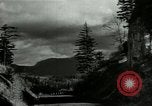
American landscape views 1930s; contributions of U.S. soldiers in the history and development of the USA.
The involvement of the American soldier in the history and growth of the United States from early 1900s until roughly 1938 before World War 2. Views of western United States countryside and mountain areas, including Mount Hood in Oregon, as seen from a slow moving car or other vehicle on a roadway. Wide, expansive landscape views in the U.S. Two Confederate and one Union uniformed veteran soldiers of the American Civil War walk together in the Arlington National Cemetery, in Virginia. U.S. Army soldiers marching at a an Army base, likely early 1930s, and wearing World War 1 era helmets. U.S. Army soldiers marching in a parade in Washington DC with U.S. Capitol in the background. Views of cities and towns in which U.S. Army posts were established, in the United States. Wide view of downtown Colorado Springs, Colorado, with Antlers Hotel in the distance and Pikes Peak in the far distance. Next shot is an unidentified downtown main street in the U.S. 1930s, followed by a scene of an industrial plant with a large water tower and snow covered low mountains in the distance. Next scene is the San Francisco skyline in the 1930s with the Bay Bridge in the far distance. Army troops and cavalry creating trails and paths, and eventually railroads, in wilderness areas of the United States. A railroad locomotive approaching beside the camera position at high speed, and then passing by pulling train cars. View of the Presidio Army Base and the Golden Gate Bridge, California. Subtle references to U.S. Army accomplishments, including curbing Mississippi River floods (Corps of Engineers) and conquering Yellow Fever (Army Doctor Walter Reed). Point of view (POV) shot from moving railroad train in a Colorado canyon; a side wheeler River boat on the Mississippi River; a sugar cane field in Cuba. View of locks in the Panama Canal. Statue of World War I soldiers.