


 Francais
 Deutsch
 Italiano
Refine Your Search
Pilsen Czechoslovakia 1945 stock footage and images
- Showing 349 to 354 of 6810 results more
more Hide
Hide
Liberated United States airmen prisoners at Stalag 7A in Moosburg, Germany (WW2)
Liberated United States prisoners (mostly military airmen) at POW camp called Kriegsgefangenen-Mannschafts-Stammlager (Stalag) VII A, located just North of Moosburg, Germany during World War II. The airmen cook food. Several are seen sunning themselves. Airmen seen shaving, shining shoes and cleaning clothes. A group of airmen around sign 'I Wanted Wings' and 'Luft 3'. These are some of the prisoners who were originally held at Stalag Luft III, in German Province of Lower Silesia, near the town of Sagan (now in Poland). (Note: Stalag Luft III is famous because the "Great Escape" took place there in March, 1944. Prisoners were forced to march from Sagan to Spremburg during the coldest winter in Germany in 50 years. There, they boarded a train of boxcars for a 3 day trip to Moosburg in January 1945, because the Russians were closing in. The addition of these prisoners to Stalag 7A, at Moosburg, led to serious overcrowding of the camp. On May 1, 1945, the New York Times reported that "The Fourteenth Armored Division liberated 110,000 Allied prisoners of war at Stalag 7A at Moosburg." This corrected an earlier report that 27,000 prisoners had been liberated.)
British and American troops join together for attack during Battle of the Bulge, scenes from Malmedy massacre and Houffalize (WW2)
Map points to Allied positions during Battle of the Bulge in World War II. British soldiers walk in a trench on the prong of the attack south of La Roche en Ardenne (La Roche-en-Ardenne or sometimes just Laroche). Trench in the snow covered area. British soldiers wear warm clothes and try to stay warm in the trench. British soldier knocks hole in ice and draws water into a bucket. British soldiers wash and shave with the freezing water. They heat water and use it to make cups of tea. They move on tanks to location where British and American forces meet and greet. The soldiers talk amongst themselves. On 14 January 1945 armored recce cars of the 2nd Derbyshire Yeomanry, 51st Highland Division, meet GI's of the 347th Infantry, 87th U.S. Infantry Division, near Ortheuville. The first link up between troops of VIII Corps and British 30 Corps. Another encounter between British soldiers, dressed in white camouflage smocks, with Americans of the 87th U.S. Infantry Division at Champlon. Later that same day. Field Marshal Montgomery wearing a new beret, commands the northern forces. British soldiers advance on a roadway and supplies move on vehicles. Houses in the background. U.S. 3rd Army soldiers shovel snow during a blizzard, clearing the way for trucks with supplies and mail to pass. Large tractors with snow plow attachments clear snow. On January 14, 1945, American forces gently sweep snow from the bodies of American soldiers at Malmedy who had surrendered to the Germans a month prior but were then massacred. (These were mostly U.S. forces of the American 285th Field Artillery Observation Battalion) German prisoners of war look on apprehensively as the Americans uncover the victims of the Malmedy Massacre. American soldiers look at from a snow covered hillside into the village of Houffalize in Belgium. A twisted sign for Houffalize is seen, and wreckage and destruction in the town. Close views of wrecked and burned homes in Houffalize. Destroyed tanks with one tipped in a river
Harry S Truman assumes office of President of the United States following death of Franklin D. Roosevelt during World War 2
Harry S Truman appointed President of the United States. The U.S. Capitol building in view. Trees in the foreground. President talks on the phone. Harry Truman attends the 1944 Democratic convention with his daughter, Margaret Truman. People gather holding boards and placards of Truman in hand. A board reads: 'Truman for Vice President'. Franklin Roosevelt seated in a car during his fourth inauguration parade, on January 20, 1945, with motorcade proceeding on Constitution Avenue in Washington DC, and then driving up to the White House. Past events show President Franklin Roosevelt talking to Vice president Truman. Flag at half staff on the U.S. Capitol following death of President Roosevelt. Truman addressing a joint session of the Congress. General Marshall, Admiral King, Secretary of War Stimson all arriving at the White House to meet with President Truman. Also seen are James Byrnes and Truman receiving Lord Halifax, Anthony Eden, Secretary of State Stettinius in the White House. Truman speaks to joint session of congress on April 16, 1945 and expresses desire to continue the efforts and direction set by Franklin Roosevelt, saying, "With great humility I call upon all Americans to help me keep our nation united in defense of those ideals which have been so eloquently proclaimed by Franklin Roosevelt...." He also states, "So that there can be no possible misunderstanding, both Germany and Japan can be certain, beyond any shadow of a doubt, that America will continue to fight for Freedom until no vestige of resistance remains. Our demand has been, and it remains, unconditional surrender. We will face the problems of peace with the same courage that we have faced and mastered the problems of war. In the memory of those who have made the supreme sacrifice; in the memory of our fallen president, we shall not fail."
Damaged buildings and casualties after atomic bomb raid over Hiroshima in Japan during World War 2.
U.S. Strategic bombing survey film about the situation in Japan after atomic bombing in World War 2. Film titled 'Effects of Atomic Bomb on Hiroshima and Nagasaki'. Map of Japan. Location of Hiroshima. City of Hiroshima. Camera pans over view of the city of Hiroshima before the atomic bomb destroyed the city. Buildings and huts in city of Hiroshima pre-destruction. Portrayal of events on August 6, 1945: Sentry standing on a platform. Sentry stands near 'bell' air raid alarm. Sentry in dugout cave. Narrator relates that bomb was dropped. Still image of Hiroshima mushroom cloud explosion seen. Views of destroyed Hiroshima (from September 1945). Bomb damage to large concrete building. Ruins of the city. Damaged street cars in street. Hiroshima station. Hiroshima Prefecture office building damaged by blast. Damaged buildings. Statistics of casualty and damage.
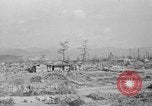
Devastation in Hiroshima and Nagasaki following atomic bomb attacks in World War 2, and view of atomic bomb blast over Nagasaki
Devastated area in north eastern Hiroshima following August 6, 1945 atomic bomb attack in World War 2. Simple shacks and buildings are being built using rubble material after the devastation of Hiroshima. Damage at Higashi station. Newspaper headlines about the atomic bomb attack on Hiroshima, and the warning to Japan by the President of the United States. A map of Japan shows the location of Nagasaki. Scenes of Japanese workers in arms factories building torpedoes and munitions, some wearing kokumin-fuku worker uniform. Workers in an assembly line munitions factory of Mitsubishi. A map shows a torpedo plant in the north and a steel and an arms plant in the south, then plots the center point between them as the U.S. target for the "Fat Man" atomic bomb attack. View of the atomic bomb explosion over Nagasaki on August 9, 1945, as seen from the B-29 bomber "Bockscar" (sometime called Bock's Car or Bocks Car). Mushroom cloud rises up to the sky. Wing of the B-29 bomber in the foreground. An aerial view of rubble and destroyed buildings in Nagasaki following the atomic bomb attack. Destroyed Mitsubishi steel plants beside the sea.
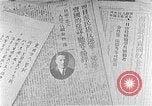
Depicts Korean suffering under Japanese occupation from 1910 through end of World War II
Korean propaganda film depicting suffering of the Korean people under Japanese occupation prior to and through World War 2. Korean citizens answering questions of Japanese civilian officials during period of Japanese occupation before World War 2. Japanese warship carrying Nakajima E4N bi-wing scout plane. Steel truss bridge being bombed. Koreans being forcibly recruited to fight for Japan. Koreans being tortured and imprisoned at hands of Japanese. Aircraft dropping bombs on ground targets. Slate announces August 9, 1945, marking the Soviet invasion of Japanese occupied areas, including North Korea, in World War II. Destroyers dropping depth charges. Battleships firing heavy guns. Soviet infantry rushing from a ship to engage Japanese forces. Soviet soldier offloading an M1910 Maxim Sokolov Machine gun onto a pier. Amphibious assault by Soviet forces. Artillery barrages. Explosions and smoke. Soviet infantry attacking industrial facilities and planting the Red flag on a hilltop in a rural area. Japanese troops surrendering to Soviet soldiers. Fallen Japanese gunner in gun position with shell in his hands. Numerous other fallen Japanese soldiers. Captured Japanese weapons and war materiel, including many swords. Japanese prisoners of war seated in an open area. Various destroyed Korean buildings and temples. Denuded trees in war zone. August 15th, 1945, shows Japanese citizens listening to a loudspeaker broadcast by Emperor Hirohito, announcing the surrender of Japan, and end of World War II. Shackles are removed from Korean prisoners. Koreans celebrate in the streets. The Korean flag flies from houses in a village. Korean people march, sing, and cheer everywhere in the country. A seated band of musicians plays. Scene shifts to the deck of the battleship USS Missouri, where Japanese Foreign Minister Mamoru Shigemitsu in formal attire sits to sign documents of surrender. General Douglas MacArthur, and other senior allied officers, stand nearby as Soviet Lieutenant General Kuzma Nikolaevish Derevyanko sits to sign for the USSR. Japanese civilians living in Korea, during the Japanese occupation, are seen moving with their belongings, to be relocated back in Japan.
CRITICALPAST.COM: About Us | Contact Us | FAQs - How to Order | License Agreement | My Account | My Lightboxes | Shopping Cart | Advanced Search | Featured Collections | Website Terms & Conditions | Privacy Policy ©2026 CriticalPast LLC.
License Agreement |
Terms & Conditions |
Privacy Policy
©2026 CriticalPast LLC.