


 Francais
 Deutsch
 Italiano
Refine Your Search
Pilsen Czechoslovakia 1945 stock footage and images
- Showing 355 to 360 of 6810 results more
more Hide
Hide
German surrender scenes and views from wrecked German cities at end of World War 2
Documentary titled 'Deutschland Erwache' recounts Germany's wartime experiences. Explosion seen as the Nazi Swastika emblem is blown up on top of the Zeppelintribüne (at Zeppelinfeld) at the Nazi party rally grounds in Nuremberg in 1945 by the U.S. Army. Following explosion, the pieces from the destroyed emblem fall from the sky. Montage shows: German Prisoners Of War (POWs) marching; Ratification of the German surrender documents (from surrender two days earlier at Reims) held at Soviet headquarters in Karlshorst, Berlin, Germany on May 9, 1945. German officers present include Colonel-General Hans-Jürgen Stumpff from the Luftwaffe, Field Marshal Wilhelm Keitel as Chief of Staff of OKW, and Admiral Hans-Georg von Friedeburg as Commander-in-Chief of the Kriegsmarine. They are seen entering room and signing documents. View of Keitel signing the surrender document. Soviet Russian General looking at surrender documents. General Eisenhower, General Montgomery and others shown in brief glimpses. Stalin, Roosevelt and Churchill at Yalta. Aerial views of heavily bomb-damaged cities in Germany, including wrecked German cities of Cologne, Nuremberg, Hamburg, and Berlin. View of Brandenburg gate in background and rubble of bombing in foreground as two people carry a stretcher down the street. A wrecked street sign for the Unter Den Linden lies on the ground partially covered in mud. Ground level views of smoking ruined buildings in Berlin and a few German citizens walking on the streets following Battle of Berlin. Views of dead German soldiers on a battlefield. German soldiers helping to carry and tend to wounded and bandaged German soldiers. Large group of German citizens gathered in a public square.
Londoners celebrate VE Day, the end of World war II, in Europe
With the surrender of Germany, World War 2 in Europe ends, on VE (Victory in Europe) Day, May 8, 1945. Scene opens with church bells ringing and view of west front of St. Paul's Cathedral, on Ludgate Hill, in London, England. Crowd is celebrating in the square. around the statue of Queen Anne. Amongst the crowd are men and women in uniform. Here and there Union Jack flags are seen, one held by a little girl hoisted upon a man's shoulder. Camera pans across various parts of the celebrating crowds. View from above, of several couples dancing within a circle of people. Several uniformed U.S. Air Force officers in a jeep celebrate with the crowd. High altitude view of Trafalgar Square in London, England. 'Victory over Germany 1945' banner draped on base of Nelson's Column. Crowd of British citizens celebrating on streets of Whitehall and closeup of the Cenotaph with inscription "The Glorious Dead".
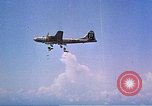
U.S. defeats Japan in Pacific through air power in World War II; multiple views of American combat aircraft in action in World War 2
From "The Last Bomb": The defeat of Japan through American airpower in World War 2. Mix of actual combat footage and a small amount of vintage, dramatized, pilot in cockpit footage. A single B-29 from the 39th Bomb Group (stationed at North Field Guam) drops clusters of incendiary and fragmentation bombs over Japan. Bombs away view of large number of bombs falling toward Japan. A formation of B-29s from the 498th Bomb Group, Isley Field, Saipan, in flight during a daytime bombing mission over Japan. Explosions and smoke rise from targets in Japan, including two Japanese aircraft plants and an airdrome as part of U.S. tactical plan 574. Color, low aerial view of massive bomb damage over Tokyo following U.S. air attacks of March 1945. Escorting P-51s from Iwo Jima engage defending Japanese fighter aircraft in dogfights. Aerial gun camera footage of Japanese airplanes being hit, exploding, bursting into flames, and falling from sky to crash. Later, P-51s conduct strafing attacks against Japanese ground targets, including: lines of communication; railroads; marshaling yards; factories; airfields; ships; and harbors. Color gun camera footage shows these strafing attacks. P-51s returning to land at Iwo Jima and performing celebratory rolls over the field. Crippled B-29s making emergency landings on Iwo Jima. A B-29 from 500th Bomb Group with an engine shutdown. A B-29 from the 29th Bomb Group. Bad weather over runway at Iwo Jima forces a P-51 pilot to bail out over the field. A B-29 from the 6th Bomb Group ditches in water near beach on Iwo Jima. A B-29 crashes and bursts into flames during landing at Iwo Jima (all crew escapes.) Firefighters douse the flames with foam. Formation of B-29s from 39th Bomb Group returning to Guam after bombing mission over Japan. A B-29 crashing on landing and bursting into flames. Sole surviving crew member being carried on stretcher, as firemen and rescue teams work at scene. Formations of B-29s from 498th Bomb Group and 9th Bomb Group, in flight. Good color view from B-29 of the atomic bombing of Nagasaki on August 9, 1945, which brought about the capitulation of Japan and end of World War 2. Large mushroom cloud rising into the air following atomic bomb explosion at Nagasaki.
Surrender of Japan after atomic bombings of Hiroshima and Nagasaki, Japan.
Surrender of Japanese Imperial forces leads to end of World War II. V-J Day (Victory over Japan) celebrations in August 1945. Americans celebrate as newspaper headlines announce V-J Day. Close up view of man holding Boston Post with headline "War Is Over." Teeming crowds in New York City's Times Square celebrating the news. Crowd of citizens, soldiers, and sailors in uniform surrounds a newspaper with headline "U.S. Announces Jap Surrender." Happy crowds of people waving, jumping, and smiling in jubilation. People show V signs. U.S. warships underway at sea. U.S. soldiers aboard ship. Japanese troops parading in Japan. Japanese aircraft lined up in flight line ready for take off to defend the Japanese mainland. Japanese amphibian tanks lined up ready for use against a possible allied invasion. Aerial view of actual atomic bomb explosion over Hiroshima as seen from second B-29 aircraft accompanying the Enola Gay on the bombing run on August 6, 1945. Ruins of twisted metal and debris in Hiroshima and Nagasaki and civilians walking among the devastation. Japanese civilians along road. Japanese Generals deplaning and meeting U.S. General MacArthur on an airfield. Troops of 11th Airborne Division land in Japan. Marines reach Japanese shores at Yokosuka Naval Base in Landing crafts. American soldier raises American flag in Japan. American troops aboard Japanese battleship Nagato after Japanese surrender. View of the Nagato (later used as a target ship during Operation Crossroads).
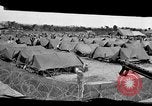
Mopping up operations at end of battle for Okinawa in World War II. Numerous Japanese prisoners of war impounded.
Opening scene shows tents housing more than 1500 Japanese prisoners of war at Kadena, Okinawa during World War 2. The area is surrounded by fencing and, as camera pans, it shows an American soldier overlooking the prison camp as he holds a Browning M1919A6 light machine gun. Another view of the prison compound with warning sign against admittance and another sign reading: "PW inclosure." As narrator refers to "mopping up operations" a jeep carrying more Japanese POWs drives past the signs. Ambulatory Japanese POW entering the prison compound past armed military policeman. View from inside the compound as Japanese POWs enter. A POW being frisked by a U.S. soldier. Closeups of some Japanese prisoners standing behind barbed wire enclosure. American soldier makes notes as he interviews a prisoner. POWs receiving haircuts under a tent in the stockade. Others washing and shaving at an outdoor trough of water. Some seen playing a board game at a tent. POWs in a wrestling contest, surrounded by others watching. Prisoners offloading supplies from a truck and stacking them in their compound. POWs cooking food in large kettles and distributing it to other prisoners. Various views of prisoners in the compound. U.S. medics attending to a wounded POW, administering blood plasma. Numerous Japanese prisoners loosely assembled outdoors. Next, on June 22, 1945, U.S. troops are assembled for a flag raising ceremony. The U.S. flag is raised on a tall flagpole to mark the securing of Okinawa. An unidentified U.S. Army Lieutenant General leads the ceremony, saluting as the colors are raised. (Lieutenant General Simon Bolivar Buckner Jr., Commander, 10th Army that took Okinawa, was killed 4 days earlier, on June 18, 1945.)
Liuchow recaptured from the Japanese forces, and Chinese 169th Division troops in flag raising ceremony in Liuchow, China.
Chinese troops recapturing Liuchow, China. Liuchow, the former U.S. 14th Air Force Base and largest communication center in South Central China, in ruins after the withdrawal of Japanese forces. The burnt buildings on the streets in Liuchow. The ruins of buildings along the sides of the road. Chinese troops walk along the road. The Chinese troops recapture Liuchow on 13th June 1945. The civilians in China cheering and welcoming the soldiers to the town. The Liuchow Air Base, which was not usable since the Japanese forces had dug holes in places. The entire stretch of the airstrip being blocked with gas drums. The center stretch of the airstrip being damaged. An Air Force engineer examines the heavily mined air strip. Men of Chinese 169th Division assemble for the flag raising ceremony on 2nd July 1945. The troops are welcomed by a citizens' committee. The Chinese 169th Division Major General addresses the men. The Chinese flag hoisted. The troops salute the flag. (World War II period).
CRITICALPAST.COM: About Us | Contact Us | FAQs - How to Order | License Agreement | My Account | My Lightboxes | Shopping Cart | Advanced Search | Featured Collections | Website Terms & Conditions | Privacy Policy ©2026 CriticalPast LLC.
License Agreement |
Terms & Conditions |
Privacy Policy
©2026 CriticalPast LLC.