


 Francais
 Deutsch
 Italiano
Refine Your Search
Prison physical examination. stock footage and images
- Showing 2323 to 2328 of 3715 results more
more Hide
Hide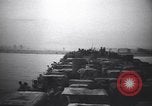
British LST reaches Salerno Beach in Salerno, Italy. Winston Churchill's son, Randolph Churchill, aboard ship (WW2)
Salerno Beach in Salerno, Italy during World War II. Views of trucks and British troops on a Landing Ship Tank (LST), men looking from the deck sides. Ship reaches the beach at Salerno. Enemy tracer bullets visible at night. British Supermarine Spitfire aircraft flying overhead. View of the LST2 captain, John P. Horgan, together with Randolph Churchill (Major Randolph Frederick Edward Spencer Churchill), son of Winston Churchill. Randolph Churchill observes the action through binoculars while smoking a cigarette and talking to the LST captain. On deck of a ship view of a German Prisoner of War and an American soldier playing chess and several other soldiers, some American and some British, standing by watching. U.S. military guards with German POWs on the beaches at Salerno.
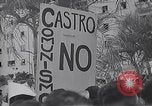
Communist and anti-communist struggles, centered on Cuba, circa 1960. Also some flashbacks to World War 2 and Cold War images.
A pro Betancourt rally in Venezuela. Crowds gathered with signage against Fidel Castro and in support of Romulo Betancourt. Betancourt addresses the crowds from a podium on a stage, outdoors. A man sitting looking at a radio tower. Images of radio control equipment and sign wave signatures on a scope. Scenes of protest and rioting in a Latin American or South American city. Police combating demonstrators. Vehicles overturned. Citizens running through the streets. Crowds being sprayed by fire hoses from moving fire trucks. Close up views of a newspaper "La Prensa" indicating Fidel Castro's support of the Communist party in Peru. Headline, "Fidel Castro Financia al partido comunista Peruano." An inside headline from the same paper reads, "La Embajada de Cuba Distribuye Propaganda Subversica en el Peru" indicating that an Ambassador from Cuba distributed anti-government, subversive propaganda en Peru. What follows are a series of images drawing parallels between Castro and other fascist historical leaders. Castro speaking forcefully, then a cut to historical excerpts from speeches by Hitler and Goebels in Germany during World War II. A scene with Hitler speaking and gesticulating wildly and forcefully, followed by a scene with Castro doing the same. A wooden sign with skull and crossbones and the words "HALT! STOJ!" on it. Prisoners in a German Nazi concentration camp, thin, weary, and huddled near a barb wire perimeter fence circa early 1945. Nikita Khrushchev on a review stand waving his hat to Soviet Army forces marching below him carrying guns with bayonets fixed. Chinese citizen-military forces (possibly early Red Guard) at a rally, with young women and young men raising rifles in the air . Soviet Russian leader Nikita Khrushchev shaking hands with Chinese leader Mao Zedong, Chairman of the Communist Party of China. A group of Chinese workers digging ditches, including men and women Chinese workers. Still image of Khrushchev and Castro embracing. An anti-communist rally in Cuba.
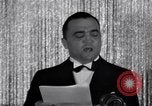
FBI Director J Edgar Hoover talks about children and youth engulfed in crime during an award ceremony.
First Director of the Federal Bureau of Investigation (FBI) of United States, John Edgar Hoover delivers a speech during an award ceremony of the Boys Clubs of America in the United States. He talks about law enforcement, plight of mothers whose children are in prison. He lays emphasis on children and youth engulfed in crime and juvenile delinquency, and the crusade of education to fight the same. The attendees applaud. An official thanks Hoover and begins to read out a telegram.
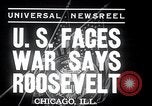
U.S. President Franklin Roosevelt addresses citizens of Chicago; scenes from 2nd Italo-Ethiopian War and Spanish Civil War
U.S. President Franklin D Roosevelt warns of an increasing danger of armed conflict (increasing danger of war leading up to World War 2). Roosevelt's motorcade on the streets of Chicago. A large crowd gathered to get a glimpse of the President. Confetti rained on the motorcade. Soldiers salute as the motorcade passes by. Policemen on motorbikes lead the motorcade. People gathered at the venue to hear the President's speech. A board advertises candy bars 'Baby Ruth, Butterfinger" in the background. President Roosevelt with officials on stage. He addresses the crowd. Excerpts from his speech are interspersed with scenes of war and conflict elsewhere in the world during the late 1930's. Roosevelt speaks of recent events of "international lawlessness" including in the last few years "unjustified interference in the internal affairs of other nations." Scenes that follow include aerial bombings, naval attacks, and war: Scenes of war carnage during the Second Italo-Ethiopian War of 1935-1936: Ethiopian soldiers on horseback cross a bridge, Italian forces fire artillery from a hill, aerial view as aircraft drop bombs. Italian soldiers pass a burning, smoldering building and overtake an Ethiopian position, with many Ethiopian soldiers lying dead. Ethiopian citizens in area of a war torn village. Bomb damage and war casualties on the street. Italian soldiers collect dead bodies and load them onto a truck. A ship quickly sinking after attack by a submarine. Scenes from battle during the Spanish Civil War in 1936 or 1937. Spanish nationalist and rebel soldiers engage in a battle in a village. Spanish prisoners are marched. Nationalist soldier fires machine gun from a balcony emplacement. Dead body on a road. Soldiers behind a barricade fire at opposition and carry wounded on stretchers. President Roosevelt concludes his speech with, "America hates war. America hopes for peace. Therefore, America actively engages in the search for peace." People applaud.
German air attack on Britain during World War II and British defenses repeling German attacks during Battle of Britain.
British defense against German aerial warfare in Battle of Britain. German aircraft in flight. A British soldier on a boat sees through binoculars. An aircraft lands on sea. German pilots are rescued and become British prisoners. Damaged German aircraft downed in Britain. Germans pause blitzkrieg campaign due to British Royal Air Force resistance. German soldiers shown having leisure time in their encampments. German military equipment idle. German long range artillery and rail guns attack England from a distance, firing over the English Channel. British Prime Minister Winston Churchill addresses the people saying that Britain will win in the Battle of Britain, and Hitler is shown addressing the Reichstag and disagreeing with Churchill. German officers including Goering greet each other. They come out of a car. Various German bomber and attack aircraft take off again following an August 30 change in air war strategy by Goering and the Luftwaffe. British listening posts and control stations as well as fighter stations seen communicating, readying, and on high alert with anti-aircraft guns and RAF fighters to repel German attack. British spitfire aircraft take off to fight German Luftwaffe. A British soldier watches through binoculars. German aircraft drop bombs. View from inside German bomber nose position as it bombs a British airfield. A man blows a whistle in a British factory. British war production workers wear helmets and continue working at the munitions factory or ordnance factory during bombing air raid. Aerial view of British Spitfire pilots in dogfights shooting down German aircraft. British airplanes land and a pilot gives a report. He is asked, "Are you all right?" and he reports the German planes he downed.
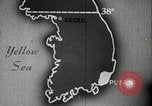
UN landings at Inchon and reoccupation of the capital, Seoul, by UN forces during the first year of the Korean war.
Animated map shows South Korea, from 38th parallel, South, and highlights Pusan, and the advances being made by UN forces after being reinforced. Next, the UN amphibious landings at Inchon (or Incheon) are shown on the map. Flashes of naval gunfire are seen in the blackness of night. Next, a Landing Craft Tank (Rocket), LCT(R), is seen firing barrages of rockets toward shore, at Inchon. On September 15, 1950, U.S. troops are seen landing at Incheon, from boats of the attack transport ship, USS Noble (APA-218). Return to the animated map shows advance of UN forces from Inchon joining with those advancing from Pusan, until they occupy most of the area south of the 38th parallel. UN infantry are seen engaged in urban combat in the city of Seoul, accompanied by M26 Pershing tanks and M46 Patton tanks. Building burning in the city. UN soldiers firing rifles inside damaged building. American soldiers, under fire, carrying wounded on litter. Medical corpsmen tending to casualties, including wounded Korean civilians. Republic of Korea (ROK) infantry following four of their soldiers carrying their flag, stretched out horizonally, between them. (Narrator states they are carrying it back to the liberated capital of Seoul.) ROK troops escorting large number of prisoners of war, marching with hands on heads. UN forces distributing rice and clothing to the Korean inhabitants of Seoul. Soldiers helping little Korean children don clothing. Bodies of men, women, and children who were slain by retreating enemy troops, are laid out on the ground, attended by Grieving relatives. Large quantities of captured North Korean weapons are piled up, including those made in the Soviet Union.
CRITICALPAST.COM: About Us | Contact Us | FAQs - How to Order | License Agreement | My Account | My Lightboxes | Shopping Cart | Advanced Search | Featured Collections | Website Terms & Conditions | Privacy Policy ©2026 CriticalPast LLC.
License Agreement |
Terms & Conditions |
Privacy Policy
©2026 CriticalPast LLC.