


 Francais
 Deutsch
 Italiano
Refine Your Search
Prison physical examination. stock footage and images
- Showing 3295 to 3300 of 3715 results more
more Hide
Hide
Patients treated and looked after at a medical mission in Central Africa
Contrasts the methods used by witch doctors with Protestant medical missionaries in Africa. An attendant comes in a village to look after patients suffering from an epidemic. Patients examined by medics at a dispensary, blood samples checked with microscopes. Patients treated for leprosy, doctors conduct a minor operation. Patient lies down on a table for the operation. African tribesmen inoculated. Women and children lined up at an outdoor clinic, men check blood samples. Doctors operate a patient, patients in bed as a nurse looks after them and takes their temperatures.
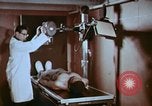
Dispensary, kitchen and quarters at Camp Century in Greenland.
United States Army engineers construct Camp Century in Greenland. A doctor examines a patient at a dispensary in Camp Century, Greenland. A man in a lab looks through a microscope. A priest conducts a service at a chapel as men offer prayers. A man checks food boxes at a deep freeze. Food blended, baked at a kitchen and men eat their meals. A man enters a quarter. Men read magazines, rest and smoke in their quarters. Scientists from Polar research and development program board a vehicle. A man with a sled dog waves as the vehicle pulls away.
U.S. Navy Lieutenant paints on a billboard to promote 4th Liberty Loan Drive for Navy personnel in World War I
U.S. Navy Lieutenant Henry Reuterdahl is seen on scaffolding painting on large billboard in front of the Navy headquarters building, in Washington, DC. He is painting out part of the bow of the U-Boat illustrated on the billboard.The message on the sign reads: "Sink the U-Boat. Watch the bow." The billboard lists the amounts subscribed by Navy Department personnel in the first three Liberty Loan drives and leaves space for the fourth loan drive amount. A Rear Admiral comes out and speaks to Lt. Reuterdahl, from the ground. Scene shifts to crowd jammed into Wall Street, New York City, in front of Federal Hall, where French army soldiers stand on the steps and a large status board is hoisted above as part of the Fourth Liberty Loan Drive. The scene shifts back to the U-boat billboard, again, where the admiral has now joined Lt Reuterdahl on the scaffold. The Lieutenant is painting out more of the U-Boat image. He rotates the image of the U-Boat upwards, revealing that it is maneuverable. Scene shifts to Federal Hall on Wall Street, again, with more views of people engaged in Liberty Loan activities. The last scene shows a man leaving what might be a court house. He has a newspaper under his arm. He pauses to light a cigarette, when the postman comes by and gives him a post card, which he examines with satisfaction. (Presumably it acknowledges something related to Liberty Bond purchase.) (World War I; World War 1; WWI; WW1)
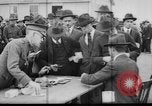
World War I draftees under Selective Service System at a receiving station in New York
Draft and WWI mobilization activities for American men in 1918. Draftees under the Selective Service system get their documents checked by officials. Doctors examine the draftees for military recruitment. Men carry their baggage and move away in a train. Military recruits at a receiving station, lined up. They are seen carrying rifles and marching, beginning their drills, though still dressed in civilian clothing. View of the men marching and Statue of Liberty seen in the distance on the horizon.
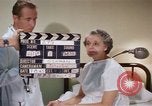
A doctor reads an electrocardiogram tape at a hospital in Washington DC, United States.
Hospital in Washington DC, United States. A doctor talks to a female patient as she sits in a bed. Female doctor reads the EKG or Electrocardiogram tape as a nurse stands by her side. Doctor examines the eyes of the female patient with an instrument.
Soldiers undergo hot and cold temperature tests at Fort Knox in Kentucky, United States (WW2)
Volunteers undergo Army medical research at Fort Knox in Kentucky, United States during World War II. Soldiers tested for their ability to adapt to hot temperatures. Soldiers carry bags and walk under high temperatures to prepare them for war conditions in deserts and humid jungles. They walk on a treadmill under high temperatures. The amount of liquid to be consumed by each one of them is determined by the medics. At night soldiers relax with temperatures lowered to 90 degrees. Tanks also examined for different climatic conditions. Men check the efficiency of Army clothing. Wire put up on the bodies of soldiers record body temperature. Men wearing clothes enter a cold room and get into sleeping bags. A man in another room observes the body temperatures. Tanks tested for weather efficiency. Men wear jackets and masks for protection against cold weather.
CRITICALPAST.COM: About Us | Contact Us | FAQs - How to Order | License Agreement | My Account | My Lightboxes | Shopping Cart | Advanced Search | Featured Collections | Website Terms & Conditions | Privacy Policy ©2026 CriticalPast LLC.
License Agreement |
Terms & Conditions |
Privacy Policy
©2026 CriticalPast LLC.