


 Francais
 Deutsch
 Italiano
Refine Your Search
Rio de Janeiro Brazil 1946 stock footage and images
- Showing 121 to 126 of 2632 results more
more Hide
Hide
The Elephant Butte Dam on the Rio Grande River in New Mexico, 1920
(Glimpse of misleading slate referring to Colorado River and Texas.) Next the Elephant Butte Dam on the Rio Grande River, near Truth or Consequences, New Mexico. It is seen from the spillway side, with large amounts of water being discharged. Several persons walk along a stone wall overlooking the spillways. Closeup of the water being discharged
The Elephant Butte Dam across the Rio Grande River in New Mexico, with car driving on its roadway, in 1920
Opening scene shows lake formed upriver of the Elephant Butte Dam on the Rio Grande River in New Mexico. Camera focuses on hilly islands in the lake. Views from upstream, of the dam, with water levels fairly low. A touring car drives on the roadway above the dam and passes a lone pedestrian walking across the dam. Next, swirling waters are seen in the river below the dam. Some form a whirlpool, of sorts. Others are seen simply flowing in rough waves. View of several dam-related buildings on high ground beside the river. The dam looms above them. Closeup of water surging from dam discharge. Brief view of a dam (unidentified) with water overflowing it.
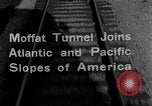
Denver and Rio Grande Western train moves under the Moffat Tunnel and arrives at Union Station in Colorado,United States.
Denver and Rio Grande Western train arrives in Colorado,United States. Train moves through the Moffat Tunnel which joins Atlantic and Pacific Slopes of America. View of mountain ranges from the moving train. Union Station building.
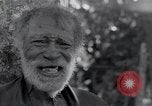
Rural Afro-Cuban villagers play various drums while couple dances and onlookers watch
A man smiles. An Afro-Cuban woman dances to the beat of drums in front of a thatched roof building. Villagers and visitors, including children,watch. Several Afro-Cuban young men pose with a variety of drums. One holds a metal device with two blades ( home made clavés?) They play and a man joins the woman in dancing. A boy in background, watching, puts on a hat and holds a lunch pail over his arm. (Note: Reportedly this is rare footage showing Yuka dancing, the precursor to modern Rhumba styles, and one of the many prototype couple dances in the Americas, similar to batuque, for example, in Brazil). It features the 3-part yuka drum ensemble, and an African-derived double bell.)
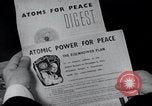
Voice of America broadcasts President's speech and USIS "Atoms for Peace" exhibits are presented worldwide
President Eisenhower of the United States addresses United Nations on December 8, 1953 about atomic bomb and atomic weapon dilemma in the nuclear age (part of Atoms for Peace initiative). Operators in radio transmission control rooms note down readings. View of time clocks of various places in the world including Honolulu, New York, London, Moscow, Calcutta, Bangkok and Tokyo displayed. The Voice of America broadcasts program in different languages by announcers. Scene of a family sitting in a living room as they listen to the president's speech on a console radio. People work at typing, printing, and translating the speech. USIA motion pictures service prepare newsreel of president's speech. A man views air mail of USIA films. Exterior views of several different United States embassy buildings worldwide. A guard standing outside the building. A Public Affairs Officer at the U.S. embassy in Japan, in Tokyo, meets with U.S. Ambassador to Japan Robert Murphy. USIA members seated around table for meeting, and, in Washington DC, creating publications about the Atoms for Peace program. People seated in a USIA library in Brazil read books and various USIA materials. Architects design 30 foot high Atoms for Peace exhibits. An exhibit being setup in a foreign country (possibly in North Africa). Exterior and interior views of the West Berlin, Germany Atoms for Peace exhibit. Prime Minister Jawahar Lal Nehru in India is seen arriving in a jeep to view the Atoms for Peace exhibit in India. Prime Minister Nehru inside the exhibit hall watching a presentation. In Japan, a woman operates remote-controlled robotic hands to hold radioactive materials, at a demonstration for Japanese citizens. In a city in Italy, a view of a mobile van unit carrying an Atoms for Peace exhibit. Scenes from a film "A is for Atom" that was translated into 30 languages and shown all over the world. Wide view of the Kremlin in Moscow, Russia, Soviet Union. A Russian radio commentator speaking at a microphone. Propaganda dramatization showing the Russian announcer attacking American plans for Atoms for Peace.

Japan's possible shortages of material for clothing in World War 2. Japanese domestic production of cotton, wool, and silk
Illustrated discussion of Japan's limitations in natural resources prior to World War II. Workers shown in textile mills which employed more than half of Japan's factory workers prior to the war, satisfying domestic and export needs. Analysis of the natural resources. Cotton thread is rolled on the spindles in the Textile mills in Japan. Textile mills produce fabric in Japan. Japanese women work in the textile mills. Bales of raw cotton imported from Japanese possessions in Korea and Formosa, and from the United States,India, Brazil and China. They are transported via horse carts and manually pushed on small rail carts to storage buildings for stockpiling. People cultivating some of the small amount of cotton grown in Japan. Horses and cattle used to pull plows in rice paddies. Pigs used as scavengers. Woolen fabric is produced from wool. Some of Japan's very few sheep being sheared for wool. Women working in fields of mulberry trees where silk worms flourish on their leaves. Views of the silk being spun onto spindles in a factory. Silk fabrics being stacked. Illustrated summary highlights Japanese domestic shortages of cotton, wool, and leather needed for clothing.
CRITICALPAST.COM: About Us | Contact Us | FAQs - How to Order | License Agreement | My Account | My Lightboxes | Shopping Cart | Advanced Search | Featured Collections | Website Terms & Conditions | Privacy Policy ©2026 CriticalPast LLC.
License Agreement |
Terms & Conditions |
Privacy Policy
©2026 CriticalPast LLC.